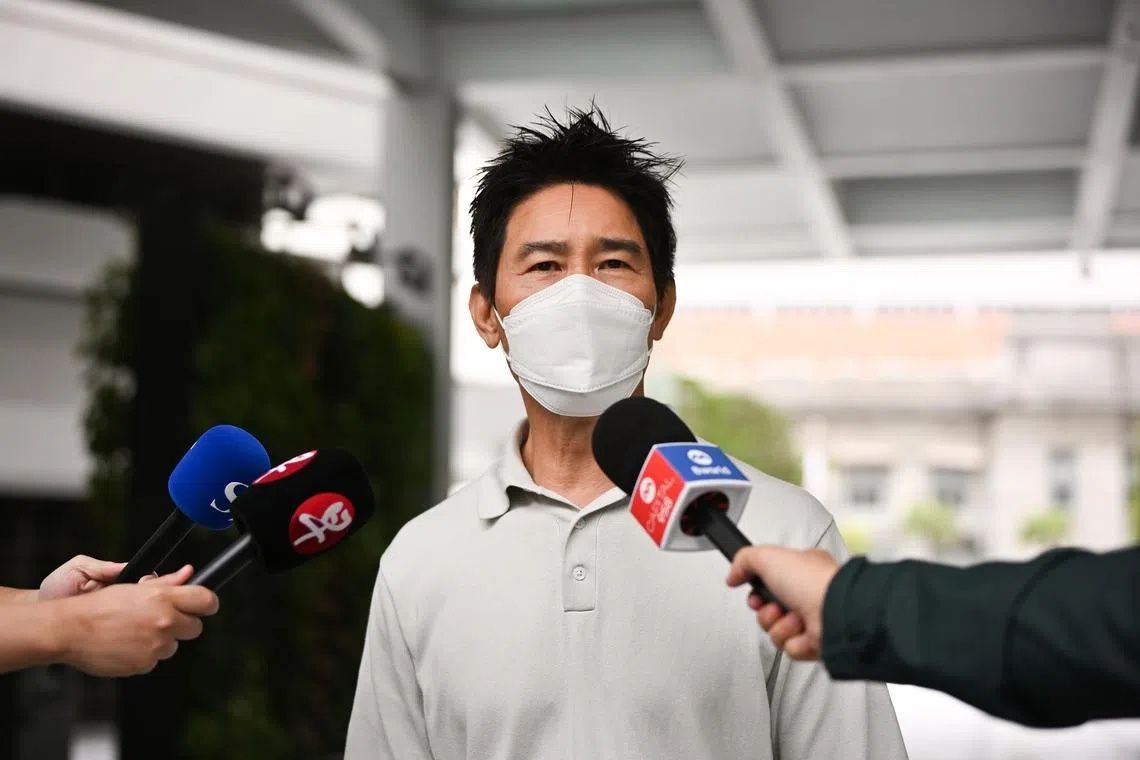
Edmund Chen, the 64-year-old former television actor whose legal name is Tan Kai Yuan, has secured a significant reduction in his jail sentence following a High Court appeal on Monday, July 20. The appellate bench, led by Justice Hri Kumar Nair, determined that the original five-day custodial term imposed by a district judge in January was disproportionately harsh, though the judge acknowledged that crossing the custodial threshold itself was not necessarily improper. Under the revised sentence, Chen will now serve just one day in jail, while retaining a five-year driving ban and remaining liable for a maximum fine of S$5,000.
The case centres on a motor accident that occurred on the afternoon of March 4, 2025, along the Ayer Rajah Expressway towards the Central Expressway. Chen, driving in the fourth lane, had begun decelerating sharply and initiated an abrupt lane change across white chevron road markings without forming up correctly ahead of a road split. His intention was to transition onto the Central Expressway or Seletar Expressway, but his manoeuvre placed him directly in the path of an oncoming motorcyclist. The 21-year-old rider, travelling behind Chen's vehicle, struck the car despite attempting to swerve clear. The impact resulted in multiple fractures to the motorcyclist's wrists, necessitating surgical intervention at Singapore General Hospital under local anaesthesia. The injured motorcyclist was subsequently discharged after two days of hospitalisation but received 99 days of medical leave to facilitate recovery.
When the district judge handed down the original five-day jail sentence on January 29, it represented a harsher outcome than the prosecution had recommended. The Crown had proposed a monetary penalty ranging from S$3,000 to S$5,000 without custodial time, believing that financial punishment coupled with driving disqualification would be proportionate. The district judge's decision to impose imprisonment rested substantially on Chen's breach of traffic regulations, particularly his illegal crossing of chevron lane markings. The judge determined that circumstances warranted crossing the custodial threshold, a finding that the High Court did not fundamentally dispute on principle. Rather, the appellate decision centred on the proportionality and severity of the sentence imposed within that custodial framework.
Chen's legal representation shifted notably during the appeal process. His original legal team, comprising Josephus Tan and Cory Wong from Invictus Law, initially handled his case through the district court proceedings. However, following the sentencing decision, Chen engaged a fresh team: Senior Counsel Abraham Vergis from Providence Law Asia took the lead on the appeal, supported by advocates Kelvin Ong and Dickson Chew from Contigo Law. This change in counsel proved strategically significant, as Vergis mounted a focused argument regarding sentencing proportionality rather than challenging the factual foundation of the conviction.
Vergis's appeal submission emphasised several mitigating dimensions that the appellate court found persuasive. Dashcam footage presented at trial, sourced from Chen's own vehicle, demonstrated that his vehicle's indicator lights were activated before the lane change, indicating an attempt to signal his intentions to other road users. The counsel further noted that a passing vehicle temporarily obscured the motorcyclist from Chen's line of sight due to the natural curve of the road, suggesting that the collision risk may not have been entirely transparent at the moment of manoeuvre. Critically, Vergis argued that the injuries sustained, while meeting the legal threshold of grievous hurt, occupied the less severe end of that spectrum. The fractures were confined to the extremities and did not result in permanent disability, suggesting that a custodial sentence was disproportionate to the harm actually inflicted.
The Deputy Public Prosecutor Ben Tan countered that the district judge's sentencing approach, while positioned toward the higher end of the available range, did not constitute an appealable error warranting appellate intervention. The prosecutor emphasised that during the lane-change manoeuvre, drivers of two separate passing vehicles had sounded horns in warning, yet Chen had persisted in completing his manoeuvre regardless. This persistence suggested a disregard for safety signals and demonstrated a troubling indifference to apparent danger. The Crown maintained that a substantial fine approaching the statutory maximum, combined with a five-year driving prohibition, provided insufficient deterrence for conduct that endangered other road users and resulted in injury requiring surgery.
Justice Hri Kumar Nair's judgment ultimately favoured the appellate position, determining that five days' imprisonment constituted manifest excess even if the custodial threshold itself had been appropriately invoked. The High Court's intervention signals judicial concern about sentencing calibration in traffic offences that cause injury but result in recovery without permanent disability. This principle carries particular relevance across Southeast Asia, where road safety remains a persistent challenge and sentencing consistency in traffic cases continues to evolve. The judgment suggests that appellate courts will scrutinise custodial terms in traffic cases more closely, particularly where injuries, though significant, fall toward the less severe end of grievous hurt classifications and victims achieve recovery.
The case has drawn considerable public attention partly because Chen occupies a distinctive position in Singaporean popular culture. During the 1980s and 1990s, he was a recognisable television personality, appearing in multiple drama serials including Star Maiden and Patrol. He subsequently withdrew from the entertainment industry to prioritise raising his daughter, Chen Yixin, born in 2000, though he returned intermittently for occasional acting assignments, most recently in the 2017 television drama Life Less Ordinary. His spouse is veteran actress Xiang Yun, whose own career encompasses classic local television productions such as The Awakening, Double Happiness, and The Little Nyonya, giving the case a dimension of celebrity visibility that distinguishes it from typical traffic prosecutions.
Chen's demeanour during the legal proceedings reflected the considerable personal toll the case has exacted. Before the High Court hearing, he informed reporters that he had prepared five days' worth of medication in anticipation of the original jail term, and that he and his family experienced a sleepless night preceding the appeal. His lawyer emphasised that the incident had caused severe psychological trauma and expressed confidence that Chen would likely refrain from driving in future, suggesting that the deterrent effect of prosecution and legal consequences had already materialised. The High Court's decision to substantially reduce the custodial component while maintaining the five-year driving ban and fine exposure acknowledges both the seriousness of dangerous driving and the proportionality principle underpinning sentencing in common law jurisdictions.
For Malaysian readers and regional observers, this judgment offers instructive precedent regarding traffic sentencing philosophies in comparable legal systems. Singapore's approach reflects a measured calibration between deterrence and proportionality, distinguishing between cases involving permanent disability or fatality and those producing temporary injury requiring recovery. As road safety initiatives gain prominence across Southeast Asia, including Malaysia's own traffic enforcement reforms, sentencing jurisprudence in neighbouring jurisdictions provides valuable perspective on balancing accountability for dangerous conduct with proportionate punishment when injury outcomes, though genuine, are ultimately non-permanent. The Chen case exemplifies how appellate courts increasingly scrutinise whether custodial sentences serve meaningful deterrent purposes when alternative penalties remain available and genuinely available, a principle with direct application to traffic safety policy across the region.

