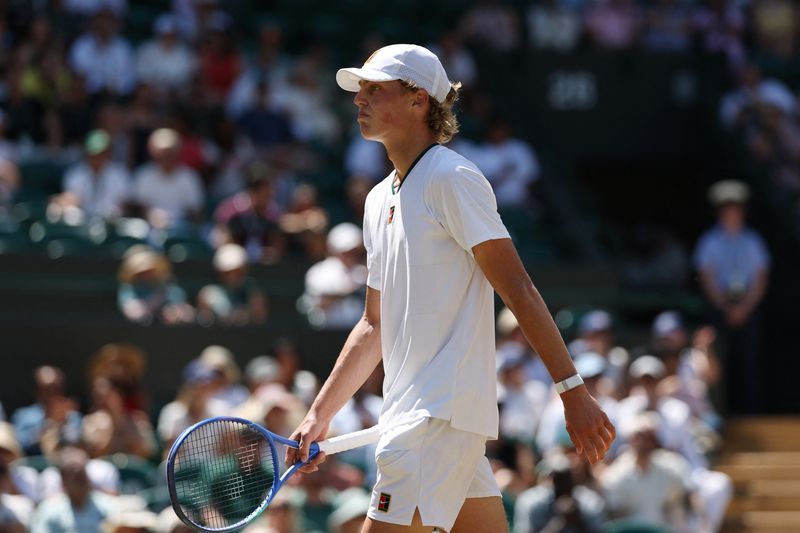
At just 17 years old, Cruz Hewitt has announced his arrival on professional tennis's biggest stage with a commanding straight-sets victory at the Washington Open, defeating American Marcos Giron 6-3 6-4 in the first round. The Australian teenager's breakthrough moment comes as the culmination of an extraordinary summer that has positioned him among the sport's most promising young prospects, though his path to the top has been accelerated significantly by genetics and inheritance of his legendary father's talent.
The significance of this particular victory extends beyond mere statistics. Cruz's triumph at the ATP 500 tournament carries profound symbolic weight—his father, Lleyton Hewitt, won the same Washington title nearly two decades ago in 2004, when the event held a special place in the former world number one's career. The younger Hewitt's ability to replicate success at a venue so closely tied to his family's legacy demonstrates both the pressure and privilege that comes with being the progeny of a tennis icon. For Cruz, who entered the main draw as a qualifier, the moment transcended ordinary competition; it represented a tangible link between generations competing on the same professional circuit.
Cruz's recent form suggests this victory is no flash in the pan. Just weeks earlier, he reached the boys' final at Wimbledon, finishing runner-up to American Jordan Lee. That near-triumph at tennis's most prestigious grass court championship occurred almost exactly a quarter-century after Lleyton claimed the Wimbledon singles title at his peak—a generational parallel that underscores the family's enduring connection to the sport's elite echelons. The Australian youngster's rapid progression through competitive hierarchies has captured widespread attention, particularly given his ranking of 612 in the world at such an tender age, which speaks to the extraordinary circumstances of his rise through professional ranks.
With this Washington victory, Cruz achieved another milestone that situates him among tennis's emerging elite. He became the youngest player to win a match at the Washington Open since Japan's Kei Nishikori accomplished the feat in 2007—a span of 16 years that illustrates how rare such precocious success truly is. Moreover, he joined an exclusive cohort of players born in 2008 or later to secure ATP-level victories, following Diego Dedura, Thijs Boogaard, and Moise Kouame. This distinction underscores that while generational talent clearly clusters around particular periods, the path to professional success remains extraordinarily challenging even for those with exceptional pedigree.
In post-match reflections, Cruz demonstrated considerable maturity and perspective beyond his years. He acknowledged the emotional resonance of winning at a venue so deeply woven into his father's professional narrative, describing the achievement as "pretty surreal." The teenager referenced his own memory of watching his father compete at Washington, suggesting that childhood exposure to elite professional tennis has imprinted patterns of excellence into his understanding of the sport. For many young players, observing a parent's career from the sidelines might prove intimidating; for Cruz, it appears to have functioned as both inspiration and instruction manual.
Lleyton's influence extends beyond mere inspiration or stadium memories. The elder Hewitt reportedly provided specific tactical counsel to his son before the Washington opener, emphasizing the importance of psychological resilience and present-moment focus. Cruz revealed that his father advised him to "enjoy it and take every point one-by-one, really enjoy the atmosphere and the crowd"—guidance that reflects decades of experience navigating the psychological pressures that accompany professional tennis. The teenager's openness about leveraging paternal wisdom suggests a relationship characterized by genuine mentorship rather than distance or unfair competitive advantage.
Yet Cruz himself articulated a nuanced understanding of the pressures he faces. Despite the considerable advantages afforded by his lineage, he acknowledged the weight of expectation and the anxiety that accompanies competing at professional levels. His commentary on "a little pressure" paired with determination to "take the positive" demonstrates psychological sophistication—an ability to acknowledge legitimate nerves without allowing them to undermine performance. This emotional intelligence may ultimately prove as valuable as raw tennis talent in determining whether his early promise translates into sustained professional success.
Cruz's second-round opponent will be either Greek sensation Stefanos Tsitsipas or fellow Australian Alex de Minaur, either matchup promising compelling narratives. The prospect of facing de Minaur, in particular, sparked genuine enthusiasm from the young Australian. De Minaur occupies an almost familial role in Cruz's life—the two families apparently spend holidays together, and de Minaur has functioned as something of a mentor figure. Cruz's description of facing his friend as a potential "dream" and "pretty cool memory" suggests that alongside raw competitive ambition, familial bonds and friendship retain genuine meaning, a refreshing counterpoint to the sometimes cutthroat nature of professional sports.
For Malaysian and Southeast Asian observers, Cruz Hewitt's emergence holds particular relevance given the region's historical connection to developing young tennis talent. While Australia has produced multiple generations of world-class players, the mechanics of how such talent develops—the combination of genetic advantage, professional coaching, psychological support, and cultural infrastructure—offers instructive lessons. The contrast between Hewitt's rapid rise and the structural barriers facing talented young players in developing cricket nations underscores how institutional support and family capital fundamentally shape athletic trajectories.
Cruz's Washington victory represents merely the opening chapter in what promises to be a lengthy and closely-scrutinized career. The particular challenge facing such prodigiously talented teenagers involves maintaining momentum while navigating the inevitable plateaus and setbacks that characterize professional sport. The advantage he possesses through Lleyton's guidance and professional network is undeniable, yet that same advantage brings corresponding pressure—every subsequent loss will be contextualized against paternal achievement, every victory contextualized as inevitable rather than remarkable.
Moving forward, the tennis world will be watching closely as Cruz develops from promising teenager into mature professional. The Washington Open victory provides him with confidence, credibility, and qualifying points, but more significantly, it confirms that his summer breakout represents genuine potential rather than temporary novelty. Whether he ultimately approaches his father's career arc—itself extraordinary by any measure—or charts his own distinctive path will depend on factors beyond immediate technical excellence. For now, though, Cruz Hewitt has announced himself as a name worth following with genuine intrigue about what comes next.

