Japan's earthquake disaster has taken a grim new turn as officials confirmed the death of an elderly woman from heat stroke while taking shelter in a vehicle in Kumamoto Prefecture, bringing the confirmed death toll from the magnitude 7.1 tremor to 36. The woman's death on Thursday, discovered in a car that was not running, represents precisely the scenario that disaster management experts had warned about as the southwestern prefecture endures a dangerous combination of seismic damage and scorching summer temperatures that have created a perfect storm of public health risks.
The 7.1 magnitude earthquake that struck Kyushu's Kumamoto Prefecture on Tuesday has exposed the vulnerabilities of Japan's disaster response infrastructure, particularly when multiple crises converge. The woman's death arrived just as temperatures in Kumamoto city soared to 36.6 degrees Celsius—classified by the Japan Meteorological Agency as "extreme heat"—with forecasts suggesting the mercury could climb even higher. For survivors already traumatised by the quake and its immediate aftermath, the compounding threat of heat-related illness has created an additional layer of vulnerability that authorities scrambled to address.
Local authorities moved quickly to distribute guidance materials to those sheltering in vehicles, warning them of the dual dangers posed by prolonged exposure to extreme temperatures in enclosed spaces. Kumamoto Governor Takashi Kimura acknowledged the human tragedy with visible emotion, urging evacuees relying on vehicles for shelter to maintain fuel supplies for air-conditioning systems or to transition to air-conditioned evacuation centres. His plea underscores a fundamental challenge facing disaster-affected regions: many survivors lack access to adequate cooling infrastructure, forcing them into impossible choices between remaining in inadequate shelters or braving fuel shortages at overwhelmed petrol stations.
The prefecture confronts substantial resource constraints that complicate relief efforts. Nearly 47,000 households remain without fresh water supplies, a critical necessity made more urgent by the extreme heat, while fuel shortages have created long queues at reopened petrol stations. Over 9,000 people are crowded into emergency shelters housed in converted community centres, school gymnasiums, and classrooms—many without air-conditioning—while thousands of others have opted to sleep in vehicles parked in town hall lots and parks. This fragmentation of shelter arrangements, though sometimes chosen for privacy, has created a dispersed population vulnerable to the very risks that claimed the elderly woman's life.
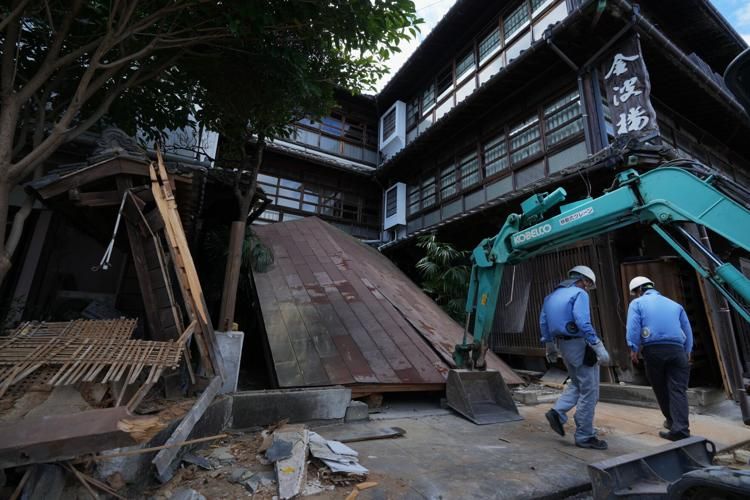
The earthquake's destruction has been geographically concentrated but severe. A catastrophic explosion at Aeon Mall in Kashima town, believed caused by a gas leak that occurred after the initial quake, brought down the structure's second floor and collapsed walls. The disaster-response operation at the mall concluded Saturday after rescue teams extracted five survivors and recovered seven bodies, exemplifying both the intensity of the destruction and the challenges faced by rescue personnel operating under extreme conditions. At the Nippon Paper Industries factory in Yatsushiro city, a collapsed chimney trapped 11 employees, of whom nine were confirmed dead and two rescued, adding to the prefecture's trauma.
Infrastructure damage extends across a broad area. Officials report that over 180 homes have been completely destroyed, while more than 3,800 buildings sustained damage, with 20 classified as severely affected. The prefecture has registered 105 injured persons, with two additional deaths under investigation to determine whether they should be classified as earthquake-related. Power disruptions, which initially affected thousands of households, have substantially diminished to fewer than 900 reported outages, indicating partial restoration of utilities.
Prime Minister Sanae Takaichi convened a government task force meeting Saturday to coordinate the national response, announcing the mobilisation of water, food supplies, portable toilets, air-conditioning units, and privacy partitions to improve conditions at evacuation centres. The acknowledgment that such basic necessities required government intervention reflects the scale of local infrastructure overwhelm. Takaichi declared that "the government is determined to do everything we can," a statement reflecting the political urgency of the situation and public expectations for rapid relief.
Japan's scientific and expert communities have long critiqued the crowded, unsanitary conditions characteristic of emergency shelters following major disasters. The absence of adequate privacy, ventilation, and sanitation facilities creates cumulative stress that heightens vulnerability to illness even before considering extreme weather. The current crisis in Kumamoto validates these concerns, as survivors confined in substandard shelters face cascading risks: dehydration, heat exhaustion, and the formation of blood clots from prolonged immobility—dangers that Japanese authorities have explicitly highlighted in their safety messaging.
The convergence of disaster and climate stress presents a forward-looking challenge for Japan and neighbouring Southeast Asian nations similarly vulnerable to both seismic activity and seasonal heat extremes. Malaysia, with its tropical climate and exposure to earthquake risks in certain regions, may find instructive lessons in Kumamoto's experience. The Japanese case demonstrates that earthquake preparedness systems designed in temperate climates may prove inadequate when disasters strike during periods of extreme heat, suggesting that regional disaster-planning frameworks should explicitly account for compound environmental stressors.
Thousands of Self-Defence Force personnel, police officers, rescue workers, and search dogs continue operations throughout Kumamoto Prefecture, with authorities determined to account for all missing persons. Governor Kimura personally urged rescue teams not to abandon search efforts, emphasising the moral obligation to recover the missing and provide families with closure. The overall number of missing persons remains undetermined, though the scale of destruction and ongoing operations suggest the figure could be significant.
Survivors in Kumamoto now navigate the immediate aftermath under conditions of resource scarcity and physiological stress that threaten to transform an acute disaster into a prolonged humanitarian challenge. The death of the elderly woman sheltering in an unpowered vehicle serves as a stark reminder that earthquake survival extends beyond escaping the initial tremor; it requires sustained access to shelter, water, food, and protection from environmental hazards. For Japanese authorities and neighbouring nations, the Kumamoto experience illustrates that modern disaster response must treat compound crises—seismic damage combined with climatic extremes—as integrated challenges requiring coordinated, well-resourced interventions that extend well beyond the immediate emergency phase.

