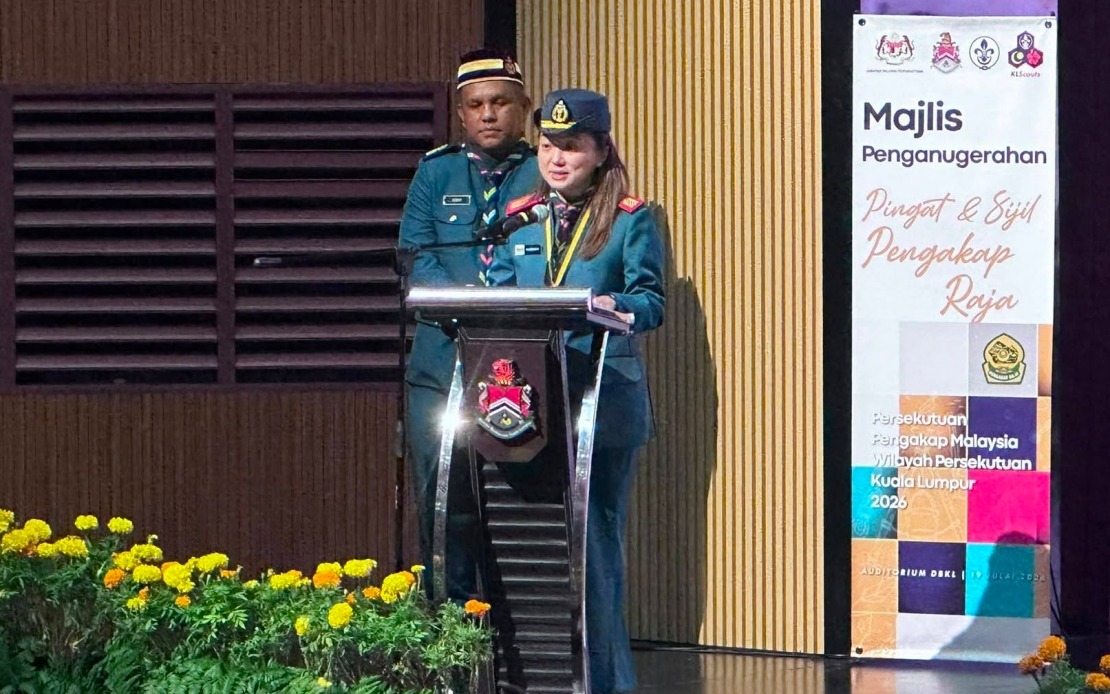
Hannah Yeoh, the Minister in the Prime Minister's Department overseeing the Federal Territories portfolio, has been formally proclaimed president of the Federal Territories State Scouts Council in a ceremony held at City Hall Auditorium here. The proclamation marks a significant leadership position within Malaysia's scouting infrastructure and signals renewed ministerial commitment to youth development programmes across the nation's three federal territories. Concurrently, City Hall's Executive Director Rosli Nordin was designated as chairman of the Kuala Lumpur Federal Territory State Scouts Council, establishing a dual-leadership structure that bridges government administration and youth organisation oversight.
The ceremony, which took place on July 19, doubled as the annual presentation of King's Scout Medals and Certificates for 2026, honouring exceptional young scouts across the Federal Territories. This convergence of administrative appointments and award presentations underscores the Malaysian government's strategy of elevating scouting's institutional prominence while publicly recognising outstanding youth achievement. The timing reflects a deliberate effort to align high-level political engagement with youth-focused initiatives, particularly as the nation continues developing its talent pipeline through structured youth programmes.
Yeoh's commitment to resourced youth engagement became immediately apparent through her announced financial allocation of RM20,000 dedicated entirely to Federal Territories scouting endeavours. This two-tranche funding approach—initially RM10,000 directed toward Kuala Lumpur Scout Association branch programming during school holiday periods, followed by a supplementary RM10,000 for targeted training initiatives—demonstrates strategic allocation methodology. The bifurcated funding structure specifically addresses accessibility challenges, with the second allocation explicitly designed to support young people who face barriers to participation in conventional scouting activities, thereby broadening the movement's social reach beyond traditionally engaged demographics.
The King's Scout Certificate represents the pinnacle achievement within Malaysia's scouting framework, awarded only to individuals who demonstrate exceptional competency across multiple demanding dimensions. Recipients must exhibit demonstrable leadership capability, practical skills development, personal resilience, meaningful community contribution, and authentic commitment to Scout Promise and Law principles. Fifty-eight young scouts received this prestigious certification at the ceremony, each having satisfied stringent evaluation criteria that distinguish them as disciplined youth leaders embodying integrity and civic responsibility. Recognition of these standards publicly reinforces that Malaysian scouting maintains rigorous developmental benchmarks rather than distributing accolades indiscriminately.
Beyond the top-tier King's Scout awards, the ceremony honoured 75 scout leaders through Chief Scout's Commendation Certificates, acknowledging their sustained mentorship roles within the movement. An additional 108 scout leaders received Federal Territories Scouts Wangsa Certificates, collectively representing significant recognition of the adult workforce essential to scouting's operational continuity. This multi-tiered recognition architecture acknowledges that youth achievement emerges through structured adult stewardship, validating the contribution of experienced scout leaders whose organisational labour typically receives less public visibility than youth recipient celebrations. The breadth of award categories highlights Malaysian scouting's comprehensive approach to recognising excellence across hierarchical levels.
Major General Datuk Prof Dr Mohd Zin Bidin, occupying the national Chief Scout position, attended the ceremony alongside Tan Sri Johari Abdul, who simultaneously serves as National Scout Council member and Dewan Rakyat Speaker. This convergence of senior political and administrative figures—including parliamentary leadership—demonstrates the institutional weight Malaysia's government accords to scouting initiatives. Johari's dual roles as legislative speaker and scout council member exemplify how scouting remains integrated within Malaysia's broader governance framework rather than existing as an isolated youth programme. Such high-level participation signals that scouting occupies a recognised place within national institutional hierarchies.
The Federal Territories jurisdiction—encompassing Kuala Lumpur, Labuan, and Putrajaya—presents distinctive demographic and administrative characteristics requiring tailored youth engagement strategies. As the nation's administrative and commercial heart, the Federal Territories contain concentrated youth populations alongside significant urban development pressures that shape young people's recreational and developmental opportunities. Scouting's structured activities offer counterbalance to screen-dominated leisure patterns increasingly prevalent among Malaysian urban youth. The ministerial allocation targeting school holiday programming specifically addresses seasonal gaps when young people face unstructured time in an urban environment, mitigating potential drift toward unproductive or risky behaviours.
Yeoh's explicit acknowledgment of accessibility barriers demonstrates evolving sophistication in youth programme design philosophy. By reserving dedicated resources for young people unable to participate through conventional channels, the Federal Territories Scouts Council signals recognition that scouting's historical orientation toward enrolled, uniformed, uniformly-equipped participants may exclude socioeconomically disadvantaged youth. This targeted inclusivity approach aligns with contemporary understanding that youth development initiatives achieve maximum societal impact when they actively address participation barriers rather than passively accepting that interested youth will self-select into existing structures. The RM10,000 accessibility allocation represents ideological commitment to democratised youth development beyond elite scouting circles.
Malaysia's scouting movement operates within a regional context where youth engagement strategies carry significant implications for social cohesion, skill development, and civic formation. Neighbouring Southeast Asian nations maintain parallel scouting systems, creating opportunities for cross-border youth exchanges and standardised leadership development frameworks. Federal Territories scouting's visibility and resourcing—enhanced through ministerial proclamation and financial commitment—contribute to Malaysia's broader competitiveness in regional youth development indices. As Southeast Asian governments increasingly compete for demonstrable youth engagement success, Malaysia's visible investment in scouting infrastructure positions the nation within peer comparison discussions regarding youth policy effectiveness.
The ceremonial framework combining administrative appointments with achievement recognition reflects deliberate communication strategy beyond ceremonial convention. By simultaneously proclaiming Yeoh as council president, designating Rosli Nordin as Kuala Lumpur branch chairman, and honouring exceptional youth and leader achievement, the government constructs a comprehensive narrative linking political commitment, administrative structure, and tangible youth outcomes. This multi-layered messaging targets multiple audiences simultaneously—political constituencies observing ministerial engagement, youth potential recruits witnessing achievement recognition, scout leadership acknowledging institutional support, and regional observers noting Malaysian governmental prioritisation of structured youth development.
The RM20,000 allocation's modest numerical magnitude requires contextual interpretation within Malaysian youth programming budgetary landscapes. While not representing transformative resource injection, the funding's symbolic significance—coupled with high-profile ministerial endorsement—potentially leverages additional participation and donor contributions beyond government allocation. Scouting movements traditionally mobilise volunteer labour and community resources proportionally to demonstrated governmental support, meaning ministerial commitment often catalyses multiplication effects exceeding direct budget allocation. The Federal Territories Scouts Council's enhanced ministerial profile and documented financial backing may therefore generate multiplicative impact on youth programme scale and quality beyond the RM20,000 direct expenditure.

