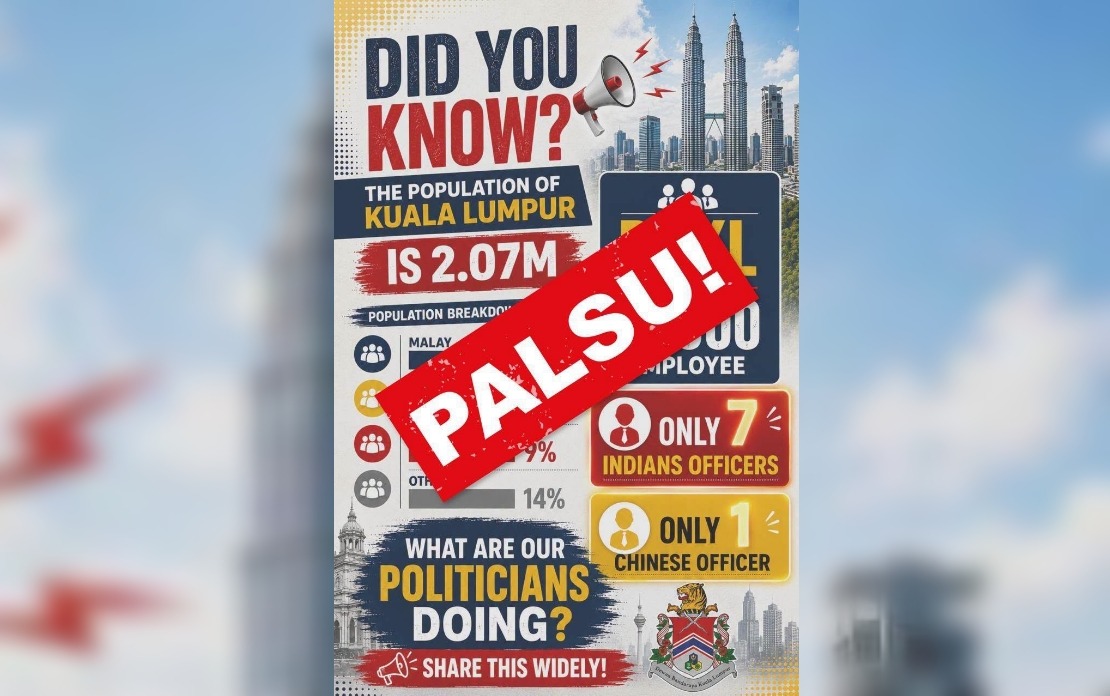
Federal Territories Minister Hannah Yeoh has pushed back against misleading social media claims about Kuala Lumpur City Hall's ethnic workforce composition, warning the public not to fall victim to deliberately distorted information circulating during the election campaign period. The minister's intervention comes as a poster widely shared through WhatsApp messaging has alleged grossly inaccurate staffing figures at DBKL, prompting an official response to set the record straight with verifiable employment data.
The viral poster in question claimed that DBKL—Kuala Lumpur's municipal authority—employed only seven Indian staff members and a single Chinese employee, a characterisation that Yeoh swiftly identified as fundamentally false and unrepresentative of the local authority's actual composition. Such exaggerated claims, particularly when weaponised during election periods, carry significant risk of inflaming communal sensitivities and undermining social cohesion in Malaysia's multiethnic context. The minister's rapid correction reflects concern about how deliberately distorted statistics about institutional representation can feed into broader narratives of exclusion and discrimination.
According to official DBKL employment records as of July 1, 2026, the authority maintains a workforce of 9,131 staff members across all levels and departments. Within this total, the council employs 490 Indian-origin staff and 22 Chinese-origin staff, figures that are substantially higher than the exaggerated claims circulating online. These numbers demonstrate a meaningful presence of minority ethnic groups within the institution, though Yeoh herself acknowledged that there remains room for improvement in ensuring equitable representation across all organisational tiers.
The disparity becomes more pronounced when examining professional and managerial positions, which traditionally offer greater authority and remuneration. Among DBKL's Management and Professional Group—the category encompassing officers, supervisors and senior roles—there are currently 10 Indian officers and two Chinese officers. While these figures may still not fully reflect Malaysia's overall demographic composition, they contradict the near-complete exclusion suggested by the misleading WhatsApp circulation. The fact that the minister felt compelled to publicly enumerate these specific breakdowns underscores how damaging unsubstantiated claims can be to institutional credibility and public trust.
Yeoh's acknowledgment that representation within DBKL warrants further improvement demonstrates a balanced approach that neither dismisses genuine concerns about workplace diversity nor accepts false narratives as fact. By simultaneously refuting the wildly inaccurate figures while committing to actual reforms, she has attempted to navigate the sensitive terrain of addressing legitimate representation gaps without allowing that discussion to be hijacked by misinformation. This nuanced stance reflects the complexity facing Malaysian policymakers who must champion merit-based advancement and equal opportunity while acknowledging historical imbalances.
In response to the controversy, the minister has instructed DBKL management to conduct a comprehensive internal review encompassing multiple dimensions of institutional practice. This examination will scrutinise recruitment methodologies, hiring decision-making processes, mechanisms for staff promotion and advancement, and the range of channels through which job vacancies are advertised to the public. By casting a wide analytical net across these interconnected systems, DBKL hopes to identify where bottlenecks or unconscious biases might be limiting opportunities for underrepresented groups. The emphasis on transparency and merit-based evaluation signals intent to move beyond tokenism toward genuinely inclusive institutional culture.
Yeoh has explicitly cautioned against the exploitation of workforce diversity issues as a tool for sowing racial discord and deepening communal divisions. Her appeal reflects growing concern about how election campaigns in multiethnic democracies can weaponise legitimate grievances about representation by amplifying false statistics and inflammatory rhetoric. The minister's call for responsible behaviour from all political actors and civil society organisations represents an attempt to keep conversations about institutional diversity anchored in factual evidence rather than inflammatory exaggeration designed to provoke intercommunal tension.
The timing of this misinformation campaign during an election period is particularly significant for Malaysian political observers. Campaign seasons frequently witness intensified circulation of unverified claims targeting government institutions, particularly regarding employment practices and affirmative action policies. By immediately contextualising these claims as false and providing authoritative counter-evidence, Yeoh has attempted to establish a higher standard of factual accountability in public discourse. This preemptive fact-checking approach recognises that allowing false narratives to circulate unchallenged can create lasting damage to institutional legitimacy even after correction.
The broader implications of this incident extend beyond DBKL's internal human resources practices to encompass questions about digital misinformation governance in Malaysia more broadly. WhatsApp, with its end-to-end encryption and peer-to-peer sharing architecture, has become a primary vector for spreading unverified claims that escape traditional media fact-checking mechanisms. The speed and scale at which false information propagates through messaging apps poses particular challenges for government communicators attempting to maintain public trust while combating sophisticated disinformation campaigns. Yeoh's intervention illustrates both the necessity and limitations of official fact-correction in an increasingly fragmented information ecosystem.
Moving forward, DBKL's commitment to reviewing and improving its recruitment, promotion and advertising practices carries implications for other government institutions wrestling with similar diversity challenges. By subjecting its own practices to public scrutiny and pledging reforms, the authority establishes a benchmark that other federal or state government bodies may face pressure to match. This institutional accountability, though initiated in response to false claims, may ultimately yield positive changes in how government agencies approach building diverse and merit-based workforces across Malaysia.
The incident also highlights the distinct challenge of countering misinformation that targets sensitive communal issues without appearing dismissive of legitimate concerns about representation. Yeoh's framing—simultaneously debunking false claims while committing to real improvements—attempts to model constructive engagement with these sensitive topics. In a context where employment equity remains contentious and ethnically charged, maintaining this balance between factual accuracy and genuine reform commitment becomes essential for preserving both institutional credibility and social harmony. The coming months will reveal whether DBKL's promised internal review translates into meaningful changes in workplace composition and opportunity access.

