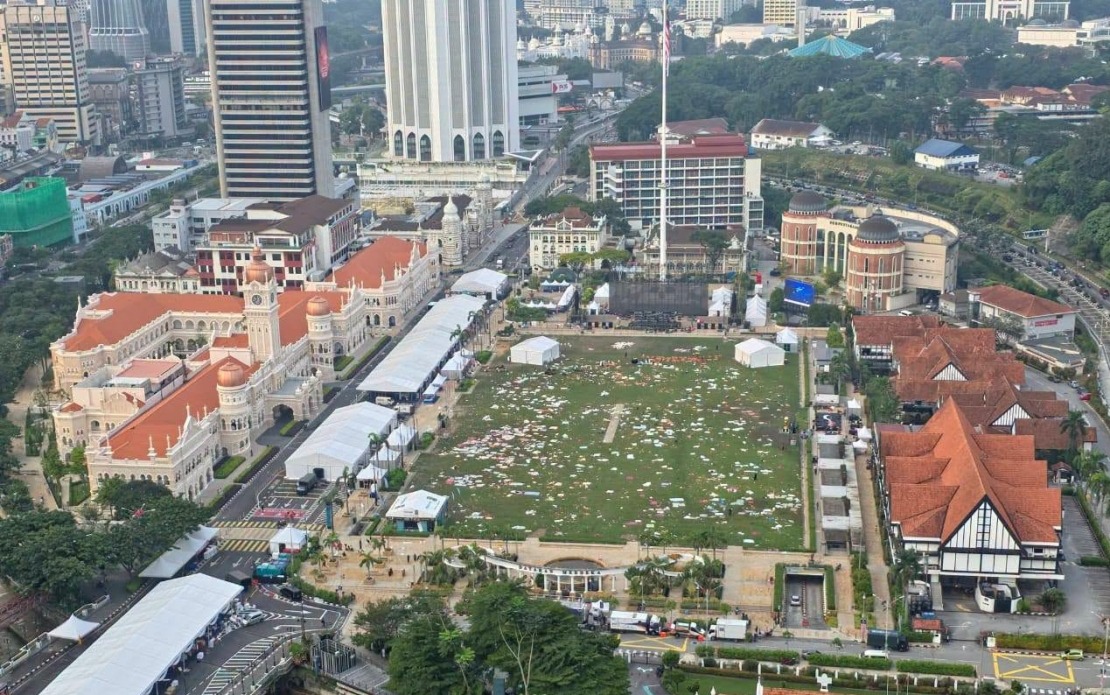
Minister in the Prime Minister's Department (Federal Territories) Hannah Yeoh has publicly recognised the dedication of Kuala Lumpur City Hall (DBKL) workers who undertook extensive cleaning operations at Dataran Merdeka following a large public gathering to watch the 2026 FIFA World Cup final screening. The venue required significant cleanup efforts after the event, prompting the minister to acknowledge the municipal workers' commitment to maintaining one of the nation's most significant public spaces.
Beyond thanking DBKL staff, however, Hannah used the incident as an opportunity to address what she characterised as a concerning mindset among certain sections of the public. In a Facebook post, she articulated a fundamental distinction between the government's obligation to deliver essential services and the basic civic duties that individual citizens must fulfil. The minister emphasised that while DBKL is responsible for maintaining public areas, Malaysian residents share an equally important obligation to dispose of their own waste responsibly rather than leaving it for municipal workers to manage.
Her intervention reflects a broader social challenge facing rapidly urbanising Southeast Asian nations, where the relationship between public institutions and citizen behaviour has become increasingly strained. The accumulation of litter at Dataran Merdeka, despite the availability of rubbish bins, suggests that some members of the public view cleanliness maintenance as primarily the government's responsibility. Hannah's comments appear designed to reframe this perspective and encourage individual accountability in public spaces.
The minister articulated the principle that accessing public services—funded by taxpayers—does not grant citizens the right to absolve themselves of basic responsibilities. She stressed that disposing of rubbish into designated bins represents a fundamental civic duty that should not require government intervention or worker attention. This framing shifts focus from government service delivery alone to a shared model of public space stewardship that depends on voluntary compliance from users.
Dataran Merdeka holds particular symbolic significance in Malaysia's national consciousness as the site where independence was declared in 1957. Hannah noted that the plaza functions as more than merely an event venue; it embodies the nation's historical heritage and serves as a representation of Kuala Lumpur's standing as the capital city. Allowing the space to accumulate litter diminishes not only its physical condition but also its cultural and political significance. Her emphasis on preserving this historical landmark suggests that cleanliness concerns extend beyond practical sanitation to encompass national pride and historical stewardship.
The minister's position aligns with Prime Minister Datuk Seri Anwar Ibrahim's previously articulated vision that national development encompasses dimensions beyond infrastructure and physical construction. Anwar has argued that a nation's true progress reflects how its citizens value and maintain shared spaces, suggesting that economic growth and physical development remain incomplete measures of societal advancement. This philosophical approach underpins the Malaysia MADANI agenda, which the government has promoted as incorporating values beyond material prosperity.
Hannah's intervention underscores the Malaysia MADANI aspiration's dual nature—it demands not only that government institutions fulfill their mandated functions but equally requires citizens to honour their fundamental civic responsibilities. The agenda frames national development as a collaborative endeavour where both state and society must contribute meaningfully. In this context, littering at public events contradicts the vision of a society where residents actively care for shared spaces and national heritage.
The practical implications of this approach become apparent when considering maintenance costs and municipal resource allocation. When public spaces accumulate litter after major events, local authorities must divert resources toward cleanup operations that could otherwise address other infrastructure needs or capital improvements. By encouraging personal responsibility, the minister advocates for a more efficient allocation of public funds and suggests that voluntary civic compliance benefits the entire community.
The incident also highlights challenges specific to major public gatherings in Malaysia's context. Dataran Merdeka regularly hosts significant events including National Day celebrations, concerts, and public screenings. The World Cup viewing attracted substantial crowds, which can overwhelm waste management capacity unless attendees cooperate with disposal guidelines. Hannah's appeal for shared responsibility appears designed to establish cultural expectations for future large-scale public events.
For Malaysian residents and regional observers, the minister's comments carry implications about how Southeast Asian societies navigate the balance between state responsibility and individual agency in maintaining public goods. Many developing nations in the region struggle with similar challenges—where rapid urbanisation and population concentration strain municipal services while public awareness of civic responsibilities remains inconsistent. Hannah's advocacy for personal accountability represents one policy response to this tension.
The cleaning operation at Dataran Merdeka ultimately succeeded thanks to DBKL's resources and workforce commitment. However, Hannah's careful framing acknowledges both the institution's capacity and the public's role. By praising DBKL while simultaneously reminding Malaysians that bins exist for their use, the minister articulates a nuanced position that avoids either over-praising bureaucratic achievement or excessively blaming public behaviour, instead framing cleanliness as a shared responsibility requiring cooperation across society.
Looking forward, the success of future large-scale public events at Dataran Merdeka and other venues may well depend on whether Hannah's message gains traction among event attendees. If the appeal for civic responsibility resonates and inspires behavioural change, it could reduce municipal cleanup costs and preserve the dignity of national spaces. Conversely, if attitudes persist unchanged, the tension between service expectations and personal responsibility will likely continue requiring government intervention and expenditure.

