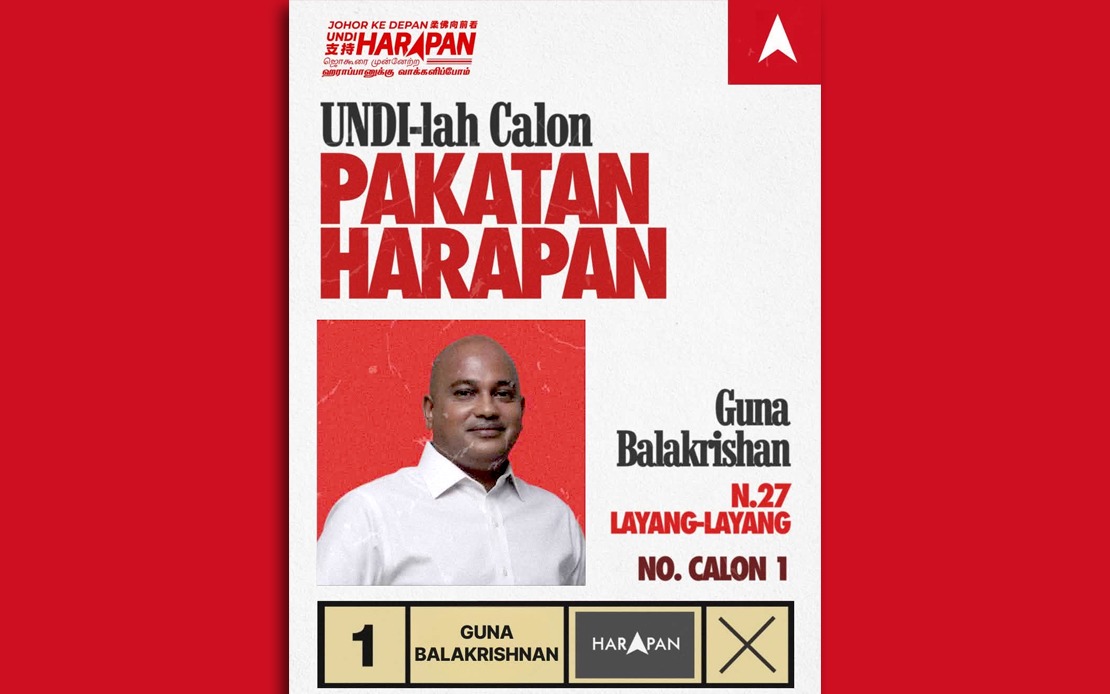
Guna Balakrishnan, the Pakatan Harapan candidate contesting the Layang-Layang state seat in the upcoming Johor election, has announced an ambitious six-point manifesto centred on inclusive development and the welfare of constituency residents. Speaking at a media engagement in Kluang, Guna positioned himself as a representative who would maintain close ties with his community and champion solutions tailored to local concerns rather than impose top-down policies disconnected from ground realities.
Flood management stands as the cornerstone of Guna's platform, reflecting the persistent vulnerability of several settlements within the constituency. Residents of Kampung Senda, Sungai Sayong, Kampung Tengah Renggam, Ulu Benut, Simpang Renggam, and Kampung Chokro have endured repeated inundation during monsoon seasons, disrupting livelihoods and threatening homes. Guna has committed to expediting the rollout of flood mitigation infrastructure, upgrading drainage networks, and establishing systematic maintenance protocols for roads and public utilities. This pledge resonates particularly in a state where annual flooding costs the economy millions and displaces families with troubling regularity, a pattern that successive administrations have struggled to address comprehensively.
Beyond water management, Guna's manifesto addresses the digital divide afflicting Johor's rural pockets. He proposes strengthening internet connectivity in underserved areas and improving street lighting, recognising that rural communities increasingly depend on digital access for educational advancement and small-business operations. The improvement of lighting infrastructure carries tangible safety benefits, particularly for women and children navigating public spaces after dark, an often-overlooked dimension of development that affects quality of life in ways beyond traditional economic metrics.
Youth empowerment features prominently in Guna's vision, with pledges to expand access to Technical and Vocational Education and Training programmes. The proposal to establish a motorsports track as a structured platform for talent development signals an attempt to channel youthful energy into organised activities rather than leaving young residents without viable pathways for skill acquisition and recreation. In a state where youth unemployment and outmigration remain concerns, such initiatives could address both immediate aspirations and longer-term economic participation.
The economic revitalisation component of Guna's platform seeks to unlock Layang-Layang's dormant potential. By supporting small traders and leveraging Renggam's tourism assets, the candidate aims to create income-generating opportunities that keep economic value circulating within the constituency rather than leaking towards larger urban centres. Tourism development, if properly managed, could diversify the local economy beyond agriculture and petty commerce, though such initiatives require careful planning to avoid environmental degradation or cultural commodification.
Women's entrepreneurship and senior citizen welfare round out Guna's manifesto, reflecting recognition that inclusive development must extend to demographic groups often marginalised in conventional political discourse. Proposals to strengthen women's economic participation through targeted support and establish a Senior Citizens Activity Centre acknowledge that development means enabling dignity and agency across all life stages. The centre concept, in particular, addresses the social isolation many elderly residents face in dispersed rural communities, where family structures are increasingly strained by rural-to-urban migration patterns.
Guna has framed these pledges not as opportunistic campaign rhetoric but as grounded commitments realised through coordinated action between state government structures, local authorities, and community organisations. This framing matters strategically because Malaysian voters, particularly in constituencies where development concerns run deep, have grown sceptical of promises disconnected from implementation mechanisms. By explicitly invoking collaborative governance, Guna signals awareness that state assemblymen succeed or fail based on their ability to navigate bureaucratic channels and extract resources for constituent benefit.
The Layang-Layang contest reflects Johor's competitive political landscape, with 25,181 registered voters distributing their support across three candidates. Guna faces Barisan Nasional's Chua Jian Boon and Perikatan Nasional incumbent Abd Mutalip Abd Rahim. This three-way contest potentially benefits any candidate perceived as offering substantive alternatives to the status quo, particularly if voter fragmentation prevents any contender from securing overwhelming support. PH's challenge involves translating policy announcements into visible delivery, as voter scepticism about unfulfilled promises remains a significant obstacle to coalition consolidation in Johor constituencies.
The Johor state election scheduled for July 11, with early voting on July 7, arrives amid broader questions about the state's political trajectory. Johor has historically served as a BN stronghold, yet recent electoral cycles have demonstrated vulnerability to opposition advances and voter volatility. Layang-Layang's development challenges, while representative of rural Johor conditions, also highlight gaps in previous governance that emerging candidates seek to exploit by positioning themselves as more responsive and community-focused alternatives.
Guna's manifesto, taken as a whole, reflects an approach to electoral politics that combines specificity regarding local grievances with broader inclusive development rhetoric. Whether such pledges translate into material improvements for Layang-Layang residents depends substantially on factors beyond a single assemblyman's control, including state government capacity, federal resource allocation, and the political durability of whichever coalition ultimately holds power. Nonetheless, the articulation of concrete commitments on flood management, connectivity, youth opportunity, economic diversification, and social welfare suggests that PH's Layang-Layang campaign has invested effort in understanding constituent priorities rather than deploying generic messaging.

