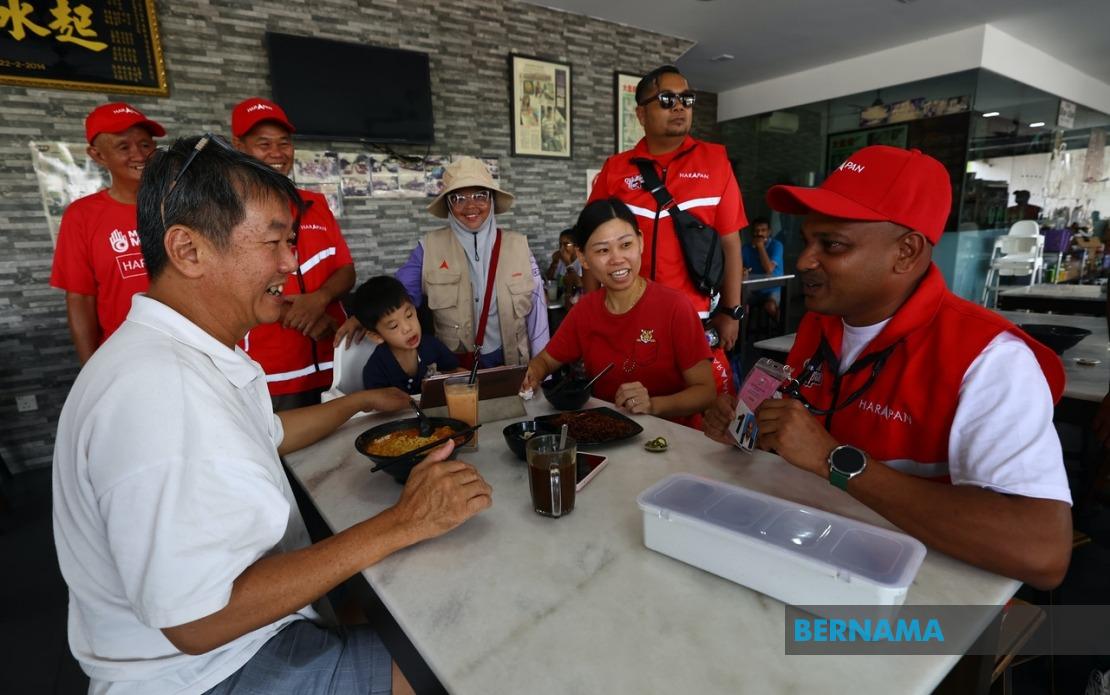
With five days remaining until the Johor state election, Pakatan Harapan candidate Guna Balakrishnan is accelerating his final campaign phase in the Layang-Layang constituency, aiming to reach the remaining 20 per cent of voters his team has not yet encountered. Speaking at the PH operations centre in Kluang, Guna emphasised the urgency of maximising every remaining moment to connect with constituents before polling day on July 11, acknowledging that the campaign machinery has already engaged nearly 80 per cent of the electorate across the 25,181 registered voters in the state seat.
The intensity of Guna's final push reflects the competitive three-way race that has emerged in Layang-Layang. Beyond Guna, voters will choose between Barisan Nasional's Chua Jian Boon and the incumbent representing Perikatan Nasional, Abd Mutalip Abd Rahim. This contested landscape underscores the shifting political dynamics in Johor, where traditional party hierarchies face challenges from competing coalitions, making ground-level engagement increasingly critical for candidates seeking to establish their credibility and connection to local concerns.
Guna's campaign messaging centres on governance reform, positioning Pakatan Harapan as the agent of meaningful change that Malaysian voters should entrust with navigating the country's development trajectory. Rather than offering vague pledges, he has articulated specific commitments tailored to Layang-Layang's demographic and geographic needs. This targeted approach reflects a sophisticated understanding that state-level elections turn substantially on bread-and-butter issues affecting daily life rather than abstract national narratives.
The manifesto unveiled by Guna addresses practical infrastructure challenges that resonate with rural and semi-rural constituencies like Layang-Layang. Flood mitigation stands as a primary concern, indicating that water management and environmental resilience remain persistent vulnerabilities in parts of Johor. Complementing this, commitments to upgrade road networks and enhance street lighting speak to connectivity and safety issues that affect residents' quality of life and economic participation. These are not novel policy propositions, yet their inclusion signals attentiveness to specific community grievances rather than generic campaign rhetoric.
Digital connectivity emerges as an unexpected but strategically important plank in Guna's platform, reflecting recognition that rural Johor faces genuine disadvantages in internet access. The commitment to improve digital infrastructure carries implications beyond mere convenience: it directly affects educational opportunities for young people, enabling participation in online learning platforms increasingly essential in a post-pandemic world. For small business operators and entrepreneurs, reliable connectivity becomes a competitive necessity, particularly as e-commerce transforms retail dynamics across Malaysia. Guna's positioning of this issue suggests campaign strategists understand that rural communities perceive digital exclusion as a form of structural inequality.
Human capital development forms the philosophical underpinning of Guna's longer-term vision for Layang-Layang. By emphasising expansion of Technical and Vocational Education and Training (TVET) opportunities, the candidate addresses youth employment anxieties without proposing unsustainable subsidies or temporary assistance. This aligns with national workforce development priorities while acknowledging that not all young Malaysians follow tertiary education pathways. Women's entrepreneurship programmes represent a deliberate nod toward economic empowerment of female constituents, recognising that small business formation offers economic pathways for women in communities where formal employment may be limited.
The proposed Senior Citizen Activity Centre (PAWE) signals inclusive governance thinking that extends beyond economically productive demographics. This commitment to elderly welfare demonstrates recognition that development agendas must encompass all age cohorts and that social infrastructure matters alongside economic growth. In Malaysian constituencies with ageing populations, such promises resonate particularly strongly, offering tangible evidence that candidates consider the full spectrum of community needs rather than focusing narrowly on voter demographics most likely to participate in elections.
Local testimonials from traders like Tan Ah Kiat and residents like R. Kalaiselvan suggest that Guna's platform messaging has achieved some traction at the grassroots level, though the limited nature of these quotes prevents firm conclusions about broader constituent sentiment. Tan's emphasis on flood mitigation and infrastructure improvement indicates that these remain salient issues for small business operators concerned with operational reliability and customer accessibility. Kalaiselvan's focus on youth and elderly welfare suggests the candidate has successfully communicated his full policy spectrum rather than emphasising only one or two signature commitments.
The campaign's final week will prove decisive in swaying undecided voters, particularly in constituencies like Layang-Layang where margin of victory may prove narrow. Early voting scheduled for July 7 offers a mechanism for mobilising committed supporters before the main polling day, potentially shaping momentum and media narrative heading into the final stretch. For Guna and his opponents, the remaining days demand intensive ground presence and voter contact rather than reliance on broader media strategies.
Johor's state election occurs within Malaysia's broader political context of coalition fragmentation and shifting voter allegiances. The three-way contest in Layang-Layang exemplifies how traditional two-coalition frameworks have splintered, with Perikatan Nasional emerging as a serious contender capable of contesting seats previously assumed safe for either Pakatan Harapan or Barisan Nasional. This fragmentation complicates voter decision-making and may suppress turnout among those struggling to distinguish between competing platforms, potentially benefiting organised campaigns with superior ground machinery.
For Malaysian political observers, Layang-Layang represents a bellwether seat worth monitoring as election results emerge on July 11. The constituency's demographic mixture—combining urban traders, rural residents, and diverse ethnic composition—makes it reasonably representative of broader Johor trends. Should Guna succeed despite a three-way split, it would suggest Pakatan Harapan's messaging about governance reform retains compelling power. Conversely, a Perikatan Nasional or Barisan Nasional victory would indicate that alternative coalitions have successfully captured disaffected voters within constituencies previously considered opposition strongholds.
The intensity of Guna's final campaign push reflects the genuine competitiveness of Layang-Layang's electoral contest and the stakes candidates perceive in this state election. Unlike national campaigns where national narratives dominate, state elections turn substantially on local candidate quality, constituency-specific pledges, and perceived responsiveness to community concerns. Guna's focused strategy of engaging remaining voters while emphasising concrete developmental commitments represents orthodox campaign practice executed with apparent effectiveness, though ultimate success depends on whether such messaging successfully converts persuasion into actual electoral support when voters enter polling booths on July 11.

