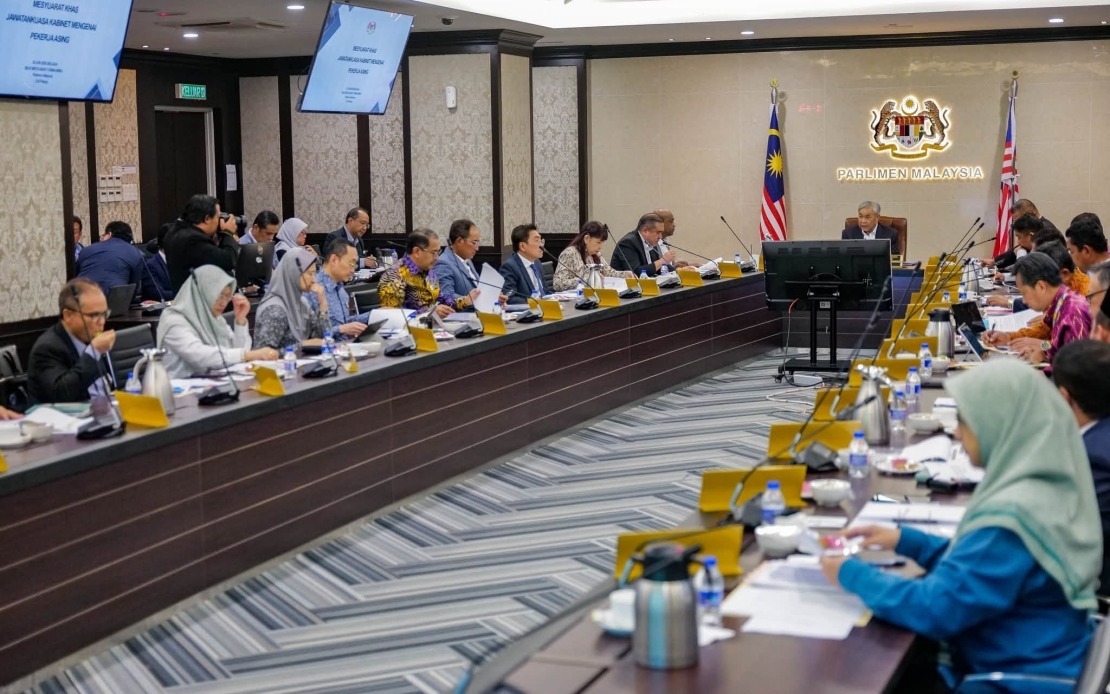
The Malaysian government intends to fundamentally reorganise how it manages its foreign workforce, bringing greater coordination and responsiveness to industry demands while protecting local employment prospects. Deputy Prime Minister Datuk Seri Dr Ahmad Zahid Hamidi made this announcement following a special Cabinet Committee meeting on Foreign Workers held at Parliament, signalling a significant policy shift in how the country approaches its substantial migrant labour challenges.
The restructuring initiative emerges from deliberations at the highest levels of government, where officials recognised the need for a more streamlined and effective approach to managing the approximately 1.9 million foreign workers in Malaysia. Ahmad Zahid's chairmanship of the Cabinet Committee underscores the political importance the administration places on resolving longstanding inefficiencies that have plagued the foreign worker system. The decision to pursue comprehensive restructuring reflects growing concerns about coordination gaps between various government agencies responsible for foreign worker oversight.
Central to the reforms is a significant organisational change: the One Stop Centre for Foreign Worker Management will now operate under the purview of the Ministry of Human Resources rather than its previous administrative arrangement. This consolidation represents an attempt to eliminate duplication and create clearer lines of authority within the sprawling bureaucracy overseeing migrant labour. By anchoring the centre within the human resources ministry, the government hopes to align foreign worker policies more closely with broader employment and workforce development objectives.
The restructuring addresses a fundamental tension in Malaysia's labour market. While the economy depends substantially on foreign workers across construction, manufacturing, agriculture and domestic service sectors, policymakers face pressure to prioritise job creation and skills development for Malaysian citizens. Ahmad Zahid's statement acknowledges this delicate balance, emphasising that the government remains committed to reducing foreign worker dependency through expanded local workforce participation and accelerated skills training programmes. This commitment reflects broader concerns about structural unemployment among Malaysian workers and the need to build a more sophisticated, technology-driven economy.
Strategic reassessment of labour requirements will form another pillar of the new system. Rather than approving foreign worker quotas based on historical precedent or routine requests, government agencies will now conduct deeper analyses of actual industry needs. This approach should prevent the scenario where sectors over-rely on migrant labour when local workers could fill positions with appropriate training and support. The government's intention to examine labour demands more rigorously suggests recognition that poor labour market planning has contributed to both unemployment among Malaysians and worker exploitation in some industries.
Automation acceleration features prominently in the government's longer-term strategy for reducing foreign worker reliance. Rather than merely capping migrant numbers, the administration appears committed to facilitating technological transitions in labour-intensive sectors. This dual approach—reducing foreign worker numbers while promoting industrial upgrading—addresses supply-side constraints that have historically made employers dependent on cheap migrant labour. Industries facing automation pressures will need to invest in new technologies and retrain existing workforces, a process government policies should facilitate rather than obstruct.
The integrity dimension of Ahmad Zahid's announcement carries particular weight given documented problems within the foreign worker management system. Corruption, document falsification and trafficking vulnerabilities have long plagued the sector, creating conditions where unscrupulous employers exploit migrants while dodging regulatory obligations. By emphasising integrity within the restructured management framework, the government signals willingness to address these institutional weaknesses. More efficient coordination between immigration authorities, labour inspectors and law enforcement should theoretically reduce opportunities for systemic abuse.
National security considerations underpin these reforms, though often receive less public emphasis than employment or economic arguments. Foreign workers constitute a population that governments must monitor and regulate, particularly given Malaysia's geographic position and regional security environment. More coordinated management theoretically improves the government's ability to track migrant movements, verify backgrounds and identify security risks. The restructuring thus reflects security imperatives alongside economic and social policy objectives.
For Malaysian employers, the restructuring will likely introduce new compliance requirements and potentially more stringent scrutiny of labour practices. Companies accustomed to navigating a fragmented bureaucracy may face transition difficulties as the One Stop Centre assumes greater authority. However, businesses genuinely seeking to comply with regulations should benefit from clearer processes and more consistent standards. The restructuring creates opportunities to raise baseline employment standards across sectors currently characterised by informal arrangements and regulatory arbitrage.
Regional context matters considerably for interpreting these reforms. Throughout Southeast Asia, governments grapple with similar foreign worker management challenges as neighbouring economies compete for migrant labour. Thailand, Indonesia and the Philippines all experience significant outflows of workers to Malaysia and other destinations. Malaysia's restructuring could influence how regional labour markets function, particularly if the reforms successfully reduce reliance on migrant workers without creating severe labour shortages that damage economic competitiveness. Other ASEAN nations may observe the Malaysian experience closely.
For migrant workers themselves, outcomes remain uncertain. Efficiency improvements and stronger integrity enforcement could reduce opportunities for exploitation and trafficking, particularly if labour inspections become more systematic and penalties for violations more stringent. However, restrictions on foreign worker recruitment could make employment opportunities scarcer, potentially driving workers toward informal or underground employment where protections vanish entirely. The government faces a difficult balance between protecting local workers and ensuring migrant workers themselves enjoy adequate protections and reasonable access to employment.
The success of these reforms ultimately depends on implementation rigour and adequate resource allocation to the restructured management system. Government announcements frequently outline ambitious objectives that encounter difficulties during execution, particularly when institutional coordination proves more challenging than anticipated. Whether the One Stop Centre under Ministry of Human Resources supervision can genuinely coordinate across multiple agencies with divergent institutional interests remains to be seen. Sustained political commitment and sufficient funding will prove essential for translating these policy intentions into operational reality.

