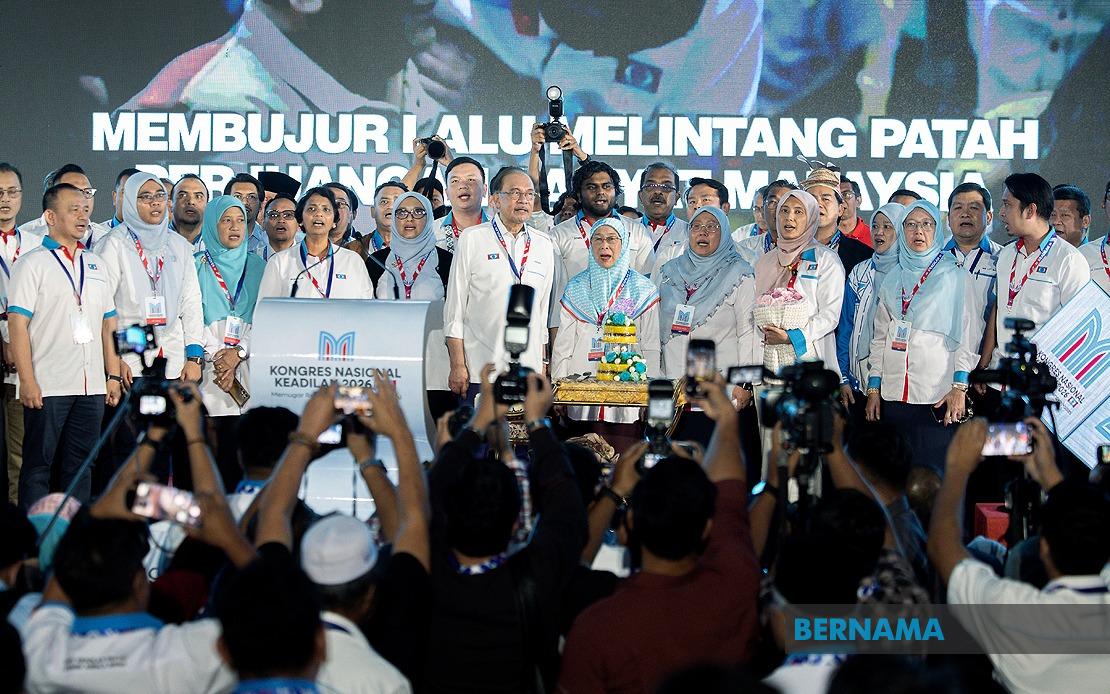
Prime Minister Datuk Seri Anwar Ibrahim has committed the government to amending the Tabung Haji Act 1995 as a key measure to restore and maintain the confidence of Muslim depositors in the institution. Speaking in his dual capacity as Finance Minister, Anwar framed the legislative overhaul as part of the MADANI Government's broader institutional strengthening agenda, signalling that accountability and structural reform remain central to the administration's governance priorities.
The announcement reflects growing recognition that Tabung Haji, which manages savings and pilgrimage funds for millions of Malaysian Muslims, requires legislative modernisation to address accumulated governance deficiencies. The pillar institution has faced scrutiny over operational transparency and asset management in recent years, making legislative amendment a necessary step to rebuild institutional credibility and ensure proper stewardship of public trust.
Beyond Tabung Haji, Anwar's governance agenda extends to higher education policy. He underscored the government's determination to completely repeal the Universities and University Colleges Act 1971 without introducing replacement legislation that would similarly constrain student expression. This position signals a departure from long-standing restrictions on campus activism, indicating a willingness to recalibrate the relationship between state authority and academic freedoms.
The Prime Minister contextualised these institutional reforms within a broader vision of economic governance that transcends political calculations. He emphasised that government responsibility encompasses all citizens and regions, explicitly including populations in opposition-led states. This framing addresses a persistent tension in Malaysian politics: whether public resources and policy attention are distributed equitably or directed primarily toward coalition supporters.
Anwar's remarks, delivered following the 2026 Parti Keadilan Rakyat National Congress, stressed that economic expansion must translate into tangible improvements in living standards for ordinary Malaysians. The government's legitimacy, he implied, ultimately depends on whether growth reaches households across the social spectrum, not merely whether headline gross domestic product figures climb steadily.
Central to his message was a distinction between power and duty. Anwar cautioned his own party against wielding state authority for personal enrichment or to benefit political networks. Instead, he framed governance capacity as a public trust requiring leaders to champion popular welfare, defend justice, and safeguard human dignity. This rhetorical repositioning matters because it establishes an internal standard against which PKR and coalition partners can be measured.
As PKR president, Anwar called on the party to maintain its foundational commitment to cross-communal solidarity and reform ideals. He argued that the party's strategic asset lies not in accumulating power but in organisational coherence, transparent leadership, and systematic execution of principled policies. This emphasis on institutional strength over naked political advantage distinguishes PKR's stated approach from historical patterns in Malaysian politics.
The MADANI framework under which these commitments are articulated represents an attempt to anchor governance reform within a coherent philosophical structure. The acronym, representing core values of strength, moderation, and unity, suggests that policy choices should reflect ethical consistency rather than electoral convenience. Whether implementation aligns with rhetoric will determine the framework's credibility.
For Malaysian Muslims, the Tabung Haji amendment carries particular significance. The organisation holds savings equivalent to billions of ringgit belonging to ordinary workers and retirees preparing for the hajj pilgrimage. Legislative reform could strengthen governance safeguards, improve transparency, and enhance accountability mechanisms—outcomes that would benefit depositors who depend on institutional reliability.
The broader policy direction also carries implications for Malaysia's development model. By signalling openness to repealing the Universities and University Colleges Act, the government acknowledges that campus restrictions may not serve contemporary national interests. Knowledge economies increasingly rely on adaptable, critically engaged workforces—constituencies less likely to develop in environments of suppressed expression.
Regionally, Malaysia's institutional reform trajectory influences perceptions of governance maturity within Southeast Asia. Demonstrable progress on institutional accountability and transparency can strengthen investor confidence and regional partnerships. Conversely, reform announcements unmatched by implementation risk deepening public cynicism about policy sincerity.
The institutional challenges Anwar highlighted reflect accumulated governance deficits requiring sustained attention. Tabung Haji, the university sector, and broader civil service frameworks cannot be reformed through announcement alone. Implementation demands legislative drafting expertise, bureaucratic coordination, and political will to override entrenched interests that may resist change.
Moving forward, the critical measure of the MADANI Government's governance commitments will be legislative progress, regulatory redesign, and institutional outcomes demonstrable to the public. Muslim depositors will assess whether Tabung Haji amendments genuinely strengthen their protections. Students and academics will evaluate whether educational freedoms actually expand. All Malaysians will judge whether government attention reaches beyond coalition strongholds. These practical tests will ultimately determine whether reform rhetoric translates into substantive institutional change.

