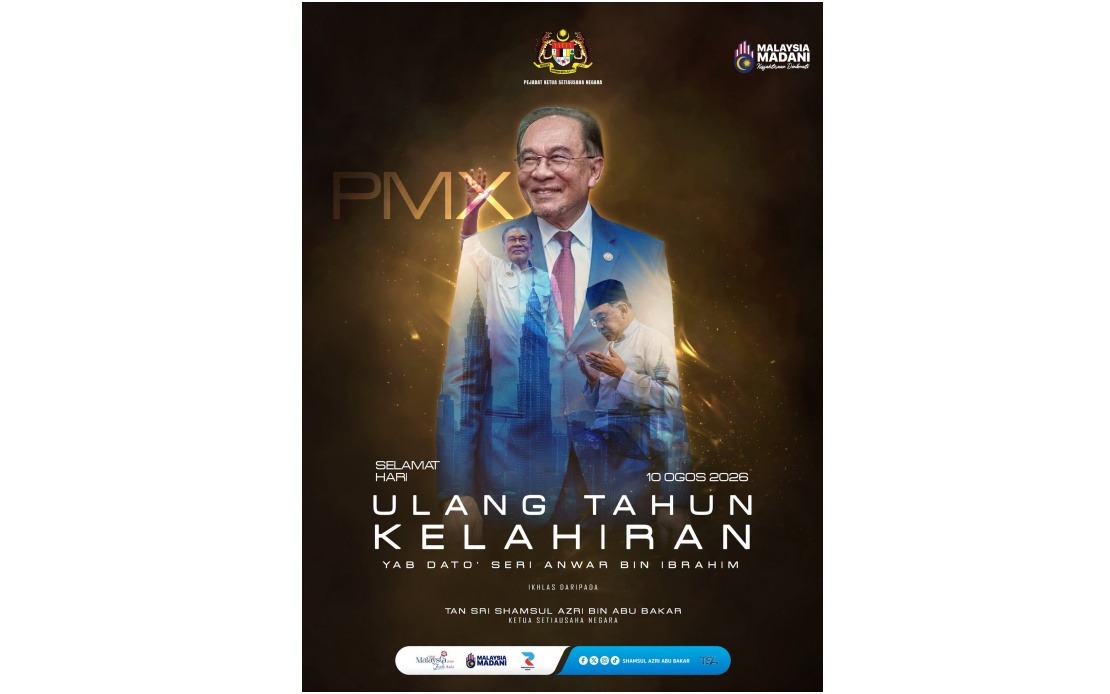
Prime Minister Datuk Seri Anwar Ibrahim received birthday greetings from Malaysia's top civil servant and government institutions on August 10, marking another year in his leadership of the nation. Chief Secretary to the Government Tan Sri Shamsul Azri Abu Bakar extended official wishes on behalf of the civil service, underscoring the government's commitment to supporting the Prime Minister's vision for institutional change and public sector modernisation.
In his Facebook message, Shamsul Azri emphasised that Malaysia's bureaucratic apparatus remains steadfast in its dedication to advancing the Prime Minister's reform agenda. His remarks reflected the critical role civil service alignment plays in executing government policy, particularly as Malaysia navigates complex economic and social challenges. The Chief Secretary's public statement carries symbolic weight beyond routine congratulations, signalling institutional continuity and the maintenance of professional relationships between the executive and administrative machinery.
The Prime Minister's Office reinforced these sentiments through its own video message, offering reflections that extended beyond ceremonial birthday wishes. The phrase "Efforts continue, the trust is fulfilled, and to Allah SWT we place our trust" encapsulated the administration's broader narrative of persistent commitment to national development and its invocation of faith-based governance principles that resonate with Malaysia's Islamic constitutional framework. This messaging approach reflects how official communications increasingly blend secular governance objectives with religious sentiment, a practice increasingly common in Malaysian public institutions.
Anwar Ibrahim's tenure as Prime Minister, which commenced in November 2022, has been marked by ambitious policy initiatives spanning economic restructuring, anti-corruption drives, and institutional reforms. At 79 years old, questions surrounding succession planning and the longevity of specific reform programmes remain pertinent within political circles, though such discussions remain largely confined to private discourse. The ceremonial expressions of support from senior government figures serve partly to reinforce confidence in the administration's continuity and the stability of Malaysia's political system.
The Malaysia MADANI social media account, representing the government's flagship development framework, added its own birthday message emphasising the Prime Minister's tireless work for national advancement. This multi-institutional acknowledgement demonstrates how government communications are coordinated across several platforms and entities, each contributing to a unified narrative about leadership commitment. The MADANI framework itself, launched as a progressive development model, serves as the philosophical backbone for various government initiatives, and its public engagement reflects the administration's efforts to maintain consistent messaging.
These birthday greetings arrive at a moment when Malaysia's political landscape continues navigating the complexities of coalition governance. The Prime Minister leads a government comprising multiple political parties with sometimes divergent interests, making public displays of institutional unity and support potentially significant for maintaining governmental cohesion. Gestures from the civil service hierarchy carry particular importance in affirming that administrative structures remain focused on policy implementation rather than becoming embroiled in political competition.
The religious language employed throughout these birthday wishes—invoking divine blessings, protection, and guidance—reflects Malaysia's unique governance culture where secular bureaucratic functions intersect with Islamic principles. This integration shapes how official communications are framed and received, particularly among a Muslim-majority population where such sentiments carry cultural resonance beyond their literal meaning. For Malaysian readers, these messages signal not merely courteous acknowledgements but affirmations of institutional commitment within an Islamic democratic framework.
For Southeast Asia more broadly, Malaysia's civil service structure and its relationship with executive leadership represents a distinctive model within the region. The formal, structured expressions of support from the Chief Secretary to the Government contrast with more informal political systems elsewhere, reflecting Malaysia's inherited Westminster traditions combined with its particular constitutional arrangements. The stability this conveys carries implications for investor confidence and regional perceptions of institutional strength.
Looking forward, the Prime Minister's administration faces significant challenges including economic growth stabilisation, managing public debt, and maintaining political coalitional stability. The sustained expressions of support from senior civil servants and government institutions provide necessary political capital for pursuing transformative agendas. As Malaysia progresses through what remains of Anwar Ibrahim's tenure, the degree to which these institutional commitments translate into concrete policy outcomes will ultimately determine the success of the current government's reform initiatives and shape Malaysia's trajectory in the coming years.

