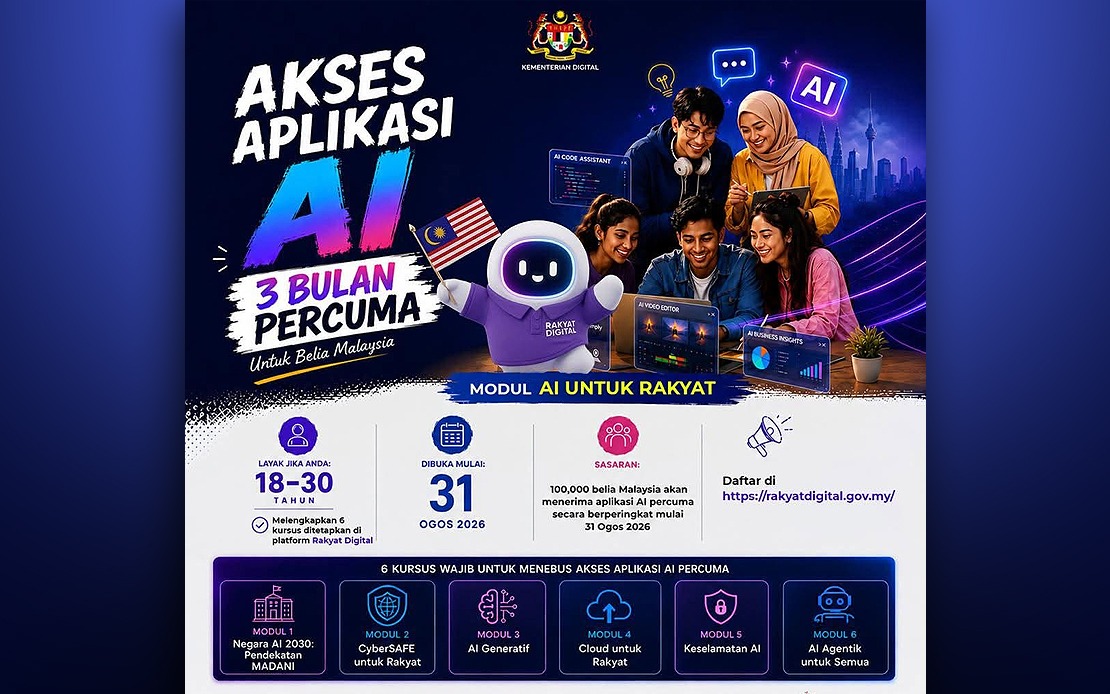
Malaysia is taking a significant step toward democratising artificial intelligence education and access by launching the AI for the People (AI Untuk Rakyat) programme, unveiled by Prime Minister Datuk Seri Anwar Ibrahim today as part of a broader push to expand digital opportunities for young Malaysians. The initiative represents a strategic investment in human capital development, recognising that AI literacy will be fundamental to Malaysia's economic competitiveness and social progress in the coming decade.
The programme, administered through the Rakyat Digital portal at rakyatdigital.gov.my, aims to reach 100,000 Malaysians between the ages of 18 and 30 through 2027, with registration and module completion beginning immediately on a phased basis. This ambitious scope demonstrates the government's commitment to creating inclusive pathways into the AI revolution, particularly for young people who may lack traditional access to such training through formal educational channels or corporate programmes.
Participants must successfully navigate and pass six carefully designed modules covering essential AI competencies for the modern digital landscape. These courses—AI Nation 2030: The MADANI Approach, CYBERSAFE for the People, Generative AI, AI Security, Agentic AI for All, and Cloud for the People—have been structured to provide both foundational knowledge and practical, immediately applicable skills. The inclusion of security and cybersafety modules reflects growing awareness that AI literacy must encompass responsible and secure technology use, not merely technical capability.
Upon completing and passing all six modules, eligible participants receive a three-month free subscription to a curated selection of AI applications and software tools. This hands-on access component addresses a critical gap in traditional online education: learners can immediately experiment with and apply their newly acquired knowledge using real-world platforms, transforming theoretical understanding into practical competence.
The initial technology partners are particularly noteworthy, combining local and international expertise. Participants will gain access to YTL AI Labs' IlmuChat, Alibaba's Wonderclip and MuleRun, and Google's Gemini Enterprise. This diversity of platforms ensures learners become acquainted with multiple AI ecosystems and approaches, preparing them for varied professional environments where different organisations employ different AI solutions. The Digital Ministry's commitment to progressively add tools from additional technology companies signals that this is conceived as an evolving ecosystem rather than a static offering.
For Malaysian youth particularly, this programme addresses a structural inequality in technology access. Many young people in smaller towns and rural areas, as well as those from less affluent backgrounds, lack exposure to cutting-edge AI tools that their counterparts in tech hubs or wealthy families might easily access. By providing free, standardised access through a national digital portal, the government creates a level playing field where aptitude and effort, rather than economic circumstance, determine who can acquire these increasingly essential skills.
The initiative aligns squarely with Malaysia's broader digital transformation agenda, specifically the Malaysia Digital 2030 framework and the aspiration to build an inclusive AI Nation by 2030. These policy commitments acknowledge that AI will reshape employment, entrepreneurship, and social participation across every sector. Without deliberate intervention to expand AI literacy beyond privileged demographics, Malaysia risks creating a digital underclass unable to access the most dynamic economic opportunities of the coming decade.
Digital Ministry Secretary-General Datuk Fabian Bigar emphasised that the programme aims to ensure young Malaysians not merely understand AI in abstract terms but genuinely develop practical capacity with actual tools used in industry and creative work. This distinction is critical: the goal is not passive knowledge consumption but active capability building that immediately enhances creativity, productivity, and digital fluency.
The programme's structure—combining guided learning, security awareness, hands-on practice, and free tool access—represents sophisticated thinking about skills development. Young participants will understand not just how AI works, but how to use it safely, how to build with it, and how to leverage it for personal productivity and creative pursuits. This comprehensive approach positions graduates to either pursue further technical training or immediately apply their learning in their current studies, workplaces, or entrepreneurial ventures.
From a regional perspective, Malaysia's investment in mass AI literacy stands out as a proactive approach to workforce readiness. As Southeast Asia competes for tech investment and talent, countries that develop broad-based AI competence among their youth create competitive advantages in attracting companies seeking digitally sophisticated labour markets. Additionally, the emphasis on local technology partners like YTL AI Labs strengthens Malaysia's domestic tech ecosystem while ensuring innovation isn't entirely dependent on foreign providers.
The programme also reflects evolving understanding of how government can support digital inclusion. Rather than simply building digital infrastructure or requiring traditional educational institutions to adapt curricula—both slow processes—the Digital Ministry has partnered with existing platforms and private technology companies to deliver rapid, scalable training. This public-private collaboration model is increasingly essential for keeping government initiatives aligned with the fast-moving technology sector.
Success of the AI for the People programme will likely influence how other Southeast Asian governments approach AI democratisation. Should Malaysia effectively reach its 100,000-participant target and demonstrate measurable improvements in AI literacy and capability among young citizens, the model offers a replicable template for regional peers seeking to avoid AI skills gaps that could exacerbate inequality. The phased rollout on Rakyat Digital also provides valuable implementation experience and data about how different demographics engage with online AI education.
Looking forward, the programme's impact will ultimately depend on sustained funding, continuous curriculum updates to reflect rapidly evolving AI capabilities, and—critically—pathways for programme graduates to leverage their credentials into meaningful employment or entrepreneurial opportunities. A well-designed skills programme that leaves participants certified but unable to apply their learning would represent a missed opportunity. The next phase of policy should therefore ensure that employers recognise these credentials and that avenues exist for programme graduates to transition their learning into economic value.

