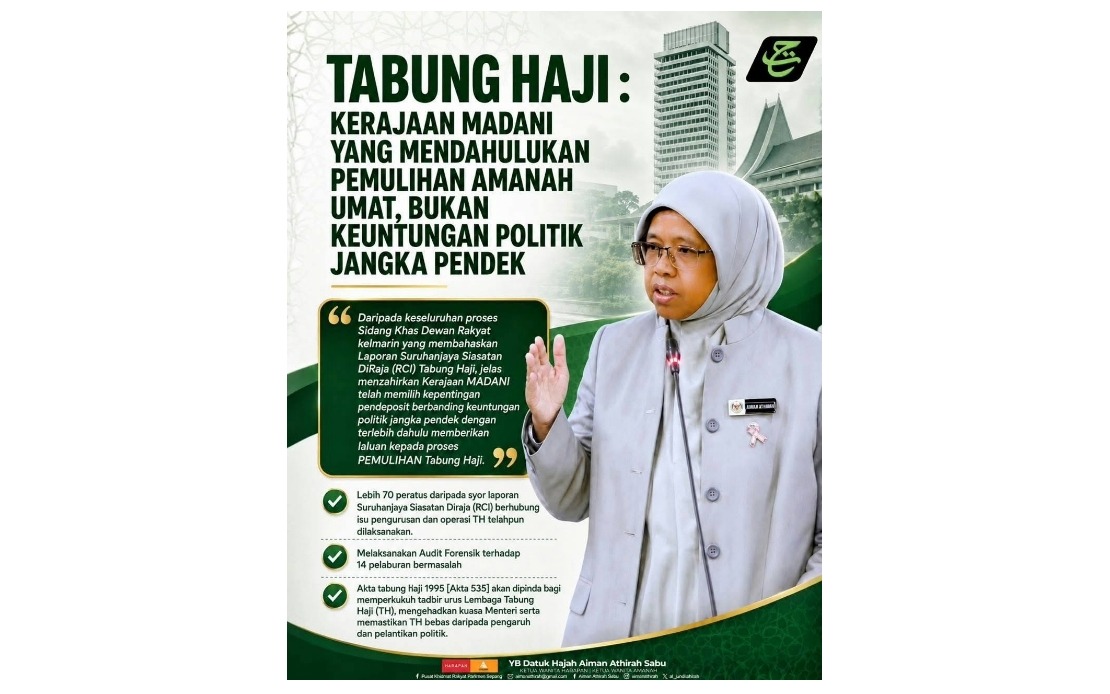
The government's measured approach to disclosing findings from the Tabung Haji Royal Commission of Inquiry reflects a strategic choice to protect the interests of over 10 million depositors rather than pursue short-term political advantages, according to Deputy Minister of Housing and Local Government Datuk Aiman Athirah Sabu. Her remarks, articulated through social media, underscore the administration's determination to preserve public confidence in the pilgrimage savings institution, which occupies a unique position in Malaysia's financial and Islamic landscape.
The caution exercised in managing the RCI report's release stems from hard-learned lessons about financial fragility. During 2018, Tabung Haji experienced massive outflows exceeding RM6 billion after revelations of governance deficiencies, a cautionary episode that exposed how rapidly institutional confidence can evaporate when concerns about mismanagement take hold. The government's present strategy accordingly prioritises structural stability over transparency timelines, recognising that the institution's role as a savings conduit for millions of Malaysian Muslims pursuing the fifth pillar of Islam demands exceptional stewardship.
Aiman Athirah's intervention responds directly to criticism from opposition figures, particularly the Islamist PAS party and Parti Wawasan Negara, who have questioned why the report's full contents remain undisclosed and suggested political motivations behind the timeline. Her counterargument frames the government's actions as transcending conventional political calculation, contending instead that managing a custodian of Muslim savings requires prioritising institutional health over managing public narratives or addressing partisan challenges. This framing attempts to remove the RCI disclosure question from the realm of political theatre and position it instead within a duty-of-care framework.
The involvement of Sultan Ibrahim, King of Malaysia, in calling for thorough investigation lent substantial weight to assertions that governance deficiencies at Tabung Haji were neither routine nor trivial. Royal intervention at this level signals that the underlying issues warranted extraordinary remedial action, thereby justifying the government's measured approach and reinforcing the narrative that this constitutes a matter requiring careful, deliberate handling rather than expedited disclosure.
Progress on implementing Royal Commission recommendations has already commenced. Minister in the Prime Minister's Department (Religious Affairs) Dr Zulkifli Hasan disclosed during parliamentary proceedings that over 70 per cent of RCI recommendations concerning Tabung Haji's management and operational framework have already been executed. Among these actions, forensic audits encompassing 14 problematic investments represent a comprehensive investigative mechanism designed to generate definitive answers about investment failures and systemic weaknesses, establishing factual foundations for future governance improvements.
The scale of financial deterioration at Tabung Haji emerged starkly during parliamentary disclosures. Second Finance Minister Datuk Seri Amir Hamzah Azizan revealed that the institution accumulated nearly RM13 billion in cumulative losses from 14 troubled investments, with seven investments recording complete losses. This figure comprises RM10.2 billion absorbed through government intervention via Urusharta Jamaah Sdn Bhd in 2018, alongside RM2.6 billion in impairment charges borne directly by Tabung Haji across 2018 to 2025 as the institution continued managing investments that steadily diminished in value. These numbers underscore the magnitude of institutional dysfunction and justify intensive scrutiny before public disclosure.
Despite these losses, Tabung Haji has demonstrated measurable recovery across multiple operational metrics. Investment income reached RM4.64 billion during 2025, representing a record performance and signalling that managerial reforms and renewed operational discipline have begun generating returns. The dividend distribution rate has expanded substantially from 1.25 per cent in 2018 to 3.5 per cent in 2025, indicating genuine improvement in surplus generation and capacity to reward depositor savings. These metrics form the foundation of the government's argument that recovery initiatives are working and that institutional stability has been progressively restored.
Critical to maintaining affordability for Malaysian Muslim pilgrims, the cost of performing the haj has been stabilised at RM33,000 across three consecutive seasons. This achievement becomes particularly significant when accounting for rising management expenses and operational costs, demonstrating that governance improvements and operational efficiency have been aligned not merely with financial recovery but with protecting access to pilgrimage for ordinary depositors. The decision to maintain fixed haj costs across multiple years represents a tangible benefit to the institution's core constituency and validates the government's claim that institutional interests supersede political convenience.
The government's legislative agenda includes amendments to the Tabung Haji Act 1995 designed to reinforce governance architecture, circumscribe ministerial discretionary powers, and insulate the institution from political interference or appointment-based patronage. These proposed structural reforms address the root causes of governance dysfunction that emerged from the RCI investigation, establishing permanent institutional safeguards rather than relying on administrative discipline or goodwill. By legislating governance constraints, the government attempts to prevent future repetition of the mismanagement patterns that necessitated the Royal Commission investigation.
Opposition parliamentarians' decision to boycott the special parliamentary sitting during which the government detailed its response to the RCI findings drew sharp criticism from Aiman Athirah, who characterised the walkout as irresponsible dismissal of substantive policy discussion. This parliamentary theatre, she argued, represented an attempt to politicise a technical governance matter rather than engage with factual information about institutional recovery and reform implementation. The incident illustrates how the Tabung Haji situation has become entangled in Malaysia's broader polarised political environment, with different factions interpreting the institution's management through partisan lenses.
For Malaysian readers, the Tabung Haji situation carries implications extending beyond financial markets or institutional administration. The institution represents a form of enforced savings for millions of Malaysians, many from modest economic backgrounds, who channel contributions toward fulfilling a central Islamic religious obligation. Governance failures at this scale threaten not merely financial returns but the sanctity of religious aspiration itself, explaining why both depositors and political actors view Tabung Haji through such intensely personalised lenses. The government's stability-first approach reflects this reality, prioritising the psychological and financial security of ordinary depositors over the political satisfaction of transparency advocates.
Moving forward, the government faces continuing pressure to balance transparency demands against financial stability concerns. The implementation of reforms and the publication of comprehensive findings will ultimately determine whether the cautious disclosure strategy preserves institutional confidence or generates accusations of concealment. Meanwhile, the trajectory of Tabung Haji's recovery will serve as the definitive measure of whether the governance reforms and financial interventions have genuinely addressed the institutional dysfunction that prompted Royal Commission investigation.

