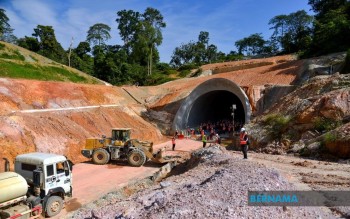
The federal government has given the nod to a substantial development package for Pasir Puteh parliamentary constituency in Kelantan, committing RM207.2 million across 46 separate projects scheduled for 2026 onwards. The initiative reflects a strategic pivot toward leveraging the East Coast Rail Link as a transformative economic engine for one of Malaysia's less-developed regions, with planners viewing the Pasir Puteh ECRL Station as the cornerstone of a broader commercial transformation.
Deputy Economy Minister Datuk Mohd Shahar Abdullah outlined the government's integrated vision during parliamentary questioning, explaining that the projects encompass land preparation and foundational infrastructure work for a planned downstream industrial zone. This approach signals a departure from piecemeal development towards a cohesive spatial strategy that connects rail connectivity with industrial capacity, recognising that isolated infrastructure investments often fail to generate sustainable economic momentum without supporting commercial ecosystems.
The Pasir Puteh ECRL Station occupies a particularly advantageous geographic position, situated in close proximity to the Tok Bali Supply Base, a factor that planners view as critical to the region's competitive positioning. This convergence of rail, port, and supply infrastructure creates what economists call a "natural cluster" — conditions where logistics and downstream manufacturing can operate with reduced transportation costs and improved supply chain efficiency. For a constituency historically marginalised by Malaysia's development geography, this alignment represents a genuine opportunity to attract capital that might otherwise flow toward already-established industrial hubs in Klang Valley or Penang.
The development framework is anchored within the broader ECRL Integrated Land Use Master Plan, abbreviated as PGTA-ECRL, which attempts to coordinate federal rail investment with regional economic planning across multiple stakeholders. Rather than treating the ECRL as merely a transport corridor, planners explicitly position the Pasir Puteh station as a dual-function facility capable of handling both passenger services and cargo operations, with the latter deemed essential for justifying the intensive logistics infrastructure being planned.
Deputy Economy Minister Mohd Shahar emphasised that the government's commitment extends beyond capital allocation toward a philosophy of targeted, locality-specific development. The 13th Malaysia Plan framework, spanning 2024 to 2030, explicitly mandates that planners identify the comparative economic advantages of each constituency and concentrate investment accordingly. In Pasir Puteh's case, this means prioritising logistics and downstream industrial infrastructure over, say, tourism amenities or technology parks that might be more appropriate for coastal resort areas or urban centres.
The synergy argument represents a central justification for the package. Government officials contend that proximity between rail facilities and port operations creates multiplicative economic effects — cargo arriving via ship can be consolidated and distributed via rail, while goods moving through the ECRL can be warehoused, value-added, and shipped onward. This clustering potential theoretically attracts distribution companies, manufacturing firms seeking logistical advantages, and supply chain operators who view Pasir Puteh not as an isolated location but as a strategic node within broader Malaysian and Southeast Asian trade networks.
For Kelantan specifically, the investment represents a deliberate effort to reduce regional inequality, a persistent feature of Malaysian development geography that concentrates capital and opportunity in peninsular economic corridors. Pasir Puteh has historically struggled with limited industrial capacity and economic dynamism, making these projects potentially transformative if implementation matches ambition. The government framed the initiative as directly responsive to local constituency needs rather than centralised planning, with Datuk Dr Nik Muhammad Zawawi Salleh (PN–Pasir Puteh) having raised the question during parliamentary proceedings.
Implementation timelines stretch across the remainder of the 13MP period, with projects commencing this year and continuing through 2030. This extended timeline reflects the reality that industrial corridor development requires phased infrastructure rollout — land cannot be successfully developed faster than markets can absorb it, and premature over-investment risks creating unutilised industrial parks that consume public resources without generating anticipated economic activity.
Monitoring mechanisms have been embedded within the process through the MyRMK system, a performance tracking platform designed to maintain visibility over 13MP project execution across all constituencies. Parliamentary reporting mechanisms will provide periodic updates on spending and progress, attempting to create accountability structures around capital deployment. This transparency framework responds to longstanding Malaysian concerns about development funds being allocated but not effectively utilised, a pattern that has undermined confidence in regional development initiatives.
The broader Southeast Asian context amplifies the significance of this Pasir Puteh initiative. As regional trade increasingly depends on efficient logistics networks, countries positioning themselves as distribution hubs gain competitive advantages in attracting foreign investment and generating employment. The ECRL, once completed, will create new east-west connectivity across Malaysia that potentially repositions secondary cities like those in Kelantan into more economically significant positions within broader trade corridors.
Critical questions remain regarding implementation capacity and market demand. Whether private investors will view Pasir Puteh as sufficiently attractive to establish logistics and manufacturing operations depends on factors beyond government control — regional economic growth, global trade patterns, and competitive positioning relative to other Malaysian and regional industrial locations. The government can create enabling infrastructure, but sustained economic dynamism requires private sector participation and genuine comparative advantage.
The RM207.2 million allocation represents meaningful but not massive investment by Malaysian federal standards, suggesting measured expectations about transformation pace. Success metrics will likely emerge by 2028-2029 regarding whether the industrial zone has attracted anchor tenants and begun generating employment, providing early indicators of whether the integrated development strategy is delivering anticipated outcomes for this historically peripheral constituency.

