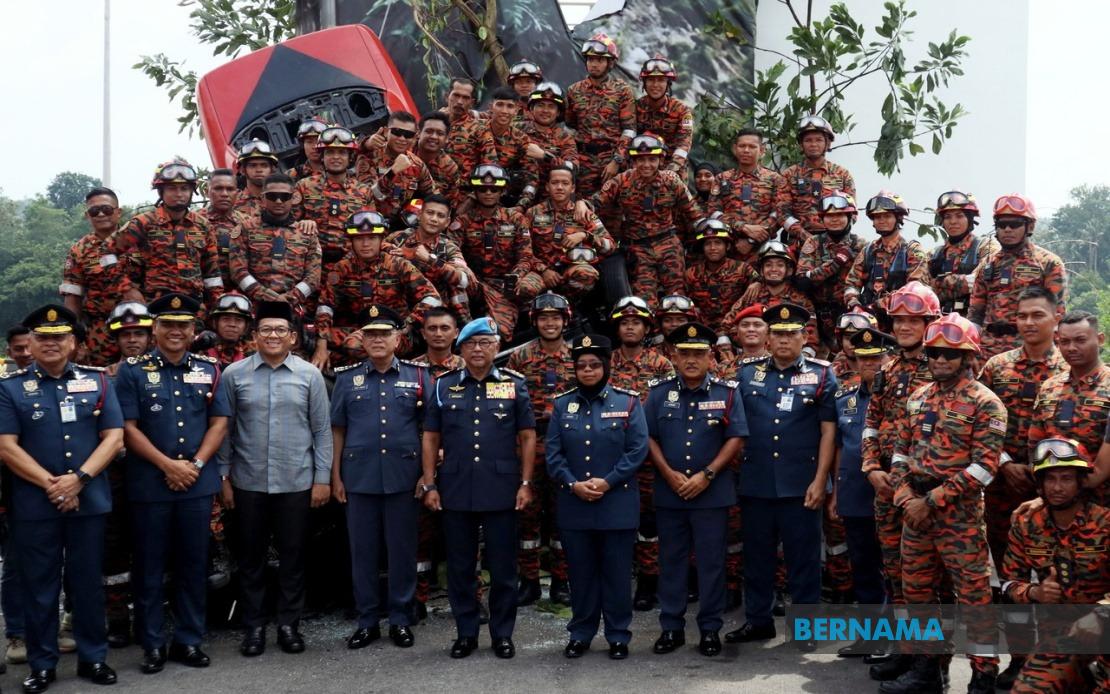
The Federal Government has committed RM278.9 million in annual development funds to the Malaysian Fire and Rescue Department (JBPM), enabling the implementation of 86 projects across the country under the First Rolling Plan of the 13th Malaysia Plan (13MP). This substantial investment reflects the administration's focus on strengthening emergency response infrastructure and public safety services throughout Malaysia's diverse regions.
The allocation encompasses both new and established initiatives, with 27 fresh projects launching this year alongside 59 ongoing schemes. According to Housing and Local Government deputy minister Datuk Aiman Athirah Sabu, this balanced portfolio ensures that Malaysia continues developing its fire and rescue capabilities while maintaining momentum on existing programmes. The distribution of resources across new and continuing projects demonstrates a strategic approach to infrastructure development that builds incrementally on previous investments.
Pahang has emerged as a particular focus of this investment drive, with seven substantial facility development projects underway in the state. These initiatives, spanning both the 12th Malaysia Plan and the current 13MP's first rolling plan, address the growing needs of communities across the state's diverse geography. The projects reflect the government's recognition that emergency services infrastructure must expand to match population growth and economic development patterns.
Among the Pahang projects currently in implementation are the acquisition of the Gohtong Jaya Fire and Rescue Station building and its associated staff quarters, construction of new facilities in Benta, and development at Tioman. Simultaneously, the government is undertaking upgrading work at the Bentong and Kuantan stations, reconstructing the Triang facility, and preparing preliminary site works for expansion in Tanjung Lumpur. This diversified approach ensures that existing facilities receive necessary modernisation whilst new stations are established in areas with expanding population centres.
The formal opening of the Sungai Lembing Fire and Rescue Station (BBP) exemplifies the practical outcomes of this strategic funding allocation. Built at a cost of RM6 million on a seven-acre site, the facility became operational on February 15 and represents the 29th fire and rescue station in Pahang. The location was deliberately chosen to serve approximately 15,000 residents in Sungai Lembing and the surrounding areas, addressing a significant service gap in this economically revitalised region.
Beyond its primary function as an emergency response centre, the Sungai Lembing BBP has been conceptualised as a comprehensive community facility. Deputy minister Aiman Athirah articulated the vision of the station functioning as a knowledge hub, delivering training and fostering public awareness around fire prevention and rescue techniques. This approach aligns with contemporary best practices in emergency service delivery, whereby stations serve as educational institutions that empower citizens to become first responders in their own communities.
The Sungai Lembing station's development sits within a broader economic and heritage revitalisation strategy for the locality. Deputy Economy Minister and Paya Besar Member of Parliament Datuk Mohd Shahar Abdullah connected the fire and rescue infrastructure investment to wider conservation and tourism initiatives underway in the area. These complementary programmes include restoration of the PCCL Cinema, development of ecotourism enterprises, construction of a digital museum, and upgrading of the historic Sungai Lembing Tunnel, all contributing to positioning the town as a potential UNESCO World Heritage Site.
Mohd Shahar's remarks underscored an essential insight: that physical infrastructure development in heritage communities requires parallel investment in public safety systems. The construction of the Sungai Lembing BBP was directly sanctioned by the Sultan of Pahang, Al-Sultan Abdullah Ri'ayatuddin Al-Mustafa Billah Shah, reflecting the high priority accorded to emergency preparedness in the state's development planning. By integrating fire and rescue capabilities into broader heritage town development, the government aims to create environments that are simultaneously prosperous and safe.
For Malaysian readers and regional observers, the JBPM allocation signals sustained commitment to emergency services expansion despite broader fiscal constraints. The RM278.9 million annual ceiling represents substantial investment in unglamorous but essential public infrastructure. The focus on both new facilities and upgrading existing stations indicates a mature approach to resource allocation, avoiding the pitfall of pursuing new projects whilst allowing established services to deteriorate.
The geographic distribution of projects also merits attention from a regional development perspective. Pahang's concentration of projects reflects recognition of rapid urbanisation and economic activity in areas like Kuantan and heritage zones like Sungai Lembing. The strategic placement of new stations addresses service coverage gaps that emerge as population patterns shift and tourism becomes increasingly significant to local economies. This targeted approach ensures that emergency response capacity keeps pace with demographic and economic transformation.
The integration of fire and rescue infrastructure development with heritage conservation efforts in Sungai Lembing demonstrates evolving thinking about how government services support broader development objectives. Rather than treating emergency services as standalone facilities, they are being positioned as anchors within comprehensive community development strategies. This integrated approach recognises that sustainable development requires not only economic growth and cultural preservation but also robust safety systems that protect residents and visitors alike.
As the 13MP continues implementation, the fire and rescue sector's RM278.9 million allocation reflects priority placed on capacity building and service expansion across Malaysia. With 86 projects spanning new construction and facility upgrades, the department is positioned to enhance emergency response capabilities in both established urban centres and emerging economic zones. The Sungai Lembing station exemplifies how targeted infrastructure investment, aligned with broader development strategies, contributes to creating safer, more resilient communities.

