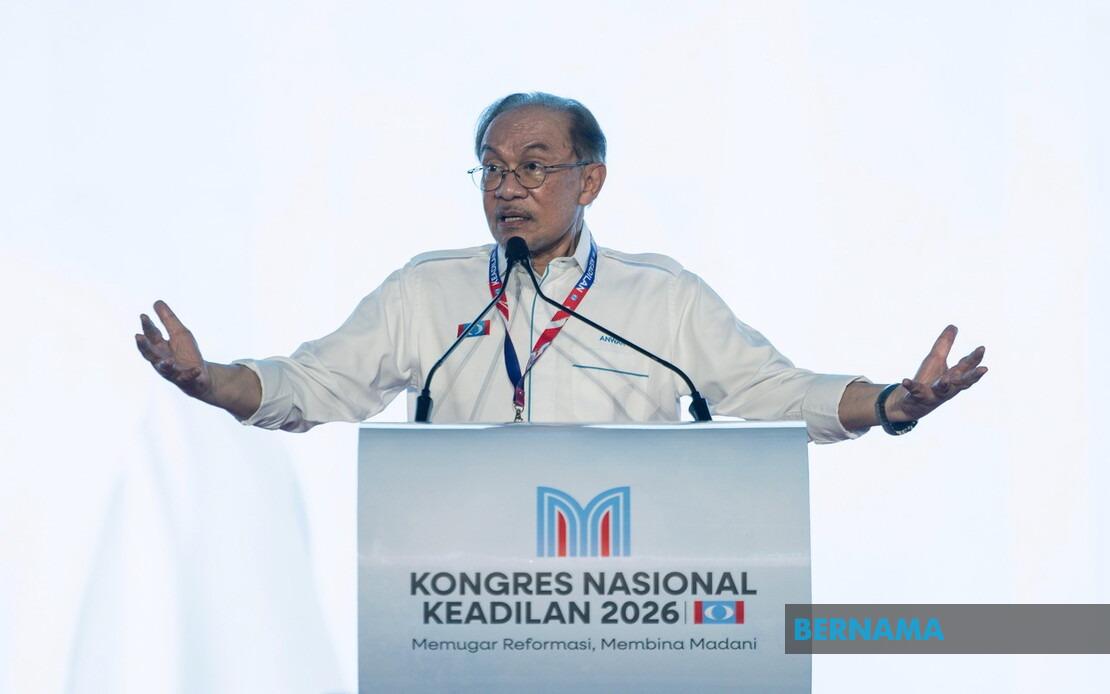
The Malaysian government has greenlit a significant spending measure that will channel an extra RM1 million directly to every parliamentary constituency nationwide. Prime Minister Datuk Seri Anwar Ibrahim unveiled the initiative at the 2026 PKR National Congress in Melaka, framing it as part of the MADANI Government's broader strategy to address immediate grassroots needs. The move represents a tangible commitment to accelerating delivery of services that affect ordinary Malaysians most directly, from welfare assistance to essential community infrastructure.
Anwar, who holds the dual role of Prime Minister and Finance Minister, positioned the additional funds as a complement to existing social protection frameworks rather than a replacement scheme. The government currently operates two major cash transfer programmes—Sumbangan Tunai Rahmah (STR) and Sumbangan Asas Rahmah (SARA)—which collectively represent RM16 billion in annual spending. The new constituency-level allocation sits atop this architecture, designed to fill gaps that national programmes may miss and to empower local representatives with direct access to discretionary funds for emergencies and unforeseen community requirements.
The structure of this allocation carries significance for Malaysian federalism. By channelling funds directly to constituencies rather than state governments or federal agencies, the announcement suggests an intent to bypass some administrative layers and reduce approval timelines. This reflects growing frustration across the political spectrum with the pace at which grassroots needs—whether fixing potholes, assisting displaced families, or funding community centres—are traditionally processed through multi-tiered government machinery. The PM explicitly stated that the initiative would prevent "excessive bureaucracy" from hampering response times to urgent matters.
For Malaysia's cost-of-living crisis, the allocation arrives at a strategically important moment. While the government has achieved macroeconomic stability and reduced the official hardcore poverty rate to 0.09 per cent, citizens across income brackets continue to feel pressure from inflation and stagnant wages. The announcement acknowledges this tension between headline economic data and lived experience. Anwar emphasised that translating "macroeconomic success into improvements at the microeconomic level" requires targeted, locally-responsive programmes that recognise the distinct needs of different communities rather than treating poverty alleviation as a one-size-fits-all exercise.
The mention of assistance reaching both B40 (bottom 40 per cent) and M40 (middle 40 per cent) income households underscores a deliberate policy shift away from purely means-tested welfare. School assistance, subsidised retail programmes, and housing finance support are now framed as universal entitlements rather than stigmatised handouts. This messaging matters considerably in a society where middle-class anxieties about relative deprivation and perceptions of unfair distribution fuel political discontent. By explicitly guaranteeing that no community will be marginalised, the government attempts to build broader coalitions of support across income strata.
However, the success of this initiative hinges critically on implementation and oversight. RM1 million per constituency—totalling approximately RM222 million across the country's 222 parliamentary constituencies—represents a meaningful but not transformative sum for most areas. Distribution will likely become a test of political will and transparency. Questions about allocation mechanisms, accountability for spending, and whether funds actually reach intended beneficiaries will shape public perception far more than the announcement itself. In Malaysian politics, where perceptions of patronage and selective service delivery have long undermined trust in institutions, the execution matters as much as the policy design.
The timing of the announcement at a PKR party congress deserves scrutiny. While Anwar positioned the allocation as a MADANI Government initiative benefiting all citizens regardless of party affiliation, the setting inevitably draws attention to partisan considerations. PKR's position as the lynchpin of the ruling coalition means that how this programme is rolled out and perceived will carry implications for party cohesion and coalition dynamics leading into the next general election. Local party machinery will be responsible for explaining and promoting these programmes, creating incentives for effective grassroots organising but also raising questions about equitable distribution across government-held and opposition-held constituencies.
Regionally, Malaysia's approach to decentralised welfare delivery offers a case study for other Southeast Asian democracies wrestling with similar challenges of poverty reduction, cost-of-living pressures, and public trust. The model of allocating funds directly to local political representatives rather than centralised bureaucratic structures reflects lessons learned from both successes and failures of earlier social safety net initiatives. Thailand, Indonesia, and the Philippines all grapple with comparable tensions between centralised policy design and localised service delivery, making Malaysia's experience instructive for policymakers across the region.
Anwar's exhortation to party leaders to "go to the ground" and explain government initiatives reveals anxiety about a communication gap between government schemes and citizens who should benefit from them. Public surveys consistently show that many eligible Malaysians remain unaware of available assistance or lack clarity about application procedures. The allocation only succeeds if people know about it and can access it without unnecessary friction. This places responsibility on local political figures to serve as effective intermediaries, a role that demands transparency and genuine commitment to community service rather than partisan advantage-taking.
Looking forward, this allocation's effectiveness will become a barometer of the MADANI Government's ability to govern responsively at the grassroots level. If implemented cleanly and visibly, it could reinforce public confidence that political leadership takes local concerns seriously. If plagued by delays, unclear criteria for usage, or perceptions of misallocation, it risks becoming another example of policy announcements that fail to convert into tangible improvements in daily life. The government's commitment to strengthening social protection is evident from the scale of spending, but the challenge of demonstrating value to ordinary Malaysians remains formidable.

