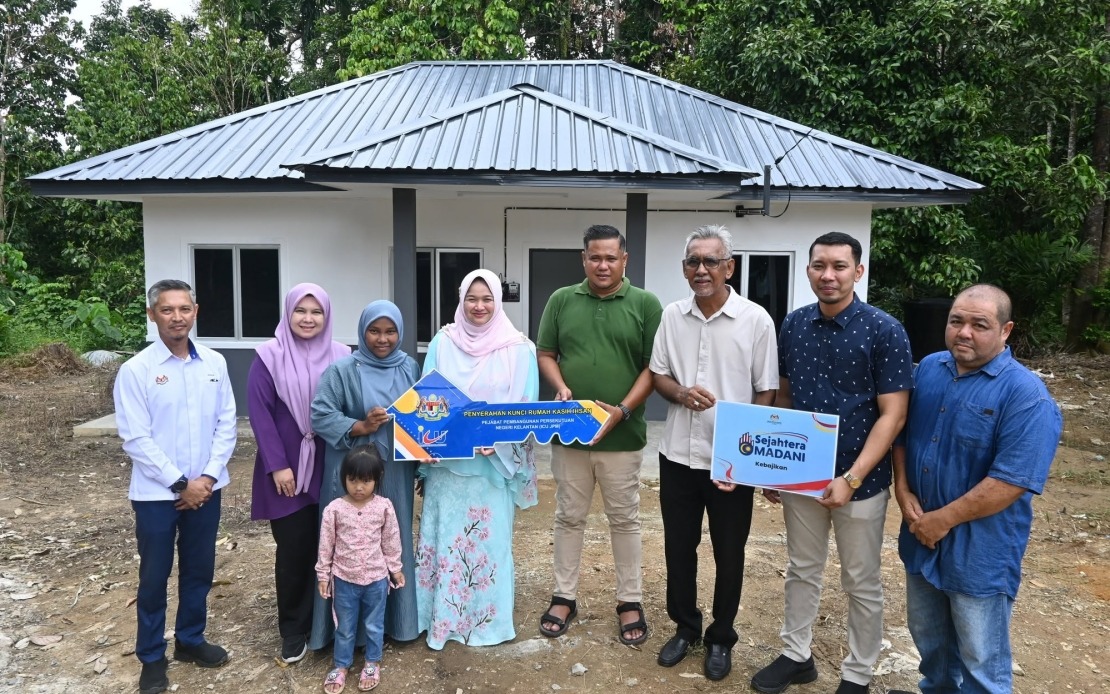
The Malaysian government is intensifying efforts to uplift household welfare standards across the country through targeted housing interventions, with the latest milestone achieved in Kelantan. Prime Minister Datuk Seri Anwar Ibrahim oversaw the handover of Rumah Kasih Ihsan units to deserving families in Jeli, reflecting a strategic emphasis on providing safe, dignified living environments for those most in need.
The Kelantan Implementation Coordination Unit (ICU) under the Prime Minister's Department (JPM) executed the distribution, addressing acute housing deficiency in the district. Two recipients benefited from the scheme this week: Yusof Mohamed Nawawi in Kampung Renyut received formal approval to construct a replacement home that meets contemporary safety standards, while Shamsul Bahri Che Musa took possession of a newly completed dwelling. The coordination was facilitated through the PMX Coordination Team, with Dr Wan Nur Ibtisam Wan Ismail, director of Kelantan ICU JPM, formally presenting the keys and acceptance letters.
This initiative represents a departure from conventional top-down development paradigms that prioritize infrastructure expansion without necessarily translating benefits to the ground level. Rather than viewing housing provision through purely economic or statistical metrics, the programme consciously positions shelter as foundational to human dignity and socioeconomic mobility. Recipients were also furnished with food baskets, signalling a holistic rather than compartmentalized approach to household welfare support.
For Malaysia's regional standing, such targeted interventions carry significance beyond immediate beneficiaries. Southeast Asian nations increasingly benchmark welfare delivery systems against inclusive growth indicators. Kelantan, historically among the country's lower-income states, has witnessed inconsistent service delivery despite being a long-established administrative region. The revival of coordinated housing efforts here sends a signal that the federal apparatus recognizes gaps in state-level capacity and is recalibrating resource deployment accordingly.
The philosophical framing by Kelantan ICU JPM—that development's authenticity lies in tangible improvements to citizens' lived experience—challenges the convention of measuring progress solely through GDP or infrastructure density. A secure home, this reasoning suggests, generates psychological and economic foundations that cascade into educational achievement among children, improved health outcomes, and reduced vulnerability to economic shocks. For families previously inhabiting substandard structures, the transition carries implications that extend far beyond shelter provision.
Jeli district has historically presented particular challenges. The predominantly rural character of the constituency means that government services, including housing support, face logistical complications absent in urban settings. Geographic dispersion of eligible recipients, limited local administrative resources, and competing development priorities have meant that housing schemes sometimes remain aspirational rather than operationalized. The concrete handovers announced this week suggest that centralized coordination through ICU structures is beginning to overcome such friction points.
The timing of these distributions coincides with evolving conversations about Malaysia's social safety net architecture. Policymakers across the region are grappling with how to balance fiscal sustainability against expanding welfare obligations as urbanization accelerates and traditional kinship-based support systems attenuate. Malaysia's approach—channelling resources through federal coordination units rather than delegating entirely to state apparatus—reflects pragmatic recognition that capacity constraints at state level can impede execution, particularly in less-resourced administrations.
Stakeholders examining Malaysian governance will note the emphasis on documentation and formality: acceptance letters, ceremonial handovers, and attributed public recognition. Such visible rituals serve multiple functions—they create accountability benchmarks, generate public awareness that schemes are operational rather than dormant, and provide recipients with formal proof of entitlements useful for accessing complementary services. In contexts where informal settlements proliferate partly due to documentation gaps, this procedural clarity carries practical weight.
The Rumah Kasih Ihsan framework appears to operate with flexibility regarding modality: for one recipient, it enabled new construction on existing land, while for another it involved completed unit transfer. This adaptability to local circumstances—whether families own land suitable for reconstruction or require turnkey solutions—enhances programme utility. Rigid schemes often falter against the heterogeneity of household situations; Jeli's experience suggests that tailored deployment can surmount such obstacles.
For comparative perspective, housing affordability crises affect numerous middle-income Southeast Asian economies. Thailand, Indonesia, and the Philippines wrestle with urban housing backlogs and rural substandard structures. Malaysia's explicit governmental engagement with residential inadequacy, through named programmes with coordinated delivery mechanisms, positions it within a cohort of nations acknowledging that market forces alone will not resolve welfare housing requirements. The visibility of Prime Minister-level oversight, while potentially performative, also signals political commitment to the issue's legitimacy.
Looking forward, the scalability question becomes central. Two households in Jeli represent progress, yet national housing deficiency remains substantial. The efficiency with which ICU structures can multiply such interventions—whether the model proves replicable across all districts, or whether local variations require customization—will determine whether this represents sustained policy architecture or isolated demonstration. Kelantan's experience will inform whether other states adopt similar coordination structures or whether the federal approach requires recalibration.
The underlying assertion that meaningful development encompasses household welfare, not merely aggregate economic metrics, aligns with international development discourse increasingly critical of growth-centric approaches. For Malaysian policymakers and regional observers, the Jeli handovers validate that targeted interventions addressing basic human needs remain defensible policy priorities, capable of co-existing alongside broader macroeconomic frameworks. Whether this philosophy translates into systematic programmatic expansion remains to be assessed.

