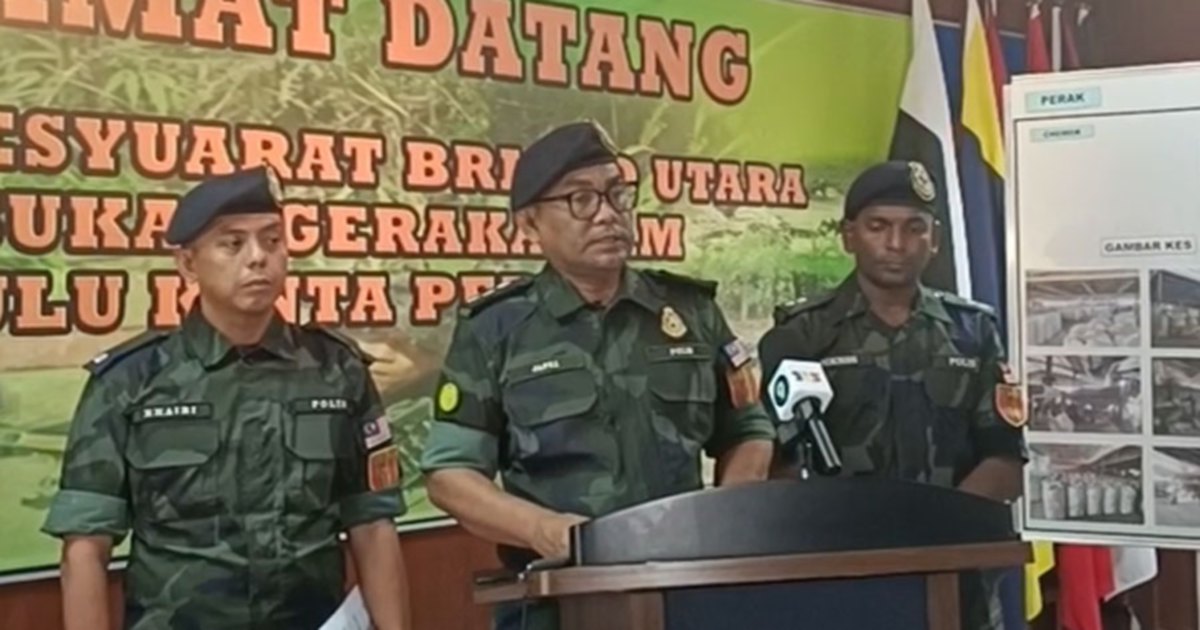
Federal and state authorities have delivered a substantial blow to illegal mining networks operating in the northern peninsular states, with the General Operations Force Northern Brigade concluding a coordinated enforcement operation that resulted in the arrest of 30 individuals and the seizure of extractive materials and industrial equipment valued at RM31.7 million across Perak and Kedah. The operation underscores the persistent challenge posed by unregulated mineral extraction in Malaysia's northern regions and signals intensified governmental efforts to curb operations that circumvent proper licensing and environmental safeguards.
Illegal mining and unregulated mineral processing have become increasingly sophisticated criminal enterprises across Malaysia. These operations frequently involve transnational networks that extract valuable minerals including tin, bauxite, and rare earth elements destined for both domestic and export markets. The Perak and Kedah corridor has emerged as a particular hotspot for such activities, driven by the availability of mineral deposits, relatively dense forest coverage that provides operational concealment, and established supply chains linking to processing and distribution hubs throughout Southeast Asia. For Malaysian stakeholders, the proliferation of these operations carries implications beyond law enforcement—environmental degradation from improper extraction, water contamination from processing chemicals, and community displacement in mining-adjacent areas represent significant collateral consequences.
The scale of the seized assets—both the raw mineral stockpiles and the industrial processing machinery—suggests an operation of considerable organizational complexity. Processing equipment alone commands substantial investment, indicating that those involved had secured significant capital and maintained operational infrastructure across multiple sites. The mineral quantities confiscated reflect not a one-off extraction effort but rather an established supply chain with accumulated inventory awaiting distribution or onward processing. This finding aligns with law enforcement intelligence suggesting that illegal mining in the region often involves layered organizational structures with distinct roles spanning extraction, processing, transportation, and commercialization.
Perak's geography and historical status as a tin-producing state have made it particularly vulnerable to mineral extraction crimes. The state contains extensive reserves of economically valuable minerals, remnant mining landscapes that can be exploited with minimal additional earthmoving, and degraded forest areas where detection remains challenging. Kedah's positioning on the northern border further complicates enforcement, as criminal networks can exploit cross-border movement to shift operations opportunistically or to receive inputs and dispatch outputs through alternative routes. The two-state scope of this operation indicates that authorities recognized these activities as a coordinated enterprise rather than localized incidents, prompting a region-wide response.
Detaining 30 suspects represents a meaningful disruption to operational continuity, though the downstream consequences of these arrests will depend significantly on prosecution outcomes and sentence severity. Malaysian courts have increasingly recognized illegal mining as a serious economic crime affecting national resource management and environmental preservation. However, sentencing disparities and case backlogs within the judicial system sometimes result in reduced deterrent impact. For would-be participants in these networks, arrest certainty and punishment severity constitute the primary disincentives. The GOF operation therefore contributes to a broader strategy of elevating perceived risk, though maintaining sustained enforcement momentum remains essential to prevent operational reestablishment.
The monetary valuation of confiscated materials—RM31.7 million—offers insight into the profit incentives driving illegal mining expansion. At global commodity prices, this volume of minerals represents substantial returns available to criminal networks after accounting for extraction, processing, and transportation costs. The appeal intensifies when compared to legitimate livelihood alternatives available to individuals in rural areas of Perak and Kedah, where agricultural incomes have stagnated and formal employment opportunities remain limited. This structural vulnerability to recruitment by illegal mining operators suggests that effective longer-term countermeasures must address not only law enforcement but also rural economic development and livelihood diversification.
Environmental rehabilitation of illegal mining sites presents a parallel concern that extends beyond criminal liability. Unregulated extraction creates degraded landscapes featuring unstable slopes, compromised hydrological patterns, and soil contamination. The costs of restoration typically far exceed the profits extracted, effectively representing a transfer of environmental debt from criminal operators to the state and affected communities. Water bodies contaminated through processing operations impact agricultural users downstream and threaten public health in populated areas. These externalities have prompted environmental organizations and community groups to advocate for stronger preventive measures and for holding operators financially accountable for remediation.
The GOF Northern Brigade's operational reach across multiple jurisdictions reflects the institutional capacity and inter-agency coordination increasingly evident in Malaysian enforcement. Successful multi-state operations depend on information sharing between federal and state enforcement bodies, intelligence integration, and synchronized enforcement timing to prevent suspects or assets from relocating ahead of enforcement actions. The scale and apparent efficiency of this operation suggests improved institutional communication and resource allocation within the security apparatus. This capacity development remains critical as criminal networks continue evolving operational methodologies to evade detection.
Regional implications extend across Southeast Asia, where similar illegal mining activities destabilize neighboring states and feed into transnational commodity networks. Materials extracted illegally in Malaysia may be processed in Thailand or Vietnam, mixed with legitimate production, and exported globally, complicating the ability of international commodity markets to identify and exclude illegally sourced minerals. This regional dimension has prompted dialogue between Malaysian authorities and counterparts in neighboring countries regarding intelligence sharing and coordinated enforcement, though substantive coordination remains incomplete. Malaysia's domestic crackdowns therefore constitute one component of a broader regional challenge requiring sustained multilateral cooperation.
Looking forward, the sustainability of anti-illegal mining enforcement depends on adequate resource allocation, technological infrastructure for detection and monitoring, community reporting mechanisms, and coordinated judicial responses that impose meaningful consequences on convicted operators. The significant asset seizures demonstrate that enforcement activity can disrupt operational logistics, yet preventing network reformation requires continued vigilance and proactive rather than reactive enforcement approaches. For Malaysian policymakers, balancing resource-sector development with environmental stewardship and community welfare remains a central challenge in regions endowed with mineral wealth but vulnerable to exploitation by criminal enterprises operating outside regulatory frameworks.

