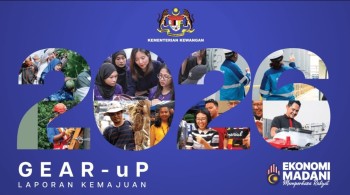
The Government-Linked Enterprises Activation and Reform Programme (GEAR-uP) has entered its third year of operation with a dramatic scaling-up of investment activity, as six major government-linked investment companies channelled RM20.3 billion into the domestic economy during 2025 — roughly three times the RM6.6 billion deployed in the previous year. The acceleration marks a significant milestone in what Prime Minister Datuk Seri Anwar Ibrahim has characterised as a shift from capital seeking passive returns to "national wealth mobilised with national purpose," with momentum expected to continue into the first quarter of 2026.
Launched in 2024 by the Ministry of Finance, GEAR-uP represents an ambitious five-year commitment to unlock RM120 billion and drive comprehensive socioeconomic reforms whilst accelerating Malaysia's industrial transformation. The programme operates through six anchor institutions: Khazanah Nasional Bhd, the Employees Provident Fund (EPF), Permodalan Nasional Bhd (PNB), Kumpulan Wang Persaraan (Diperbadankan) (KWAP), Lembaga Tabung Angkatan Tentera (LTAT), and Lembaga Tabung Haji (TH). This institutional architecture reflects a deliberate strategy to harness the collective investment firepower of Malaysia's largest pools of institutional capital to drive systemic economic change across multiple sectors simultaneously.
The deployment activity spans several high-impact initiatives that underscore the programme's commitment to building enduring economic capability. KWAP's backing of Google's Selangor data centre project exemplifies this approach, with the facility projected to generate 320 megawatts of additional capacity and create 26,500 jobs through 2026 and 2027. Running parallel to this initiative is Empyrion Digital's phased expansion in Johor, suggesting a coordinated strategy to position Malaysia as a competitive hub for critical digital infrastructure in Southeast Asia at a time when regional demand for data centre capacity continues to surge.
On the enterprise development front, GLIC-managed investment funds including Dana Impak, Dana Perintis, Dana Pemacu and Ekuinas are actively shepherding companies through the venture-to-growth transition pipeline. This venture capital function becomes increasingly important as Khazanah prepares to launch Dana Ciptawan, a dedicated RM200 million fund targeting Bumiputera enterprises and mid-tier Malaysian firms. The tiered approach to capital provision addresses a critical gap in Malaysia's investment ecosystem, where many promising domestic companies struggle to secure growth capital once they outgrow seed-stage funding but lack the scale to attract conventional institutional investors.
The broader corporate sector is benefiting from renewed focus on value creation, with government-linked companies (GLCs) tracking towards RM100 billion in additional market value by 2028. The expansion of the MY Value Up discipline to Malaysia's 88 largest listed companies signals an intention to embed performance standards across the corporate ecosystem. These efforts gain urgency given the Capital Market Masterplan's target of achieving RM5.8 trillion to RM6.3 trillion in market capitalisation by 2030, a goal that depends fundamentally on maintaining a healthy pipeline of growth companies and ensuring that institutional investors continue to find compelling domestic investment opportunities.
Infrastructure modernisation represents another critical pillar of GEAR-uP deployment, with substantial investments flowing into energy and transport systems that underpin broader economic activity. Tenaga Nasional Bhd's (TNB) grid investment programme continues its expansion under Regulatory Period 4, climbing from RM12 billion in 2025 towards RM15 billion in 2027 as Malaysia works towards its target of achieving 70 per cent renewable energy in installed capacity by 2050. Concurrently, Malaysia Airports is executing a five-year upgrade programme valued at RM11 billion, with Kuala Lumpur International Airport's (KLIA) capacity planning oriented towards accommodating over 100 million annual passengers. These investments address the reality that Malaysia's existing infrastructure, particularly in aviation and energy transmission, requires substantial modernisation to support rising economic activity and population growth.
Bumiputera wealth creation and enterprise development constitute distinct strategic priorities within the GEAR-uP framework. The programme targets ten company listings over 2026-2027, underpinned by the 10 Bumiputera Champions Programme, which provides structured support to scale homegrown enterprises capable of competing at regional and international levels. Zakat Wakalah, the Islamic social finance mechanism, is targeted to reach RM100 million in deployment by 2026, up from RM28 million the prior year, reflecting an intention to mobilise faith-based capital for developmental purposes. These initiatives address historical concerns about wealth concentration and access to capital within the Bumiputera community, embedding inclusive growth principles directly into the investment programme's operational design.
Minister of Finance II Datuk Seri Amir Hamzah Azizan has articulated a vision of GEAR-uP that transcends conventional metrics, emphasising that capital deployment must translate into tangible livelihood improvements for ordinary Malaysians. He stressed that the programme measures success not merely in ringgit deployed but in living wages adopted, graduates placed in quality employment, Bumiputera firms scaled to regional competitiveness, and supply chains anchored on Malaysian soil. This framing reflects recognition that infrastructure investment and capital reallocation lack political legitimacy unless ordinary citizens perceive material improvements in their employment prospects, income security, and economic opportunity. The emphasis on job quality rather than quantity alone distinguishes GEAR-uP from earlier infrastructure initiatives that sometimes generated temporary construction employment without creating sustained career pathways.
The programme's strategic positioning acknowledges the challenging external environment in which Malaysia currently operates. Global volatility and ongoing reshaping of trade relationships create unpredictability for export-dependent economies across Southeast Asia. The GEAR-uP Progress Report notes that Malaysia's ability to navigate recent external turbulence derived substantially from reform efforts undertaken in 2023, underscoring how macroeconomic fundamentals and domestic policy credibility influence private sector confidence and investment flows. By directing government-linked capital towards priority sectors and demonstrating decisive policy execution, GEAR-uP sends market signals about the government's commitment to structural economic improvement, potentially crowding in private investment that might otherwise remain cautious in uncertain global conditions.
The tripling of annual deployment from RM6.6 billion to RM20.3 billion raises important questions about capital allocation discipline and returns on investment. The report notes that the GLIC portfolio delivered an aggregate shareholder return of 8.0 per cent in 2025, a respectable figure that suggests investment decisions are being subjected to rigorous financial analysis rather than pure subsidy logic. However, the rapid scaling of deployment volumes will require sustained institutional capacity to identify and execute quality investments, particularly given the emphasis on transformative projects that carry higher technical complexity and longer payback horizons than conventional treasury investments. Success will depend on whether GLICs can maintain disciplined underwriting standards as deployment accelerates.
For Malaysian readers, the implications of GEAR-uP's acceleration extend beyond headline investment figures. The programme's focus on data centre capacity, renewable energy infrastructure, and enterprise development directly addresses competitive pressures Malaysia faces from neighbours like Singapore, Thailand, and Vietnam in attracting high-value foreign investment and developing indigenous entrepreneurial capacity. Job creation projections, particularly the 26,500 positions linked to Google's data centre alone, offer concrete examples of how strategic capital deployment translates into employment. For Bumiputera entrepreneurs, the dedicated funds and listing initiatives represent genuine pathways to scale businesses beyond family ownership. For employees, TNB's grid modernisation and airport expansion signal long-term economic growth that supports wage growth and career advancement in critical infrastructure sectors.
The stated commitment to staying the course through 2026 and beyond carries implicit recognition that transformative economic reform operates on timescales extending beyond electoral cycles or quarterly reporting periods. GLICs and government-linked companies have signalled their intention to maintain deployment discipline and allow investments time to mature and generate returns. Whether GEAR-uP ultimately succeeds in reshaping Malaysia's growth trajectory will become apparent only as current investments mature and their wider economic impacts accumulate. The programme's emphasis on building enduring capability rather than chasing short-term returns positions it as a genuine structural reform initiative, though outcomes will ultimately be measured by whether ordinary Malaysians perceive improvements in their economic circumstances and opportunity sets over the coming years.

