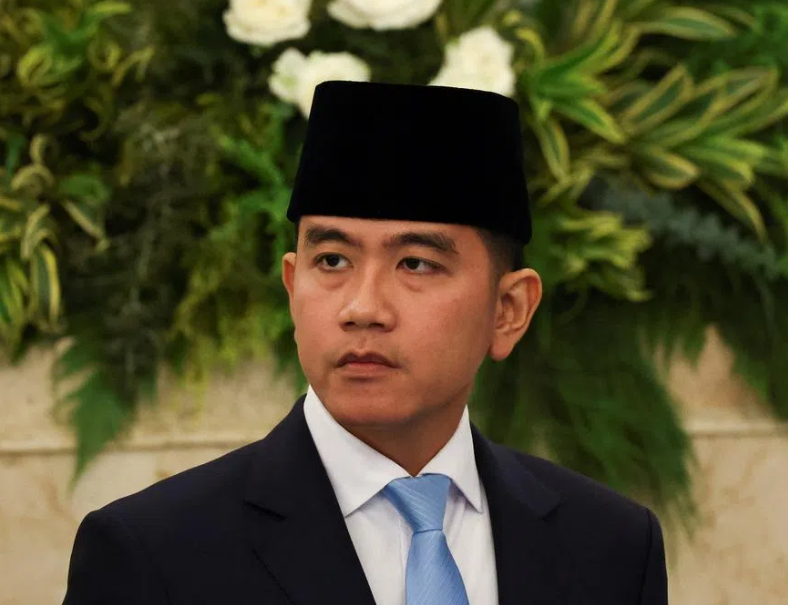
Indonesia's Vice-President Gibran Rakabuming Raka has thrust himself into the centre of mounting student protests against two of the government's most contentious programmes—free meals for schoolchildren and the Red and White Cooperative initiative—by personally meeting with student representatives and later inviting five activists to join him on a working visit to eastern Indonesia on June 18. The move signals an attempt to redefine his role within the administration while capitalising on widespread public discontent, yet observers remain divided on whether the gesture reflects substantive engagement or calculated political positioning.
The initiative emerged just three days after Gibran held a private meeting with student leaders protesting against the government's signature initiatives. In a statement released by his office, Muhammad Abdi Maludin, a leader from Bung Karno University, characterised the Vice-President as receptive to their research findings and concerns. Gibran pledged to audit the students' findings and escalate them to President Prabowo Subianto, creating an impression of openness to policy recalibration. However, the carefully orchestrated nature of the engagement immediately drew scrutiny from both social media critics and academic observers who questioned whether the students selected genuinely represented Indonesia's broader student movement.
Online reactions to Gibran's public announcement of the meeting proved decidedly mixed. Commenters criticised the Vice-President's choice of participants, noting that invitations to representatives from Indonesia's largest and most prominent universities might have lent greater credibility to the exercise. One commenter suggested that excluding top-tier institutions made the engagement appear contrived rather than organic. These observations carried weight given that activists from major campuses had spearheaded much of the recent protest momentum against government policies.
The involvement of student protesters presents a delicate positioning opportunity for the 38-year-old Vice-President at a moment when sustained criticism of flagship government programmes has intensified alongside multiple corruption scandals. Researchers at Jakarta's Center for Strategic and International Studies, including Nicky Fahrizal, frame Gibran's strategy as cultivation of a public persona centred on accessibility and willingness to dialogue with ordinary citizens. However, analysts also note that such image-building activity appears deliberately timed ahead of Indonesia's 2029 presidential election cycle, with speculation mounting that Gibran might eventually enter the race despite maintaining public silence on the matter.
Yet beneath the surface engagement lies a fundamental structural reality that limits Gibran's capacity to effect substantive change. Since assuming office alongside President Prabowo in October 2024, Gibran has largely remained peripheral to major policy decisions despite nominal involvement in high-profile assignments related to Papua development and the new capital Nusantara. Unlike some predecessors, he has received no major policy portfolio, leaving him without formal authority over the programmes now dominating public discussion. The free meals initiative remains under direct presidential oversight through the National Nutrition Agency, while the Red and White Cooperative programme operates as a presidential priority coordinated across multiple ministries and agencies reporting directly to Prabowo.
The timing of Gibran's outreach coincided notably with escalating scandal surrounding the free meals programme. In June, National Nutrition Agency chief Dadan Hindayana was replaced and subsequently arrested alongside two former deputies as authorities investigated alleged procurement irregularities. During his visit to East Nusa Tenggara on June 18, Gibran acknowledged governance shortcomings in the programme and called for improvements, while instructing officials to accelerate implementation in areas with completed infrastructure. These actions suggested an effort to address public anger through administrative adjustments rather than fundamental programme redesign.
Academic observers including Edbert Gani Suryahudaya of CSIS interpret Gibran's expanded visibility as a calculated strategy to appear responsive to public concerns without necessarily possessing the institutional authority to implement major policy shifts. This distinction matters considerably, as Gibran's engagement risks appearing performative—a low-cost method of maintaining public attention during a period when he occupies an ill-defined position within government structures. The strategy prioritises relevance and visibility over substantive policy influence, allowing the Vice-President to project responsiveness without committing to transformative change.
Troublingly, discrepancies between public narrative and private arrangements emerged within days of the palace meeting. By June 23, Indonesian news outlets reported that student participants had received substantial cash payments following their engagement with Gibran. One leader from Bung Karno University acknowledged receiving 20 million rupiah, while other attendees reported sums ranging from 2 to 2.5 million rupiah. The source and justification for these payments remain unexplained, with the Presidential Palace claiming to investigate the matter. Such revelations substantially undermine Gibran's framing of the encounter as genuine dialogue between government and authentic grassroots critics, instead suggesting coordination orchestrated through financial incentives.
University of Padjadjaran researcher Irman Lanti emphasised that Gibran's growing public association with both programmes masks his actual minimal involvement in their formulation and implementation. According to Lanti's assessment, the free meals and cooperative initiatives remain primarily controlled by military and police institutions, with Gibran largely sidelined from substantive decision-making. This observation aligns with broader patterns of the Vice-President attempting to claim relevance by visibly responding to protest movements rather than exercising genuine administrative authority. Lanti characterised Gibran's approach as deliberate attempt to prove his worth by positioning himself as intermediary between student activists and presidential leadership, despite lacking formal mechanisms to influence the outcomes these students demand.
The episode reflects broader challenges facing the Indonesian vice-presidency as an institution. Historically, the role has alternated between being a genuine deputy with defined responsibilities and serving as a ceremonial or marginal position dependent on presidential allocation of authority. Gibran's current position appears closer to the latter arrangement, leaving him to manufacture relevance through public engagement and responsive gestures. This dynamic creates incentives for the Vice-President to pursue visibility-generating activities even when substantive policy change remains improbable, potentially explaining the apparent coordination evident in both the student meeting and subsequent financial transactions.
For Malaysian observers and Southeast Asian analysts tracking Indonesian political developments, Gibran's manoeuvres signal important questions about governance, institutional accountability, and the evolving relationship between student activism and state authority. The Vice-President's engagement demonstrates both the genuine mobilising power of student movements and the sophisticated strategies through which governments attempt to neutralise criticism through co-optation and performative responsiveness. Whether Gibran can eventually translate current positioning into increased influence within the Prabowo administration remains uncertain, but his willingness to engage students directly—however strategically—suggests that sustained protest pressure does force government attention to public grievances.
The broader implications extend beyond Indonesia's domestic politics. As student movements across Southeast Asia increasingly challenge government policies on education, economics, and governance, the mechanisms through which state officials respond deserve careful examination. Gibran's approach—combining apparent openness with limited actual authority, coupled with financial inducements of dubious legitimacy—offers a cautionary template for how governments might attempt to channel dissent without fundamentally altering policies or power structures. For student activists throughout the region, the Indonesian experience underscores the importance of maintaining independent organising capacity and remaining sceptical of individual officials offering dialogue without accompanying institutional reform.