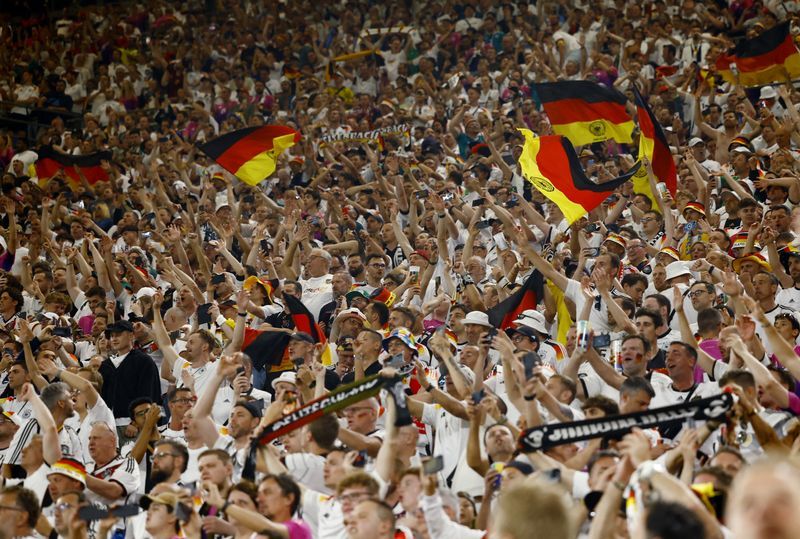
German law enforcement agencies launched coordinated search operations across the country on Wednesday, targeting multiple locations including the headquarters of the Deutscher Fußball-Bund (DFB), amid an expanding investigation into alleged improprieties surrounding the allocation of tickets and hospitality packages at the 2024 European Football Championship. The raids represent a significant development in what authorities describe as a probe into unauthorized distributions of access and benefits connected to the tournament, which took place across ten German cities earlier this year.
Prosecutors based in Bochum, working in collaboration with criminal investigators from North Rhine-Westphalia state, confirmed that searches were being conducted at several sites throughout Germany without initially providing specific details about the DFB's involvement. However, the Bild newspaper reported that the football association's offices were among the locations subjected to investigation, signalling the breadth and seriousness of the authorities' inquiry into potential violations of regulations governing ticket distribution and guest privileges for the continental championship.
The investigation centres on a scheme involving hotel reservations and thousands of match tickets that reportedly may have been distributed outside official channels to select individuals prior to the tournament. According to reporting from Bild, the allocation process appears to have circumvented standard procedures, with tickets and hospitality amenities being directed to preferred recipients rather than through legitimate sales or allocation mechanisms. This pattern of irregular distribution raises questions about accountability within Germany's football governance structures and the oversight mechanisms meant to prevent such irregularities at major sporting events.
Among those under investigation is a municipal employee working in Gelsenkirchen, one of the ten host cities for Euro 2024, who is suspected of receiving benefits including match tickets, travel arrangements, and hotel accommodation valued at approximately €2,400. This figure provides concrete evidence of the scale of individual benefits distributed through what authorities consider unauthorized channels. The inclusion of a local government worker in the inquiry suggests that the scheme may have involved leveraging official positions to gain preferential access to tournament resources, a concern that extends beyond football administration into broader questions of public integrity.
Investigators are also examining the conduct of a French national, among other individuals yet to be publicly identified, indicating that the suspected violations may have extended beyond Germany's borders. This international dimension complicates the investigation and may involve coordination with French authorities to establish the full scope of the alleged improprieties. The involvement of foreign nationals raises questions about whether the scheme was part of a more organized effort or represented isolated instances of individuals exploiting their connections to secure tournament benefits.
The formal statement issued by prosecutors characterizes the matter as an investigation into what they describe as "unauthorized advantages, including a visit to an international football match." This legal framing suggests that authorities are treating the case not simply as administrative mismanagement but as potential criminal conduct involving the unauthorized provision of benefits. The language employed in official statements indicates that prosecutors believe the distribution of tickets and hospitality constitutes a breach of regulations that may rise to the level of criminal wrongdoing rather than mere procedural violations.
For Malaysian observers and Southeast Asian sports governance practitioners, this development carries significant implications regarding stadium management and tournament administration standards at continental-level competitions. The investigation underscores the vulnerability of major sporting events to internal abuse of allocative authority, even in highly developed footballing nations with established institutional frameworks. The case demonstrates that no federation, regardless of its resources or reputation, is automatically insulated from scrutiny when it comes to the distribution of valuable tournament assets like match tickets and hospitality packages.
The DFB, which has historically maintained a prominent position within European football's administrative hierarchy, now faces public scrutiny over its internal control mechanisms and the oversight systems designed to ensure transparent and equitable ticket distribution. The organization declined immediate comment when approached by news organizations, a response that may reflect either ongoing legal consultations or the sensitivity surrounding an active investigation into its operations. This silence, while understandable from a legal perspective, nonetheless contributes to uncertainty about the federation's accountability structures and whether measures exist to prevent similar incidents in future tournaments.
UEFA, European football's governing body, similarly did not immediately provide comment on the investigation, despite the championships falling under its jurisdiction and authority. UEFA's apparent distance from the inquiry at this initial stage raises questions about the oversight mechanisms employed by continental football bodies when host nations conduct investigations into tournament-related matters. The European federation's involvement in ensuring compliance with regulations governing ticket distribution and hospitality provision represents an important dimension of tournament governance that remains unclear from publicly available information.
For stakeholders involved in hosting major sporting events across Southeast Asia and beyond, this investigation serves as a cautionary reminder about the necessity of establishing robust internal controls and transparent processes for resource allocation during tournaments. The case demonstrates how the distribution of valuable assets like premium match tickets and hospitality experiences can become vectors for corruption or unauthorized advantage if adequate oversight mechanisms are not embedded into tournament planning and execution. As countries across the region continue to bid for and host international sporting competitions, the German experience provides instructive lessons about the importance of anticipating and preventing the types of irregularities that have now triggered a criminal investigation.
Investigators in Bochum declined to elaborate further on the specifics of their inquiry or provide timelines for expected developments, leaving significant aspects of the case shrouded in ongoing secrecy. The investigation remains active and developing, with authorities presumably gathering evidence and conducting interviews to determine the full extent of any violations and the individuals or entities potentially culpable. As the probe continues, additional details are likely to emerge that may clarify the mechanisms through which tickets were allegedly distributed and the extent to which senior officials within football's administrative structures were aware of or participated in the irregular allocation process.

