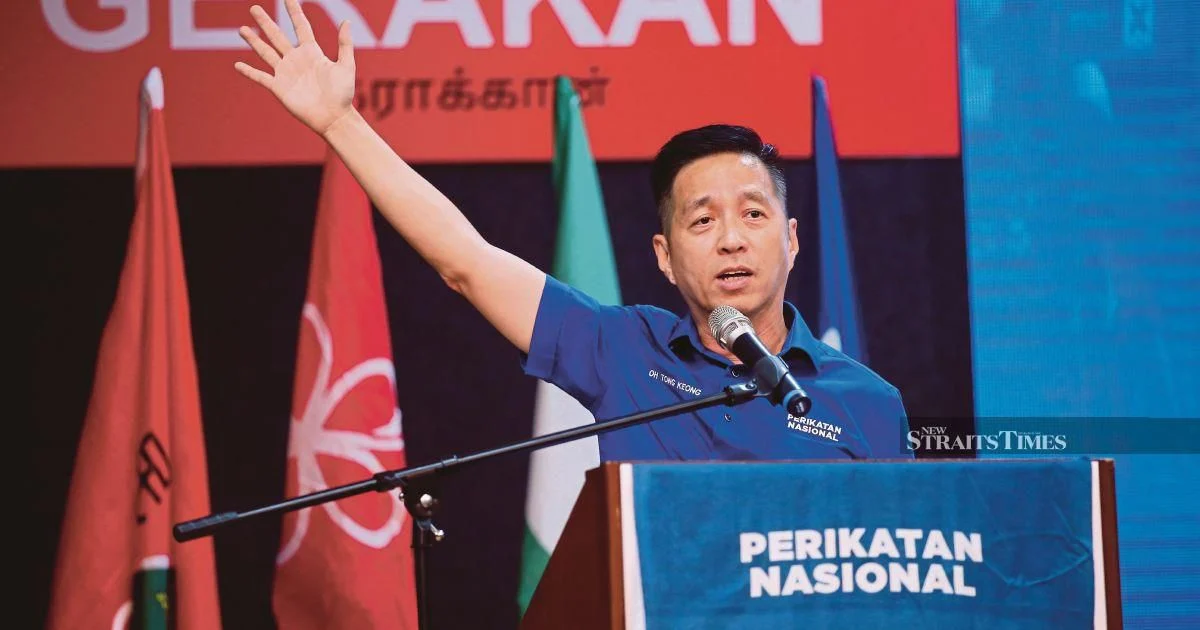
Gerakan has stepped back from contesting the Johor state election, shifting its political strategy to bolster the election campaigns of Perikatan Nasional component parties instead. The decision was announced by party election director Oh Tong Keong, signalling a tactical recalibration within the broader right-wing coalition that has gained considerable traction across Malaysia's east coast and northern states over the past three years.
The withdrawal represents a pragmatic reassessment by Gerakan, a party that has historically struggled to maintain electoral relevance outside its traditional strongholds in Penang and parts of the central peninsula. By declining to field candidates in Johor, the party avoids the prospect of splitting the opposition vote in constituencies where PN-backed candidates might otherwise perform strongly. This manoeuvre underscores the reality that Malaysia's fractious political landscape often demands calculated compromises among allied parties seeking to maximise their collective representation.
Johor holds particular significance in Malaysian politics as one of the country's largest and most developed states, second only to Selangor in economic output and population. Control of the state assembly carries substantial administrative and fiscal power, making electoral success there a priority for any coalition aspiring to influence national politics. Perikatan Nasional's grip on Johor has been consolidating since the 2022 general election, and Gerakan's withdrawal effectively acknowledges PN's dominant position within the alliance structure.
The decision also reflects internal party calculations about resource allocation. Smaller parties in coalition arrangements must weigh the costs of running their own campaigns—financial expenditure, volunteer mobilisation, and organisational strain—against the strategic value of contesting in unfavourable territory. For Gerakan, which commands limited grassroots machinery compared to larger PN partners such as Bersatu and PAS, concentrating efforts on supporting established candidates proves more efficient than attempting to build electoral traction from scratch.
From a broader coalition perspective, Gerakan's withdrawal serves to streamline campaign messaging and reduce the fragmentation that often plagues multi-party alliances. When numerous parties compete in the same constituencies, confused voters may split their support unpredictably, and parties exhaust resources competing against allies rather than adversaries. By consolidating behind PN candidates, Gerakan helps present a unified front that voters can recognise and support more readily, potentially amplifying the coalition's overall performance.
The timing of this announcement carries implications for Malaysian electoral dynamics more generally. Johor elections frequently serve as bellwethers for national political sentiment, with their results influencing calculations ahead of federal polls. A coordinated and unified PN showing in Johor could reinforce the coalition's claims to be a stable governing force, potentially swaying undecided voters nationally and strengthening its negotiating position should post-election coalition arrangements become necessary.
Gerakan's strategic positioning within PN also warrants examination. The party has sought to maintain relevance by presenting itself as a moderate, business-friendly alternative to more ideologically driven partners. By supporting PN candidates rather than competing directly, Gerakan can preserve this centrist positioning while still demonstrating loyalty to the coalition—a balancing act that smaller parties must constantly perform to avoid marginalisation yet maintain distinctive identity.
The announcement raises questions about Gerakan's long-term electoral viability. The party's repeated inability to contest competitively in multiple states could gradually erode its organisational capacity and public profile. However, this strategy also hedges against the risk of humiliating electoral defeats that might further diminish the party's standing. For Gerakan, symbolic support for coalition partners may prove more valuable than costly but futile candidatures.
For Malaysian voters, particularly those in Johor, this development means a cleaner ballot in many constituencies, with less competition among opposition-aligned parties. This could genuinely clarify electoral choices, though it also removes alternative voices and candidates who might have offered different perspectives or leadership approaches within the broader anti-establishment camp.
The move illustrates how Malaysian coalition politics operate in practice. Parties must constantly negotiate territorial arrangements, candidate selection, and campaign support to optimise collective outcomes. Such behind-the-scenes coordination rarely receives public attention, yet profoundly shapes electoral results and determines which combinations of parties ultimately govern states and the nation.
As Johor prepares for elections, Gerakan's withdrawal signals confidence—or at least acceptance—that PN partners are positioned to advance the coalition's interests effectively. Whether this proves strategically wise depends on PN's actual electoral performance and whether Gerakan's self-restraint is rewarded with meaningful cabinet positions or policy influence in subsequent state governance arrangements. For now, the party is betting that collective coalition success serves its interests better than individual electoral ambition.

