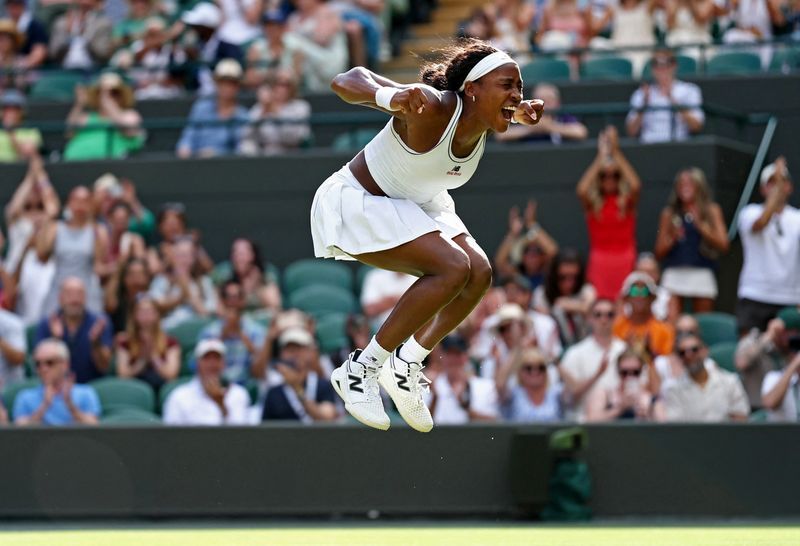
Two-time Grand Slam champion Coco Gauff narrowly escaped an early exit from Wimbledon, rallying past Argentina's Solana Sierra 6-3 3-6 7-6(10-7) in a tension-filled tiebreak on Wednesday to secure her place in the third round. The American seventh seed delivered a masterclass in composure under pressure, particularly in the decisive final set, where she erased a deficit to claim victory on Court One and keep her campaign alive at the only major tournament where she has yet to progress beyond the fourth round.
Gauff's path to victory was far from straightforward. She began authoritatively, dominating the opening set with her powerful groundstrokes and efficient movement. However, her form deteriorated dramatically in the second set, where she appeared rattled following an unusual moment when one of her serves sailed sideways into the umpire's chair—an uncharacteristic lapse that seemed to undermine her confidence and rhythm on grass.
Sierra, ranked 56th globally and notably the player who became the first lucky loser to reach the women's final 16 at Wimbledon in the Open era just last year, seized the momentum with clinical efficiency. Breaking Gauff to love immediately, the Argentine forged ahead 2-0, then constructed a 4-1 advantage that forced the match into a deciding set. Her direct entry into the tournament this year reflected her improved standing, yet her performance suggested she remained a legitimate threat to established seeds.
The third set evolved into a grinding battle of attrition where neither player could establish clear dominance. Sierra earned a break point at 1-1, but Gauff extinguished the threat and responded with a devastating 124 mph serve that enabled her to reclaim the initiative at 2-1. The momentum continued to ebb and flow as Sierra saved multiple break points when trailing 2-2 and again at 3-3, demonstrating the resilience that has defined her career trajectory despite her unconventional route to prominence.
Just when Gauff appeared to have seized control, Sierra broke her serve to lead 4-3, shifting the psychological advantage and forcing the American to serve for survival. Gauff held firm at 5-3 and then broke back to restore equilibrium, placing Sierra in a precarious position as the set headed toward a tiebreak. The Argentine's ability to claw back from the brink illustrated why her upset victory as a lucky loser had captured attention, but it would ultimately prove insufficient against Gauff's superior firepower and experience in pressure moments.
The tiebreak itself encapsulated the match's oscillating nature. Sierra established what appeared to be a commanding 7-4 lead, seemingly on the cusp of engineering a shock victory over a player ranked significantly higher. However, Gauff's serving prowess—a weapon she would later emphasize in her post-match reflection—reasserted itself decisively. The American reeled off six consecutive points, demonstrating the mental fortitude required at the highest level of professional tennis. She clinched victory on match point with a 117 mph ace, ending the exhausting encounter with the kind of decisive stroke that epitomizes champions performing when it matters most.
Gauff attributed her recovery to her serve's consistency throughout the contest. In her on-court interview, she acknowledged Sierra's elevated performance, describing their match as a relentless tug-of-war where her Argentine opponent frequently dictated play with aggressive shot-making. Yet she credited her first serve with providing the crucial foundation upon which she could build when defensive positions demanded protection. This technical observation reveals an important dimension of modern tennis strategy: even elite players must occasionally absorb pressure and rely on their fundamental strengths rather than outright domination.
For Malaysian and Southeast Asian tennis enthusiasts, this match carries broader significance within the context of Asian representation at major tournaments. While Gauff's American credentials place her among the tour's elite, her struggle against a relative outsider like Sierra underscores how the sport's competitive landscape continues to democratize. Players from Latin America, Europe, and other regions increasingly possess the tools and preparation to challenge tennis's established hierarchy, creating unpredictable narratives that captivate global audiences.
Gauff's Wimbledon history makes this victory particularly meaningful. The American has found grass courts frustratingly resistant throughout her major tournament career, with her fourth-round barrier suggesting either tactical vulnerabilities specific to fast surfaces or an element of mental resistance at the sport's most prestigious venue. Progressing to the third round represents incremental progress toward breaking through that psychological ceiling. Her serve's dominance in the tiebreak hinted that she may be developing the kind of surface-specific mastery required to eventually challenge for the title at the All England Club.
Sierra's performance, meanwhile, reinforces the adage that Wimbledon's unique conditions and format create opportunities for unexpected deep runs. Her demonstrated ability to break top-ranked players and construct winning patterns suggests her breakthrough year as a lucky loser may establish the foundation for sustained competitiveness rather than representing a one-time anomaly. The tournament's willingness to accommodate lucky losers has occasionally produced compelling underdog narratives, and Sierra's trajectory suggests she belongs among the beneficiaries of these opportunities.

