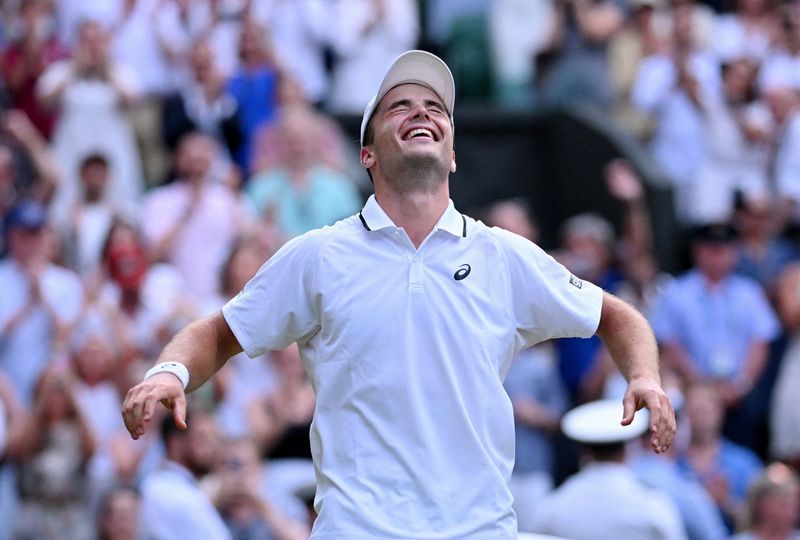
Arthur Fery's path to the Wimbledon semi-finals reads less like a genuine sporting narrative and more like a Hollywood screenplay rejected for being implausibly optimistic. The 23-year-old British wildcard, ranked 114th in the world, has defied conventional wisdom by winning his way through one of tennis's most prestigious tournaments, having arrived at the All England Club with just two previous Grand Slam match victories to his name. His presence in the last four represents not merely an upset but a fundamental challenge to how the sport's hierarchy is understood, particularly in a Wimbledon context where tradition and seeding normally dictate outcomes with mathematical precision.
The narrative becomes even more improbable when examined through personal geography. Fery quite literally grew up in the shadow of Centre Court, having spent his formative years in Wimbledon itself after relocating from France as a child. He attended King's College in the very heart of the tournament's host borough, making his semi-final appearance a homecoming of sorts. This proximity to tennis's greatest stage during childhood, rather than propelling him to automatic stardom, somehow makes his current achievement feel more earned. He walked past these gates countless times as a schoolboy before earning the right to compete upon them as a professional.
On Wednesday, Fery dismantled ninth-seeded Flavio Cobolli with stunning efficiency, recording a 6-4, 7-6(4), 6-0 victory on a sweltering Centre Court. The Italian's capitulation in the third set underscored just how comprehensively the young Briton had seized control of the match. Fery's performance transcended mere tactical superiority; he appeared to expand beyond his modest 5ft 9in frame, retrieving balls that had no reasonable business being reachable and constructing points with the assurance of a veteran. The crowd's energy, channelled through the cauldron-like atmosphere of Centre Court in peak summer heat, seemed to amplify rather than intimidate him. This was only the fifth British man in the professional era to reach a Wimbledon semi-final, a statistic that underscores both the rarity of homegrown success in this tournament and the significance of Fery's achievement.
What separates this run from mere Cinderella narrative is Fery's composure in managing the psychological weight of his own unlikelihood. He watched from Centre Court as Queen Camilla occupied the Royal Box, later recounting with evident delight that the British monarch congratulated him after his victory and offered words of encouragement. Princess Kate had cheered him through an earlier round. Yet Fery responded to these extraordinary circumstances with measured calm, speaking to reporters in considered tones and explicitly noting that the rapid succession of matches worked in his favour because it kept him psychologically contained. He called it staying "in my bubble," a remarkably astute description of the mental discipline required to ignore the mounting pressure and noise surrounding his name.
Friday brings Alexander Zverev, the French Open champion and second seed, into Fery's path. The German represents a qualitative leap in opposition that Cobolli could not have provided. Zverev's pedigree, ranking, and recent major tournament success create an obstacle that would end most fairytale runs. Yet the mathematical possibility remains tantalizingly real: a victory over Zverev would propel Fery into Sunday's final on his 24th birthday. Should he win the championship, he would become only the second player ever to claim the Wimbledon singles title as a wildcard entry, emulating Goran Ivanisevic's achievement from 2001. That Ivanisevic's feat remained singular for more than two decades speaks to its rarity and significance.
Fery's journey to this improbable moment reveals a player who has made deliberate choices about his development. Rather than turning professional immediately, he pursued the American college pathway, matriculating at Stanford University where he majored in science, technology and society while simultaneously becoming the country's top-ranked college player. This education-first approach distinguishes him from many contemporaries and suggests a maturity that extends beyond tennis. His measured responses to questions and his evident comfort with the spotlight hint at someone whose preparation has been thorough rather than accidental. The composed demeanour he displays in the Royal Box or facing down aggressive opponents appears entirely congruent with his personality.
The Anglo-French dimension of Fery's identity adds another layer to his narrative. Born in Sevres, a suburb of Paris close to Roland Garros itself, he carries French genetics through both parents. His father, Loic Fery, is a French hedge fund manager of substantial wealth who owns the football club FC Lorient. His mother, Olivia, was a former professional tennis player. Fery briefly represented France as a junior player, giving the French tennis federation a legitimate claim to what might have been. Yet he moved to London as a child, integrated into the British educational system, and came through British tennis structures. When asked about his national allegiance, Fery has made clear there was "no decision to make." His father reinforced this to French media, describing Arthur as "a true Wimbledon boy," noting that attending school five minutes from the tournament's home constituted a form of destiny itself.
For British tennis, Fery's semi-final appearance arrives as unexpected salvation. The home nation endured a catastrophic opening rounds, with fifteen of nineteen British singles players eliminated in the first round. This national collapse rendered Fery's sudden emergence as standard-bearer particularly poignant. He has shouldered the burden of representing his adopted nation at the sport's most prestigious home tournament, a position he has accepted with quiet professionalism. The contrast between Britain's dismal early performance and Fery's remarkable progression creates a narrative of redemption for the host nation.
Ferry's route to Friday showcases victories of increasing stature. His five-set thriller against Grigor Dimitrov in the fourth round drew approval from Roger Federer, the eight-time Wimbledon champion, who observed from the stands. The Swiss legend's nod of recognition carried symbolic weight, representing passing the torch from one generation of British-aligned Wimbledon history to another. Against Cobolli, Fery demonstrated that such moments could be sustained and built upon rather than representing a single burst of inspiration. His tennis has revealed itself to be genuinely cogent, built on solid fundamentals and tactical intelligence rather than lucky escapes.
The psychological architecture of Fery's approach deserves particular emphasis in understanding his continued success under pressure. His commitment to staying "in his bubble," as he phrased it, reflects awareness that the external narrative threatens to overwhelm the internal focus required for competitive tennis. By actively avoiding the temptation to anticipate the final or contemplate Ivanisevic's precedent, Fery maintains the mental clarity that has sustained his run thus far. This psychological discipline may prove as decisive as his backhand or serve when Zverev steps across the net on Friday.
What unfolds over the coming days will determine whether Fery's narrative concludes as a magnificent semi-final performance by a talented prospect or evolves into genuine sporting mythology. The former would represent a career-defining achievement; the latter would place him alongside the sport's most remarkable moments. For Malaysian and Southeast Asian tennis followers, Fery's run carries particular resonance, exemplifying how geographic proximity to excellence, combined with measured ambition and psychological resilience, can produce extraordinary outcomes. Whether Friday brings triumph or defeat, Fery has already redefined what remains possible at Wimbledon.

