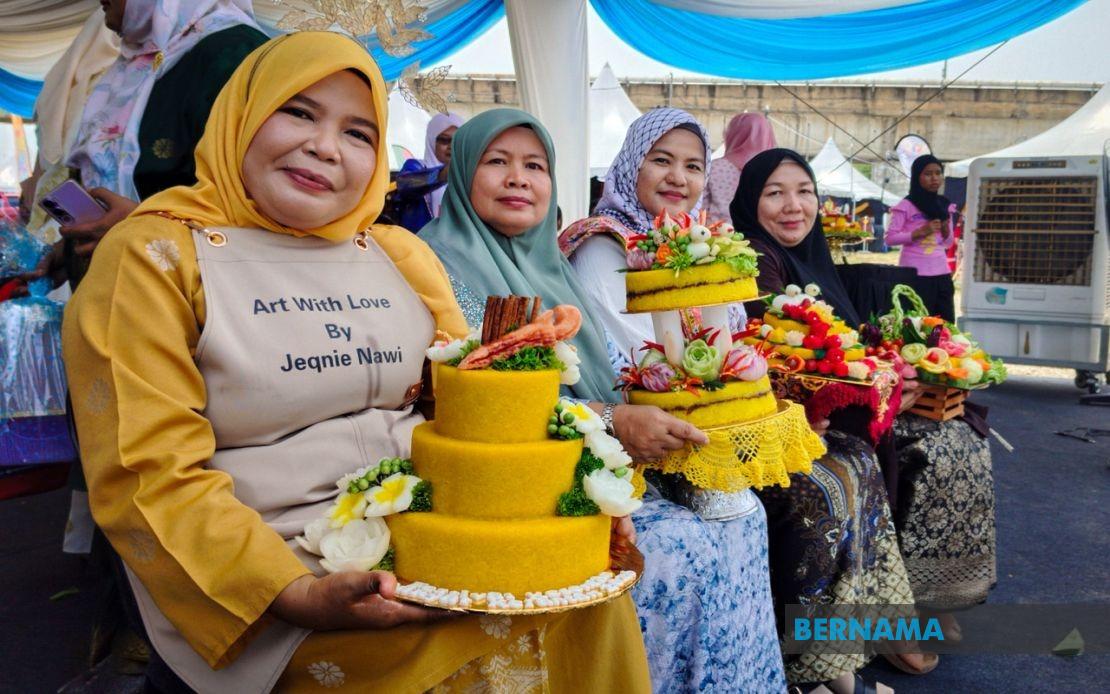
Nortiny Nawi's career pivot four years ago from resort marketing officer to pulut kuning entrepreneur demonstrates how traditional Malaysian culinary skills can generate substantial income in today's market. Operating from her home in Kampung Gong Cokoh, Pasir Puteh, the 46-year-old has built a business around meticulously crafted turmeric glutinous rice arrangements that command growing demand from individuals, educational institutions and government bodies throughout Kelantan.
The transition from corporate employment to self-employment reflects broader trends in Malaysia's economy, where home-based food enterprises have gained prominence as both economic drivers and cultural preservation vehicles. Nortiny's venture capitalizes on the enduring importance of pulut kuning in Malay-Muslim celebrations, where the dish features prominently at thanksgiving feasts, birthday gatherings and bridal table dinners known locally as makan beradab. This positioning ensures her products address genuine market demand rooted in cultural practice rather than fleeting consumer trends.
Pricing for her arrangements ranges from RM100 to RM280 depending on the weight of glutinous rice and design complexity, reflecting the labour-intensive nature of the craft and the premium customers willingly pay for artisanal quality. Her capacity to accept up to six orders daily demonstrates sufficient market demand to sustain what has become her primary income source, validating the business model despite its demanding production schedule. This revenue generation capacity, achieved without formal retail premises or significant capital investment, illustrates how traditional food craftsmanship can generate middle-class income in rural Malaysia.
Nortiny's recognition at the Kelantan Folk Arts Festival (FKRK) with a top prize for her eight-kilogramme arrangement adorned with intricate white radish floral carvings underscores the artistic dimension of her work. The competitive validation provides market credibility and potential marketing advantage, signalling to customers that her creations represent recognized excellence in the field. Such festival recognition, particularly in Kelantan where folk arts receive institutional support, enhances her standing within the local creative economy.
Her path to entrepreneurship illustrates how workplace experience can incubate business ideas. During her resort employment, Nortiny spent leisure hours observing kitchen operations, gradually building the technical knowledge and creative vision necessary to launch her venture independently. This informal apprenticeship model, common in hospitality and food sectors, demonstrates how curiosity and workplace access can democratize skill acquisition beyond formal culinary training programs.
The production process demands extraordinary dedication and precision. Beginning work at 3 am to steam glutinous rice before kneading, cooling and shaping arrangements requires physical stamina and meticulous attention to detail. The timing constraints are unforgiving—unlike cake-based businesses where products can be prepared in advance and refrigerated, pulut kuning must be shaped fresh to achieve the desired texture and appearance. This production reality limits scaling potential and ties the business closely to Nortiny's personal labour availability, creating both a constraint and a quality assurance mechanism.
Her customer base spans diverse sectors, reflecting pulut kuning's multi-functional role in Malaysian society. Individual consumers seeking centrepiece arrangements for family celebrations represent one market segment, while schools and government departments commissioning pieces for official events constitute another. This diversification reduces revenue volatility and demonstrates how traditional food crafts can serve institutional as well as domestic markets.
The psychological motivation underpinning her business reveals the personal satisfaction dimensions of entrepreneurship beyond financial returns. Nortiny articulates how customer compliments and feedback inspire continuous improvement in her craft, suggesting that intrinsic motivation and external validation reinforce her commitment. This intrinsic drive distinguishes sustainable creative businesses from those driven purely by profit maximization, potentially explaining why daily bookings have become routine rather than exceptional.
Expansion plans envision larger dedicated premises to accommodate growing demand, signalling confidence in market trajectory and her ability to scale production while maintaining quality standards. Such expansion would formalize what currently operates as a home-based enterprise, potentially opening opportunities for hired assistance and increased daily output. However, expansion carries risks: larger premises increase fixed costs, hiring introduces labour management complexity, and maintaining the artisanal quality that differentiates her products becomes more challenging as production volume increases.
Nortiny's success carries implications for rural economic development policy in Malaysia, particularly regarding women entrepreneurship and cultural enterprise support. Her case demonstrates that rural women can generate substantial income by commercializing traditional skills without relocating to urban centers, addressing both employment and rural retention challenges simultaneously. The model showcases how cultural practices embedded in community life can serve as entrepreneurial foundations when artisanal quality and aesthetic refinement are prioritized.
The business also represents cultural preservation through economic incentive. By generating income from pulut kuning craftsmanship, Nortiny creates market value around traditional knowledge and techniques that might otherwise diminish as younger generations pursue different careers. This market-driven preservation mechanism differs from subsidized cultural programs but potentially proves more sustainable by demonstrating genuine economic viability.
For Malaysian entrepreneurs considering home-based food businesses, Nortiny's model offers actionable lessons: identify products with sustained cultural significance, emphasize artisanal quality over volume, build reputation through consistent excellence and festival recognition, and maintain production standards that justify premium pricing. Her four-year trajectory from corporate employee to thriving small business owner, operating from a village home in Kelantan, illustrates that traditional culinary entrepreneurship remains economically viable and personally fulfilling in contemporary Malaysia.

