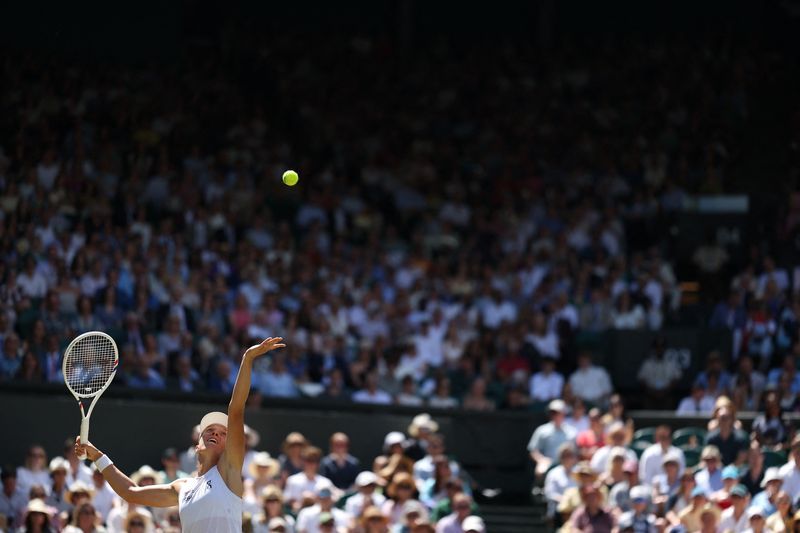
Alexandra Eala's Wimbledon campaign reached an extraordinary milestone on Saturday when the rising Filipino star toppled third-seeded defending champion Iga Swiatek in a dramatic Centre Court encounter, claiming a 7-6(9) 6-2 victory that resonated far beyond tennis circles. The 24-year-old's victory against the Polish champion—a five-time Grand Slam winner—represents one of the most significant achievements in Filipino tennis history and marks a watershed moment for Southeast Asian representation at the sport's most prestigious venues.
Swiatek arrived at the All England Club in uncertain form following an early exit from the Bad Homburg warm-up event, and her title defence unraveled against an opponent who combined raw power with tactical maturity beyond her years. The Pole had previously vanquished questions about her capabilities on grass courts with last year's triumphant Wimbledon run, yet found herself vulnerable against Eala's aggressive baseline game and psychological fortitude. After navigating past Taylor Townsend and Karolina Pliskova in successive rounds, Swiatek encountered an inspired opponent determined to seize an opportunity that may not arrive again for years.
The opening set epitomized the match's ferocious intensity, with both players refusing to yield ground in extended rallies under sweltering afternoon conditions. Swiatek's frustration mounted visibly as the set progressed—she gestured sharply toward her coaching team and hurled her racket against a chair as momentum shifted—while Eala absorbed the crowd's energy and converted her powerful left-handed baseline strokes into consistent winners. The first-set tiebreak became a referendum on mental resilience, and Eala's steadier nerve in the critical moments proved decisive at 9-7.
Eala's emotional response to her victory transcended typical post-match commentary, offering insight into the magnitude of her achievement for someone from her background. She spoke of training as a schoolgirl in ruffled socks and light-up shoes, with her brother and grandfather as her only coaching infrastructure, transforming modest resources into competitive advantage. This narrative resonates powerfully throughout Southeast Asia, where access to world-class tennis facilities and coaching remains concentrated among elite economic circles. Eala's journey from Manila's modest training grounds to Centre Court symbolizes the potential lying dormant in the region's tennis academies and community programs.
The second set demonstrated Eala's ability to capitalize on momentum, as she secured consecutive breaks early to establish a commanding 3-0 lead before Swiatek staged a partial recovery. However, Eala's superior shot-making and defensive positioning ultimately repelled the Polish champion's comeback attempt, with a perfectly struck forehand winner confirming Eala's passage into the fourth round. This was no fluke performance—Eala had previously defeated Swiatek in Miami's hard court conditions, though the Pole reversed that result on Madrid's clay surface, suggesting this rivalry possesses competitive depth.
Eala's acknowledgment of the crowd's support and her respect for Swiatek's achievements added grace to her victory, yet she pointedly emphasized that emotional gratification would not deter her from pursuing the tournament's subsequent rounds. Her fourth-round opponent will be 2024 runner-up Jasmine Paolini of Italy, a formidable challenge but one that Eala has already proven herself capable of meeting at the sport's highest level. The Italian's recent Grand Slam success means Eala faces the sternest test yet, though recent confidence and the psychological edge of upsetting the defending champion may prove invaluable.
The implications of Eala's breakthrough extend beyond individual sporting achievement. Filipino tennis has historically occupied the periphery of global tennis consciousness, with the archipelago producing occasional talented players who rarely achieved sustained success at Grand Slam level. Eala's presence in Wimbledon's second week, accomplished by defeating one of the sport's elite competitors, elevates her nation's standing within professional tennis and provides tangible evidence that Philippines-based players can compete meaningfully against the sport's established hierarchy. For young Filipino athletes considering tennis careers, Eala's trajectory offers powerful validation that geographic location and initial resource limitations need not determine career ceiling.
Swiatek's elimination carries broader significance for the women's professional tennis circuit. The third seed had been regarded as a genuine title contender despite her inconsistent warm-up results, meaning her unexpected exit reshuffles the championship landscape considerably. The Pole's grass-court form has historically proven problematic despite her clay dominance, and this loss suggests that Wimbledon's unique surface continues to expose vulnerabilities even among the world's top players. Her earlier struggles at Bad Homburg foreshadowed Saturday's disappointment, highlighting the importance of decisive preparation periods for Grand Slam competitions.
Eala's performance style—powerful baseline striking from the left side, aggressive court positioning, and psychological resilience—reflects evolving trends in women's professional tennis where defensive solidity combined with offensive weapons increasingly determines competitive outcomes. Her ability to construct points rather than relying exclusively on individual shot brilliance suggests tactical coaching of considerable sophistication, making her advancement through Wimbledon's rounds plausible rather than merely probable. The intensity she generated against Swiatek, combined with her composed handling of crowd pressure, indicates emotional intelligence and match management capabilities that typically require years of major competition experience to develop.
For Malaysian tennis followers and Southeast Asian observers more broadly, Eala's Wimbledon breakthrough carries special resonance. The region has produced scattered world-class players across various sports, yet sustained tennis success has remained elusive at the professional touring level. Eala's trajectory—from junior development through consistent progression up the rankings to defeating elite established champions—provides a roadmap for regional programs seeking to develop homegrown talent. Her victory suggests that with appropriate technical coaching, psychological support, and competitive opportunities, Southeast Asian players can close the gap separating them from established tennis powerhouses.
Looking forward, Eala faces pressure of elevated expectations that victory over a defending champion inevitably creates. Previous giant-slayers at Wimbledon have sometimes struggled to capitalize on breakthrough moments, their confidence and physical reserves depleted by the effort required to defeat seeded favorites. Eala's maturity in acknowledging both her achievement and her unfinished business suggests she possesses the mental framework to navigate these pressures productively. Her fourth-round meeting with Paolini will test whether Saturday's performance represented a career-altering moment or a singular brilliant effort, with the answer determining the trajectory of her trajectory through professional tennis's upper echelon.

