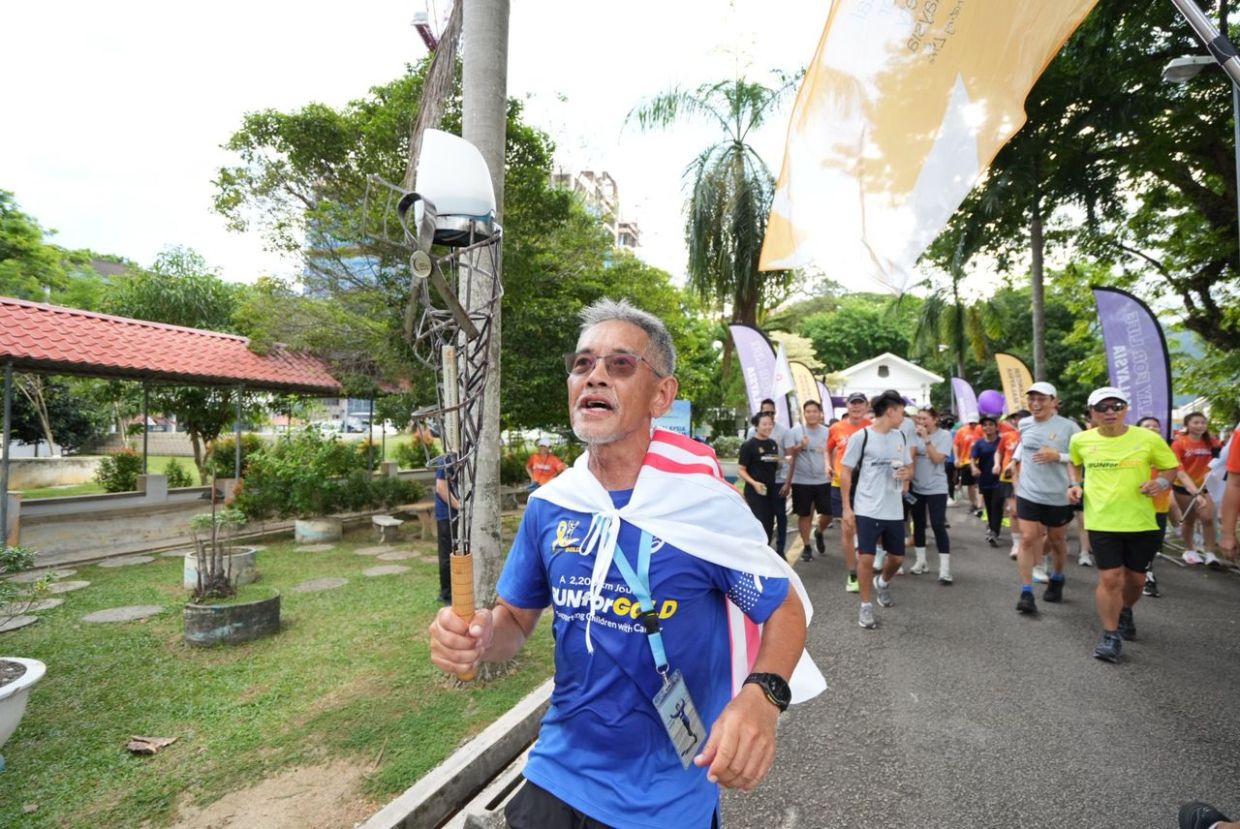
When Lim Shyang Guey, widely known as SG Lim, turned 66, he faced a retirement unlike most. Rather than slowing into quiet domesticity, the Penang-based retired civil engineer and avid runner found himself navigating profound loss after his wife, Goh Joo Lee, succumbed to cancer in 2024 at age 63. In the months that followed, Lim became a restless traveller, splitting his time between Australia where his two adult children lived, Malaysia where his extended family awaited him, and Hong Kong where he sought solitude. But it was in this displacement that he would discover an unexpected path forward—one that would eventually see him pounding the tarmac across 11 states and federal territories, transforming private anguish into public purpose.
The woman he had built nearly four decades of life with was, in Lim's estimation, defined by two qualities: her capacity to love and her instinct to care. During her final days in hospital, even as cancer ravaged her body, Goh remained preoccupied with her family's wellbeing rather than her own suffering. What struck Lim most profoundly was an incident that revealed the depth of her compassion beyond her immediate circle. While battling her own illness, she noticed a fellow patient in the adjacent ward—a stranger she had never met—and insisted that Lim purchase flowers for her. The gesture brought immeasurable joy not just to the sick woman but to her exhausted husband, an act of kindness that illuminated how Goh's generosity extended indiscriminately to anyone within her orbit. Beyond her warmth, she possessed an artistic temperament; her drawings, paintings, and creative pop-up installations, shared across social media, remain digital monuments to her imagination and the vibrant energy she channelled into her craft.
Grief, rather than imprisoning Lim in stationary sorrow, became a catalyst for reinvention. While processing his loss, he encountered a book by Laurence Carter that sparked an audacious idea: to undertake an extended running journey across Malaysia's length and breadth. He reached out to Carter for guidance, and with encouragement from the National Cancer Society Malaysia (NCSM), the concept crystallized into Run For Gold—an ambitious undertaking designed simultaneously to raise consciousness about paediatric cancer and mobilize financial resources for affected children. The choice to focus on child cancer patients carried personal resonance; it represented a tangible way to honor his wife's compassion while confronting the disease that had claimed her.
Preparation for such an extraordinary physical feat demanded systematic discipline. Having completed the Sydney Marathon in August, Lim leveraged that recent endurance accomplishment as his foundation. Over subsequent months, he methodically expanded his weekly running distances, conditioned his body to tolerate early morning starts at 5am, subjected himself to punishing midday heat to simulate race conditions, incorporated strength training to fortify vulnerable joints, and taught himself digital video production to chronicle his progress across social media platforms. Every element of his preparation reflected not mere athletic ambition but a deliberate crafting of the conditions necessary to sustain his mission across the vast distances that separated Malaysia's far-flung communities.
The actual journey, stretching across nearly three months and covering 2,200 kilometres, proved as emotionally transformative as it was physically demanding. During his first organized visit to a children's oncology ward facilitated by NCSM, confronting the frail frames of young patients and witnessing the hollow desperation etched across parents' faces crystallized his conviction that he had embarked on righteous work. These children, still in their formative years, faced an enemy that most adults could scarcely comprehend. Their parents, stripped of the reassuring narratives that usually govern parental responsibility, grasped at whatever hope they could muster. In that clinical ward, surrounded by monitored heartbeats and medicinal antiseptic, Lim recognized that his personal loss had acquired a larger significance.
Along the route, unexpected human connections reinforced the venture's deeper meaning. While traversing through Pekan in Pahang, Lim encountered a retired educator and his spouse who possessed no financial means to contribute substantially to the cause yet possessed something arguably more valuable—their sustained physical presence. This couple, embodying a partnership of tender devotion, accompanied Lim through multiple stages of his journey, running alongside him in Johor and Melaka and supporting him through to the final Penang stretch. The wife maintained vigil from the roadside while her husband matched Lim's pace, and wherever they encountered gathered crowds, they became impromptu ambassadors, methodically visiting roadside establishments to articulate the campaign's purpose to anyone who would listen. Observing their synchronicity and mutual care inevitably summoned memories of his own partnership, producing bittersweet awareness of what he had lost.
The finish line arrived in George Town, Penang, after 2,200 arduous kilometres and nearly 90 days of continuous physical exertion. As Lim crossed that final threshold, completing the ultimately 80-kilometre concluding segment, his immediate reflexive utterance was directed toward the woman who had motivated the entire undertaking: "Darling, we made it!" The triumphant declaration acknowledged that although she could not physically accompany him, her spirit had sustained him through every grueling kilometer. Yet relief at the completion mingled with profound emotion as he observed the assembled throng—family members, intimate friends, former schoolmates, and countless strangers who had intersected with his journey and felt moved to witness its culmination. What had commenced as a solitary processing of grief had metamorphosed into a communal affirmation of shared humanity.
The true significance of Run For Gold extends far beyond the personal catharsis Lim achieved or even the financial contributions channeled toward paediatric cancer treatment. The campaign represents a remarkable example of how individual suffering, when channelled through purposeful action, possesses the capacity to mobilize entire communities toward collective good. For Malaysian readers, particularly those navigating their own losses, Lim's journey offers a potent reminder that grief need not remain quarantined within private experience but can be transmuted into meaning-making endeavours that ripple outward. His transformation from a bereaved retiree into an unlikely athlete-activist demonstrates that the most powerful responses to tragedy often emerge from those willing to fundamentally reconstruct their lives in service of others' welfare, ensuring that personal sorrow becomes a bridge rather than a barrier between self and community.

