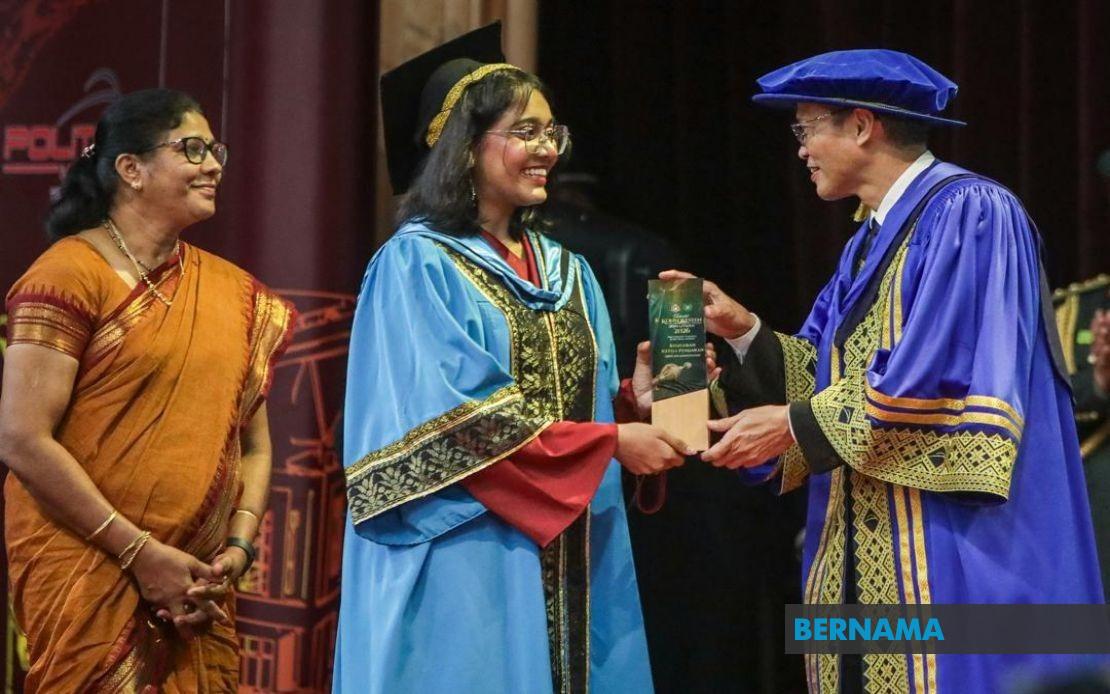
Teerti Ganapathi Rao's academic journey at Politeknik Tuanku Syed Sirajuddin serves as a compelling reminder of human resilience in the face of profound personal adversity. The 22-year-old Information and Communication Technology student was honoured with both the Director-General's Award and the Academic and Co-Curricular Excellence Award during the Northern Zone Polytechnic and Community College Convocation Ceremony held in Arau, with the ceremony graced by the Raja of Perlis, Tuanku Syed Sirajuddin Jamalullail. Her recognition stands out not merely for the numerical achievement—a cumulative grade point average of 3.61—but for the circumstances under which she attained it, having experienced the devastating loss of her father while sitting for her Semester Two examinations in 2023.
The loss occurred at a critical juncture in Teerti's educational trajectory, precisely when her academic performance hung in the balance and her entire future direction remained uncertain. Rather than allowing grief to derail her ambitions, she channelled the memory of her father's encouragement into sustained academic effort. Speaking to reporters following the convocation, Teerti reflected on the emotional weight of receiving the award, describing herself as genuinely surprised given the turbulent period through which she had just navigated. This candid admission reveals not overconfidence but rather a grounded understanding of the real obstacles she had overcome—obstacles that extended far beyond the typical academic pressures faced by her peers.
Teerti's connection to her late father remained the emotional anchor throughout her three-year diploma programme. She recalled moments when her conviction wavered, particularly when she had initially considered pursuing a foundation programme instead of committing to the full diploma course. It was her father's persistent counsel and belief in her capabilities that ultimately steered her towards completing the diploma, creating a profound sense of obligation to honour his faith in her potential. This familial dynamic underscores an often-overlooked dimension of academic success in Malaysia: the crucial role played by parental support and encouragement, particularly in technical and demanding fields where dropout rates remain a persistent concern.
Beyond the headline achievement, Teerti's institutional record demonstrates comprehensive excellence across multiple dimensions of student development. She earned the Head of Department's Award for Semesters One, Three and Four, indicating consistent performance rather than a single exceptional moment. Simultaneously, she maintained active involvement in the Student Representative Council, deliberately cultivating leadership, communication and teamwork competencies that employers increasingly value alongside technical qualifications. This dual-track approach—balancing academic rigour with leadership development—aligns with Malaysia's broader educational objectives of producing graduates who can navigate complex professional environments.
International engagement formed another notable component of Teerti's portfolio at PTSS. She represented the polytechnic at a collaborative programme and seminar paper presentation conducted at Universiti Putra Indonesia, exposing herself to regional academic networks and comparative educational contexts. This exposure becomes particularly significant for Malaysian polytechnic graduates, whose institutions have historically positioned themselves as alternative pathways to university education rather than gateways to regional or international academic communities. Her participation suggests growing recognition of polytechnics' role in fostering cross-border academic collaboration within Southeast Asia.
Teerti's final-year project, the Koop Printing System, demonstrates her capacity to translate theoretical knowledge into practical solutions addressing real institutional challenges. The system was specifically designed to enhance operational efficiency within cooperative printing service management, a problem-solving orientation that reflects contemporary industry demands. This project-based learning approach, increasingly common in Malaysian polytechnic curricula, equips students with portfolios demonstrating tangible technical competence—a significant advantage when competing for university places or employment opportunities in competitive technology sectors.
Linguistic versatility represents another distinguished dimension of Teerti's profile. Her fluency in Mandarin, Tamil and Telugu, alongside her command of Bahasa Melayu and English, positions her as unusually equipped for multicultural professional environments. Malaysia's demographic diversity creates particular advantages for individuals demonstrating this linguistic range, whether for domestic corporations expanding into Asian markets or for regional technology firms requiring cross-cultural communication capabilities. Her basic proficiency in French, Japanese and Korean further illustrates a systematic approach to language acquisition that transcends mere academic requirement.
Teerti's trajectory into technology emerged from an unexpected source: personal friendships formed through video gaming platforms, through which friends introduced her to coding and computer systems at age sixteen. This pathway—informal, interest-driven and peer-facilitated—reflects how technology adoption and skill development increasingly occur outside traditional institutional structures. Her recognition of gaming as a gateway to serious technical pursuits also validates informal learning environments that Malaysian educators sometimes overlook when designing technology curricula.
Her future trajectory remains ambitious and deliberately sequenced. Teerti has applied for undergraduate admission, identifying Universiti Malaya's Bachelor's degree in Information Technology as her preferred destination, with a longer-term aspiration to pursue doctoral research. This educational pipeline—diploma to bachelor's to doctorate—represents an increasingly common pathway for technically talented Malaysians who leverage polytechnic education as a foundation for advanced university study. Her articulated interest in deepening conceptual understanding rather than merely acquiring technical skills suggests intellectual maturity beyond her years, particularly her observation that systematic learning and conceptual clarity render challenging technical material accessible.
The 2026 Northern Zone Polytechnic and Community College Convocation involved 6,104 graduates from institutions across Perlis, Kedah and Penang, reflecting the substantial output of Malaysia's polytechnic system. Within this cohort of thousands, Teerti's recognition for outstanding achievement carries particular weight given the personal adversity she surmounted. Her story illustrates polytechnic education's democratic function—providing pathways for students of varying backgrounds and circumstances to develop technical competencies, leadership capabilities and regional engagement opportunities.
Teerti's achievement resonates beyond individual recognition; it demonstrates how institutional support systems, familial encouragement and personal determination converge to produce outcomes that benefit both the graduate and the broader Malaysian economy. Her trajectory from grief-stricken examination candidate to award-winning graduate, and onward toward doctoral aspirations, constitutes a narrative of resilience that extends beyond sentiment to encompass practical illustration of how Malaysian educational institutions can nurture talent even amid profound personal challenges. As Malaysia continues developing its technology workforce to support digital economy ambitions, individuals like Teerti—combining technical capability, linguistic sophistication, regional exposure and demonstrated resilience—represent the human capacity upon which these developmental goals ultimately depend.

