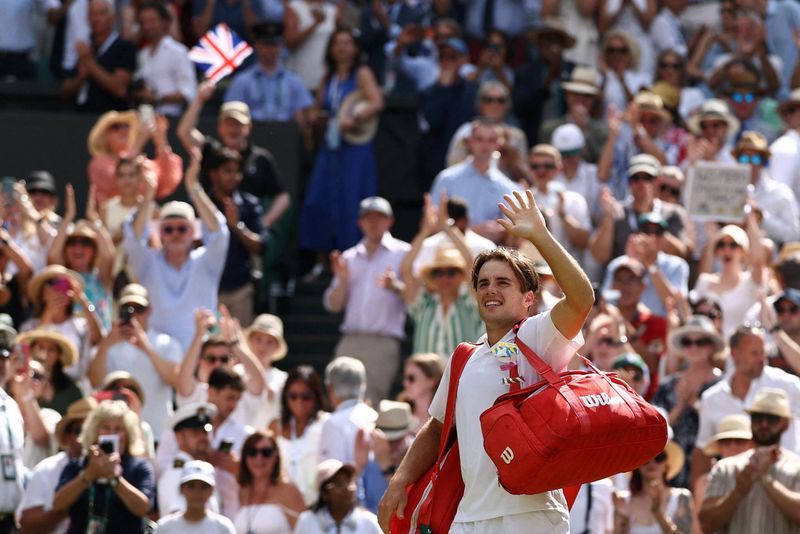
Arthur Fery had resigned himself to a summer escape. The British tennis player, ranked 114th in the world, had mapped out a Mediterranean getaway to Greece with friends, expecting his Wimbledon campaign to conclude well before the semi-finals arrived. Yet as the 23-year-old progressed through match after match at the All England Club, those vacation plans became increasingly tenuous. What began as a longshot appearance at the grasscourt Grand Slam transformed into an improbable run that would capture the imagination of a nation and rewrite the trajectory of his professional career.
Fery's path to the semi-finals remains extraordinary by any measure. Entering Wimbledon as a wildcard entrant, he defeated five consecutive opponents to reach the last four—a feat no wildcard had accomplished at the men's championships in the past quarter-century. His progress through the tournament's upper bracket defied the conventional wisdom about unseeded players at the sport's most prestigious events. The contrast between his modest world ranking and his unexpected success created a compelling narrative that resonated far beyond the tennis community, drawing support from unlikely quarters across the United Kingdom.
The scale of public backing Fery received underscored how thoroughly his story had captivated British audiences. Queen Camilla and the Princess of Wales attended his matches at the All England Club, offering their personal endorsement to the emerging talent. The England World Cup football team recorded a video message of encouragement, illustrating how Fery's campaign had transcended sport to become a broader cultural moment. Even his friends proved somewhat skeptical of his prospects—one companion had travelled to Greece ahead of schedule, essentially betting that Fery would exit early enough for him to enjoy his holiday. That friend's subsequent return and reversal of allegiance speaks to the infectious momentum surrounding the player's unexpected ascent.
For Fery himself, the pressure and unreality of the situation intensified with each passing round. He joked about the peculiar circumstances of his run, acknowledging that the support he received seemed almost designed to carry him through successive rounds. Coming into Wimbledon, he had compiled a meagre record at Grand Slam events, having won just two matches across the four major championships in his career prior to this tournament. The contrast between that resume and his current status as a semi-finalist revealed the magnitude of his achievement and the exceptional nature of grasscourt tennis, where conditions can dramatically level the playing field for unexpected challengers.
Alexander Zverev ultimately halted Fery's journey in the semi-finals, defeating him in straight sets on Friday. While the loss represented a disappointment after advancing so far against the odds, it did not diminish the accomplishment of reaching that stage. Zverev's victory provided some measure of order to a tournament that had been turned on its head by Fery's improbable progression, but it could not erase what the British player had already achieved in capturing the public imagination.
The financial windfall accompanying Fery's semi-final appearance will provide some compensation for his abandoned holiday plans. The prize money of £900,000 ($1.21 million) for reaching the final four represents a sum considerably larger than the purse he would have expected to accumulate through normal tour results during an equivalent time period. Fery acknowledged with characteristic humour that the upgraded holiday such a sum would facilitate represented a pleasant consolation for missing his original Greek trip. The monetary rewards, however, represent only one dimension of what his Wimbledon run has generated.
The implications for Fery's ranking and future tour calendar promise to be transformative. He anticipates his ranking will rise into the mid-30s following his semi-final appearance, a dramatic elevation from his pre-tournament standing. This improvement carries practical significance beyond the numerical ranking itself—it qualifies him to compete in the main draws of tour events throughout the coming year and potentially beyond. Access to such competitions forms the foundation upon which professional tennis careers are built, and Fery's Wimbledon breakthrough provides him with an opportunity that might otherwise have required years of incremental progress to achieve.
Fery recognises that managing the expectations and pressures accompanying his sudden prominence represents a distinct challenge. He spoke candidly about needing to adjust to the transformed circumstances, both in terms of his own internal expectations and the external pressure that will accompany his status as the news story of British tennis. The demands of competing in tour-level events where he faces more consistent elite opposition differ substantially from the wildcard pathway that defined his Wimbledon experience. His willingness to confront these psychological dimensions of sudden elevation suggests a maturity beyond his years.
The remainder of the tennis calendar holds particular significance for Fery as he seeks to build upon his Wimbledon success. He indicated his intention to take time away from competition to process his recent experiences before returning to the court. His next major objective lies on the North American hardcourt swing, culminating in the United States Open at Flushing Meadows. A debut appearance at the American Grand Slam represents another milestone that would have seemed unreachable merely weeks ago, yet which now appears within reach given his transformed circumstances and confidence.
For Malaysian and Southeast Asian tennis enthusiasts, Fery's story holds particular resonance as it demonstrates how grasscourt specialisation and a fortunate draw can produce unexpected results at the sport's highest level. His experience serves as a reminder that the established order at Grand Slams remains susceptible to disruption by players with specific skill sets and the willingness to embrace unconventional pathways into major tournaments. As Fery navigates his next chapter, his trajectory will offer valuable lessons about how players can capitalise on breakthrough moments and sustain momentum across the demanding professional circuit that defines modern tennis.

