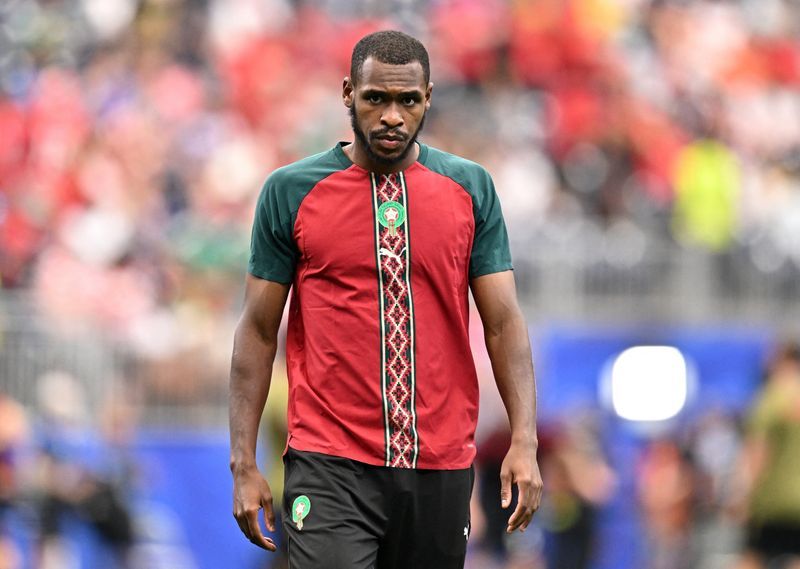
Issa Diop's journey to the World Cup quarter-final represents one of international football's most compelling reversals of fortune. The 29-year-old Moroccan centre-back, who spent years declaring his absolute commitment to France and dismissing overtures from both Morocco and Senegal, now finds himself tasked with the impossible: containing Kylian Mbappe as Morocco challenges the European champions in one of the tournament's most anticipated knockout matches. The fixture has become far more than a simple sporting contest—it encapsulates a dramatic personal redemption arc that Diop himself could scarcely have imagined just months earlier.
Diop's background presented him with a natural pull towards multiple footballing identities. Born in the French city of Toulouse to a Senegalese father and Moroccan mother, he carried the genetic heritage of West Africa while enjoying the formative years of his career within French football structures. His family tree itself embodied this African-European duality; his grandfather had served as one of Senegal's pioneering national team coaches, establishing a direct lineage to African football leadership. Yet throughout his development as a player, Diop consistently and vocally rejected the notion of representing any nation other than France.
His stance hardened into public pronouncement seven years ago when, as a member of France's Under-21 programme, he granted an interview to Canal Plus in which he articulated a position that brooked no ambiguity. "I am French. I was born in France. France has given me everything," he declared, adding that switching allegiances because of selection disappointment would constitute hypocrisy and represent merely a fallback option. These were not the cautious, diplomatic words of a young player keeping doors open. Rather, they represented a definitive declaration of footballing identity that appeared to close off any possibility of future representation for Morocco or Senegal. When the comments resurfaced on social media following his eventual switch to Morocco in March, they triggered considerable controversy and questions about his genuine commitment.
The catalyst for Diop's change of heart coincided with Morocco's urgent need for defensive reinforcement ahead of the World Cup. Captain Romain Saiss had departed the squad following the Africa Cup of Nations in January, while Nayef Aguerd suffered an injury that removed him from consideration in March. These vacancies in Morocco's defensive infrastructure created both opportunity and necessity. Coach Mohamed Ouahbi, recognising that Diop's eight-season tenure in the English Premier League—spanning West Ham United and Fulham—had developed him into a reliable defensive presence, pursued the defender with focused determination.
Outahbi's faith in Diop proved justified almost immediately. Making his competitive debut for Morocco in a March friendly against Ecuador, Diop secured the starting position in central defence and established a productive partnership with Crystal Palace's Chadi Riad. The coach, reflecting on his recruitment decision, emphasised the intangible qualities that extended beyond statistical analysis. "I sensed someone who is committed, who lives a somewhat Moroccan lifestyle and visits the country frequently," Ouahbi observed, suggesting that Diop's integration into Moroccan society ran deeper than his previous public statements had indicated. The coaching staff resolved to move beyond the historical record of his earlier rejections, instead focusing upon his pitch performance and attitude.
Diop's most compelling contribution arrived during Morocco's round-of-32 encounter against the Netherlands, where the stakes could hardly have been higher. With the match approaching its conclusion, the Dutch appeared to have withstood Morocco's challenge. Yet in the 91st minute, Diop ventured forward into attack—an unusual positioning for a centre-back in the dying moments—and connected powerfully with a cross delivered by Chemsdine Talbi. His header found the back of the net, delivering a stoppage-time equaliser that dragged the fixture into extra time and ultimately towards a penalty shootout triumph. The dramatic nature of this contribution transcended conventional football analysis; Diop had literally rescued his adopted nation at the moment when elimination seemed inevitable.
Reflecting on the goal afterwards, Diop displayed the straightforward pragmatism expected of a defender thrust into an attacking moment. "I went forward, I don't know what I was doing there, it was the end of the match. I tried to find some space and scored," he explained with characteristic understatement. The modesty of his description belied the psychological significance of the moment. A player who had only months earlier faced considerable scrutiny regarding his commitment to Morocco had delivered the crucial intervention that kept his new nation's World Cup dreams alive. The sporting redemption appeared complete.
Yet the ultimate test awaited in Boston, where Morocco would confront France—Diop's original footballing home—with a semi-final berth at stake. The subplot of a defender who had once rejected his current nation now standing between them and their primary rival held obvious narrative appeal. The challenge of containing Mbappe, France's mercurial superstar and primary attacking threat, would demand precisely the kind of focused, committed defending that Diop had already demonstrated throughout the tournament. The match represented far more than a contest between two talented footballers; it embodied the culmination of Diop's personal journey from outsider to essential component of Morocco's World Cup campaign.
For Ouahbi and the Moroccan squad, Diop's presence and demonstrated commitment provided legitimate grounds for confidence. His established Premier League experience meant he possessed familiarity with the intensity and tactical sophistication of European football at its highest level. The partnership he had forged with Chadi Riad offered defensive stability upon which Morocco could construct their approach to the quarter-final. More intangibly, his dramatic rescue against the Netherlands had established him as a player capable of performing decisively under maximum pressure—precisely the quality required when facing Mbappe's pace, technical ability, and proven tournament pedigree.
Morocco's ambition to reach the semi-finals for a second successive World Cup represented a significant achievement for African football, yet faced the formidable challenge of France's established quality and tournament experience. The presence of Diop in the defensive line symbolised both Morocco's tactical approach and the programme's capacity to attract experienced players who could contribute immediately. His journey from emphatic French allegiance to Moroccan commitment, crystallised through his performance against the Netherlands, had silenced earlier critics and demonstrated that sporting commitment transcends the historical record of prior declarations.

