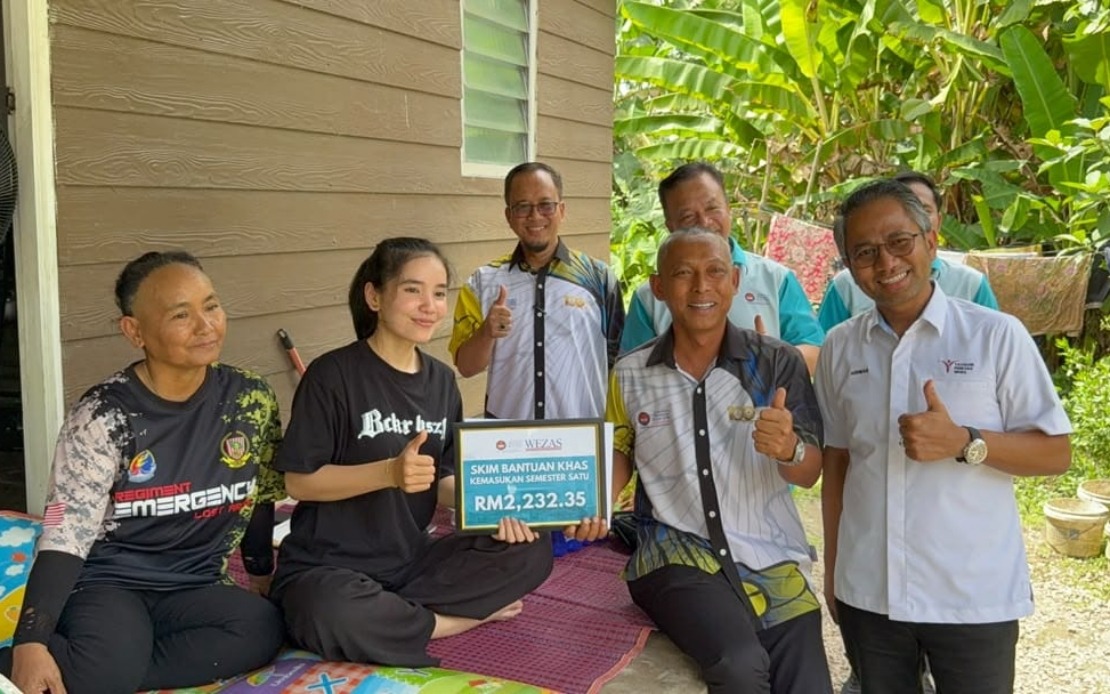
Three high-achieving secondary school leavers have overcome significant financial barriers to pursue university education after receiving targeted assistance from Universiti Pendidikan Sultan Idris and Malaysia's Higher Education Ministry. The initiative, which provided each student with RM1,500 in support, demonstrates a coordinated effort between educational institutions and government bodies to ensure that merit and potential are not overshadowed by economic hardship.
Lovely Sabana Augustine's journey to university exemplifies the challenges many Malaysian families face when attempting to access higher education. Her appeal for help covering registration fees and essential study materials gained traction on social media, highlighting the real struggles of students from low-income households. Now enrolled in the Faculty of Human Sciences at UPSI, Sabana represents a broader cohort of capable learners whose futures might have been derailed without timely intervention.
Sabana's personal circumstances underscore the depth of need among university-bound students across Malaysia. Growing up as the youngest of four children in Tumpat, Kelantan, she depends entirely on her mother's income of approximately RM800 monthly from work as a school cleaner, supplemented by her mother's involvement with RELA. The loss of her father, a former military serviceman, in 2017 intensified the family's financial vulnerability. Despite these obstacles, her academic performance earned her a place at UPSI, yet the practical costs of registration and preparation threatened to prevent her enrolment.
The support package extended beyond Sabana to encompass two additional students facing comparable economic pressures. Siti Nurdianis Nordin, pursuing studies in the Faculty of Management and Economics, comes from a household relying on irregular daily wages without stable employment. Muhamad Ilias Danish, enrolled in the Faculty of Languages and Communication, lost his father and now carries responsibility for assisting his mother in meeting family expenses. Their selection reflects a deliberate institutional focus on identifying and supporting the most vulnerable among incoming cohorts.
The financial assistance was structured through a partnership involving multiple funding sources. UPSI's Centre for Waqf, Endowment, Zakat, Khairat, and Sadaqah contributed RM500 per student, while Yayasan Perkasa Siswa provided the remaining RM1,000. This blended approach leverages both Islamic charitable mechanisms and dedicated student welfare foundations to create sustainable support infrastructure. The decision to mobilise these resources demonstrates institutional commitment to welfare beyond conventional scholarship programmes.
Higher Education Ministry officials framed the intervention as integral to the government's broader access agenda. Hirman Awang, director of the Department of Higher Education's Student Affairs Division, emphasised that financial barriers should not exclude capable students from advancing their education. He characterised Yayasan Perkasa Siswa as a frontline mechanism for safeguarding student welfare, while noting that the RM1,000 contribution aims to address both psychological and practical needs—boosting confidence alongside covering essential expenses.
UPSI's institutional response reveals a deliberate strategy for student support that extends beyond crisis intervention. Prof Dr Norkhalid Salimin, the university's deputy vice-chancellor for Student Affairs and Alumni, articulated a philosophy of proactive identification and early assistance. Through collaboration between the Student Affairs and Alumni Department and WEZAS, the institution monitors prospective students for signs of hardship before they arrive on campus. This early-warning approach prevents situations where financial strain accumulates before official enrolment procedures commence.
The programme represents a coordinated three-way partnership between UPSI, Yayasan Perkasa Siswa, and the Department of Higher Education, designed to create systematic pathways for assisting vulnerable students. Rather than treating financial support as a charitable afterthought, officials positioned it as a strategic commitment to ensure that economic circumstances do not filter out talented individuals at the point of university entry. The collaboration signals institutional willingness to address structural barriers that disproportionately affect low-income families.
For Malaysian policymakers monitoring education access and equity, this initiative offers insights into scalable intervention models. The involvement of waqf and endowment mechanisms specifically speaks to leveraging Islamic financial principles for social welfare—an approach with potential for expansion across Malaysia's public university sector. The early intervention timing, before students formally enrol, may prove more effective than remedial support extended after students encounter difficulties.
The three students' progression into higher education carries implications beyond their individual circumstances. Each represents a household where university attendance can amplify intergenerational economic mobility. Sabana's success in accessing UPSI may influence expectations among her siblings and their families in Kelantan. Similarly, the visibility of institutional support mechanisms—as demonstrated through this case—potentially encourages other capable but financially constrained students to apply rather than assume university remains inaccessible.
The success of this cohort also creates data points for assessing whether targeted assistance at the entry point translates into successful degree completion. Tracking these three students through their academic careers could generate evidence about the effectiveness of early intervention relative to reactive crisis support. Such longitudinal outcomes become increasingly valuable as Malaysian universities grapple with retention and graduation rates across economically diverse student populations.
Looking forward, the partnership model demonstrated here offers a template potentially applicable across Malaysia's public university system. As enrolment pressures increase and economic inequality persists, early identification of financially constrained high achievers, combined with coordinated assistance from institutional, foundation, and governmental sources, may represent a scalable approach to widening access. The principle that merit should determine university participation regardless of family income remains aspirational for many regions, yet initiatives like UPSI's demonstrate that institutional commitment, strategic partnerships, and targeted resource mobilisation can begin closing the gap between aspiration and reality.

