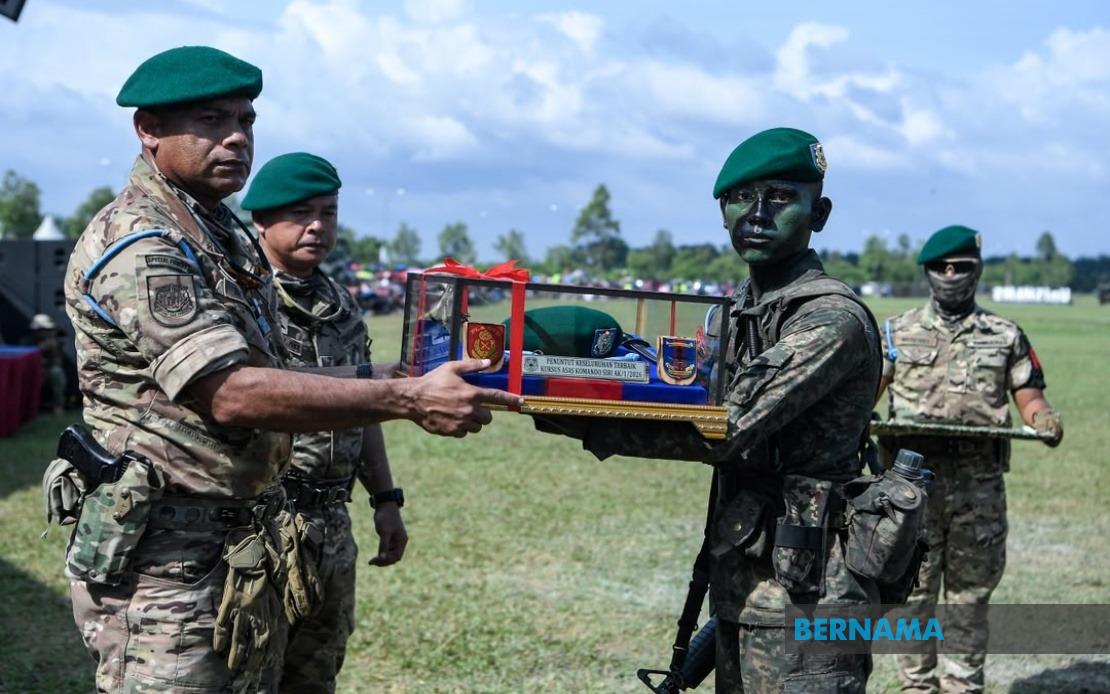
Second Lieutenant Muhammad Fadli Jamalluddin's journey to becoming Malaysia's Best Overall Commando Trainee was far from smooth. The 24-year-old officer from Ampang, Kuala Lumpur, initially stumbled when attempting the Basic Commando Course Series 3/2024, but rather than accept defeat, he regrouped and returned with renewed determination to claim the coveted green beret in the recent Basic Commando Course Series AK/1/26 held at Universiti Sultan Abdul Halim Mu'adzam Shah in Kuala Ketil.
Muhammad Fadli's military aspirations took root during his secondary school years, a formative period when he recognised his calling to serve in uniform. He pursued this ambition methodically, enrolling at the National Defence University of Malaysia (UPNM) to obtain the necessary qualifications before formally commissioning into the Royal Malay Regiment in 2024. His academic foundation—a Bachelor's degree in Global Policing and Intelligence with Honours—provided the intellectual framework necessary for modern military operations, yet nothing could fully prepare him for the physical and psychological gauntlet that lay ahead in commando training.
The road to success proved treacherous even during his second attempt. During the eighth week of the gruelling three-month course, Muhammad Fadli encountered another critical juncture when he failed a training exercise that could have necessitated repeating the entire programme from the beginning. At that moment, having already endured more than 100 kilometres of punishing endurance marching, the prospect of starting over seemed almost unbearable. Yet this second brush with failure became transformative rather than destructive, hardening his resolve rather than breaking it.
What distinguishes Muhammad Fadli's achievement is not merely his technical mastery of commando skills, but his demonstrated capacity for resilience under conditions deliberately designed to test mental fortitude. The three-month course encompasses demanding land and sea training elements that push trainees to the edge of their physical capabilities while simultaneously straining cognitive functions and decision-making capacity. Becoming a commando officer, he notes, requires more than raw physical strength—it demands a sharp, tactical mind capable of executing complex special operations that depend on meticulous planning and sound judgment under pressure.
Family motivation served as a crucial wellspring for Muhammad Fadli's perseverance. As the third of five siblings, he carries particular responsibility to honour his family's support and aspirations. This drive intensified following his father's stroke more than a year ago, an event that transformed his commando dream from a personal ambition into something far more significant—a gift of pride and strength for his ailing parent. Despite his father's inability to attend the closing ceremony at UniSHAMS, Muhammad Fadli views his achievement as the most meaningful present he could offer to his family, hoping the news of his success brings his father renewed hope and strength during his recovery.
The specific motivation to join Malaysia's elite 21st Special Service Group (21 GGK) reflects Muhammad Fadli's deliberate choice to pursue the most demanding path available within military service. During his final year of officer training, he consciously weighed the options before him and determined that if he had genuinely committed to a military career, he should test himself against the highest possible standard. This mentality—seeking the most challenging avenue rather than the easiest route—characterises the mindset cultivated within Malaysia's special forces community and reflects the institutional culture that values continuous self-improvement and willingness to confront one's limitations.
The broader significance of Muhammad Fadli's achievement extends beyond individual accomplishment to illuminate the nature of Malaysia's professional military development. His journey demonstrates how contemporary officer training institutions like UPNM are producing military leaders with both academic sophistication and practical operational capability. The combination of university-level education in fields like global policing and intelligence, followed by intensive commando training, creates officers equipped to handle the complex security challenges facing Southeast Asia in an increasingly volatile geopolitical environment.
Muhammad Fadli's experience also sheds light on the deliberate psychological testing embedded within commando courses. The fact that he was permitted to continue following a failed exercise in week eight, rather than automatically being returned to civilian duties, suggests that Malaysia's Special Warfare Training Centre (PULPAK) operates under a philosophy that distinguishes between those who lack capacity and those who temporarily stumble. This nuanced approach allows genuine commando material—individuals with the mental resilience to recover from setbacks—to persist and ultimately succeed. Such selection methodology produces operationally effective personnel more reliably than systems that apply rigid pass-or-fail criteria without regard to individual recovery potential.
The Best Overall Trainee award, presented by Colonel Nordin Abu, Commandant of PULPAK, carries particular weight in Malaysian military circles. Among the five officers and 33 other ranks who successfully completed the Basic Commando Course Series AK/1/26, Muhammad Fadli emerged as the standout performer—recognition that accounts for overall tactical competence, physical conditioning, leadership potential, and the intangible quality of operational judgment that separates truly elite personnel from capable soldiers.
For Malaysian military observers and prospective officer candidates, Muhammad Fadli's trajectory offers an instructive lesson. Military excellence is not simply a function of initial aptitude or early success, but rather reflects sustained commitment to improvement, psychological resilience in the face of disappointment, and willingness to reframe failure as opportunity. His achievement suggests that Malaysia's defence establishment continues to identify and cultivate officer-level personnel capable of meeting contemporary operational demands. As Malaysia faces ongoing transnational security challenges throughout Southeast Asia—from maritime security concerns to counter-terrorism operations—the consistent production of psychologically resilient, intellectually capable commando officers like Muhammad Fadli strengthens the strategic capacity of the nation's armed forces.

