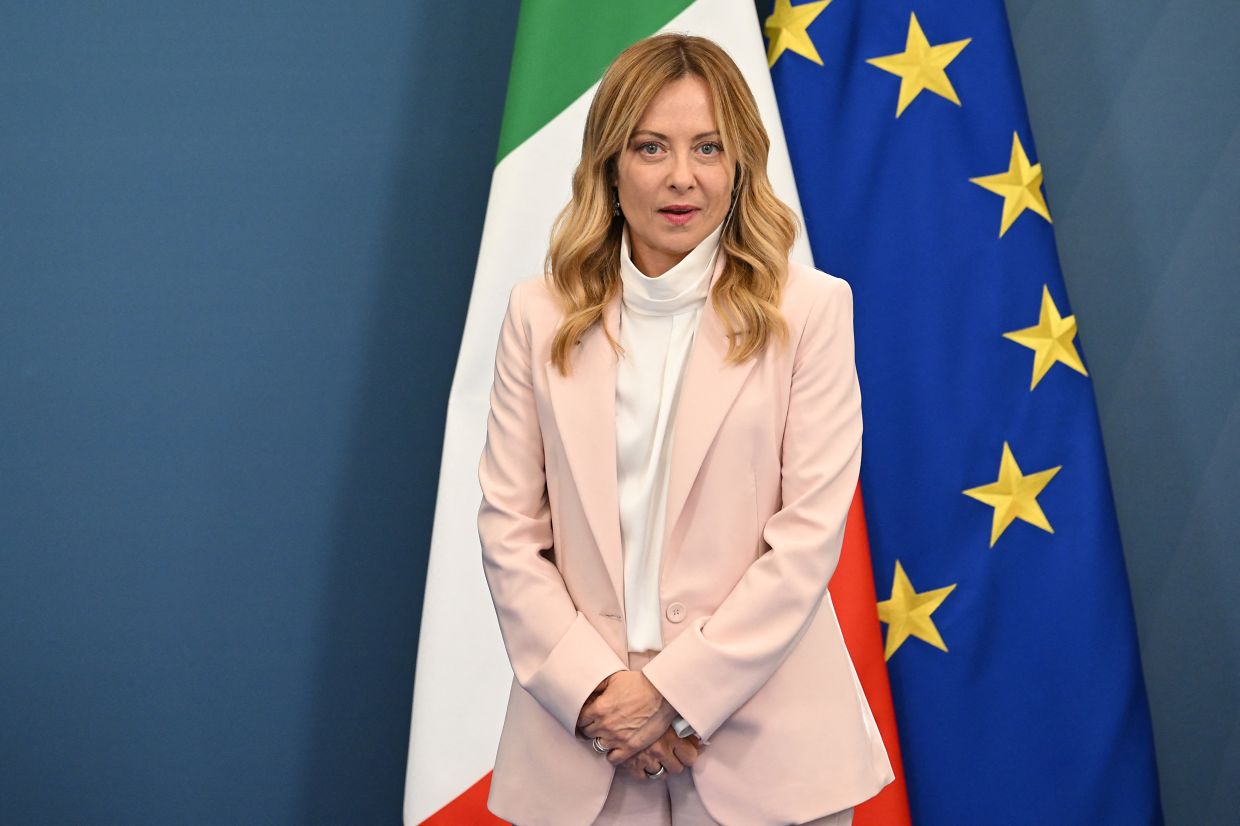
Italy's Prime Minister Giorgia Meloni has undergone a remarkable transformation since assuming office in October 2022—one that extends far beyond policy positions into the subtle realm of sartorial presentation. When she first stepped into the premier's office, she cut a deliberately austere figure in dark suits and heavy black boots, visual markers that announced her emergence from the fringes of Italian right-wing politics. Today, as she nears the finish line of what may become Italy's longest postwar premiership, Meloni predominantly appears in tailored pastel suits with flowing, wide-legged trousers that conceal her heels. This shift in wardrobe, according to fashion and political analysts, represents far more than personal preference—it signals a deliberate messaging strategy that projects authority tempered with approachability.
The connection between political identity and fashion is neither accidental nor trivial, particularly in Italy, a nation where design heritage and aesthetic refinement occupy a central place in national identity and economic output. Antonio Mancinelli, an instructor at Rome's Costume and Fashion Academy, observes that Meloni demonstrates acute awareness of how clothing functions as non-verbal political communication. For a woman leading a country internationally synonymous with high fashion, the wardrobe question carries exceptional significance, as Italian-Haitian designer Stella Jean notes. When a female leader represents a nation where fashion constitutes a pillar of economic prosperity, the implications of sartorial choices multiply considerably, touching upon questions of national identity, gender representation, and soft power projection.
Meloni's political journey has traced an arc from ideological radicalism toward pragmatic centrism, and her clothing choices have mirrored this trajectory with striking precision. Upon taking control of a party with post-fascist roots, international observers predicted she would adopt an antagonistic stance toward European institutions and pursue extreme foreign policy positions. Yet she has largely confounded these expectations, pursuing domestically conservative anti-immigration policies while simultaneously embracing a pragmatic relationship with the European Union and emerging as one of Ukraine's most steadfast supporters in its conflict with Russia. Her willingness to publicly challenge American President Donald Trump further consolidated her standing among European partners, transforming her international profile from potential pariah to reliable establishment figure.
This political evolution demanded corresponding shifts in visual presentation. When Meloni functioned as a small party leader addressing a narrow ideological base, her aesthetic choices reflected that constrained constituency. As she ascended to leadership of a major European Union nation, however, the calculus shifted entirely. Riccardo Alcaro, a political analyst with Italy's Institute for International Affairs, explains that her expanded role necessitates projecting herself as a credible government leader whose ideas merit serious international engagement—a positioning that her earlier combative style would have undermined. The wardrobe adjustment serves this repositioning strategy by signaling stability, seriousness, and openness to dialogue.
The specific chromatic and stylistic choices Meloni has adopted carry psychological and symbolic weight that extends beyond fashion convention. Her transition toward lighter colours and tailored silhouettes emerged gradually following her assumption of office, as she began appearing with increasing frequency on the global stage. Fashion educators like Michela Bonafoni, who instructs at Florence's Unicollege, note that lighter colours communicate loyalty, tenderness, and gentleness—qualities that enhance a leader's approachability quotient. The muted palette represents a deliberate inversion of the visual aggression conveyed by her earlier all-black ensembles, which carried particular baggage in the Italian context where black has historically carried associations with fascist aesthetics alongside its conventional fashionability and mourning conventions.
Meloni's current wardrobe preferences represent a striking departure from her younger activist self. A 1996 French television documentary captured the nineteen-year-old Meloni, dressed almost entirely in black, as she organized right-wing youth movement members. During that interview, she offered a controversial defense of Benito Mussolini—comments that have persistently shadowed her subsequent political career. The comments underscore why her sartorial evolution carries such weight; the visual language of her younger years became entangled with extremism, making any perpetuation of that aesthetic potentially catastrophic for her reinvention efforts. Since that period, Meloni has undertaken sustained efforts to distance herself from the extremist heritage that continues to complicate Italy's political landscape.
Her transition accelerated during her tenure as Youth Minister under Silvio Berlusconi beginning in 2008, when she began adopting more serious professional attire consisting primarily of dark suits paired with white shirts. This intermediate period established a template for respectability that would eventually evolve further. By the time she launched her successful 2022 electoral campaign, Meloni had already begun broadening her appeal beyond ideological purists. Her campaign speeches pivoted toward personal identity framing, with Meloni describing herself passionately as "a woman, a mother, a Christian"—rhetoric that resonated powerfully among conservative centrist voters and subsequently spawned viral cultural remixes that amplified her message across generational lines.
As premier, Meloni has virtually disappeared from public view in the all-black ensemble that characterized her earlier political identity. The transition has been both consistent and deliberate, with wide-cut trousers now consistently concealing her high heels—previously visible markers of her more confrontational aesthetic. Her current wardrobe repertoire emphasizes tailored construction, neutral colour palettes, and an almost studied avoidance of bold patterns that might suggest ideological provocation. This refined aesthetic conveys the impression of someone governing from the political mainstream rather than from its margins, a positioning that proves particularly crucial as she enters the final year of her mandate and faces mounting competitive pressure from rival right-wing politicians.
The sophistication of Meloni's image strategy lies in its recognition that fashion functions as a form of political rhetoric legible to both domestic and international audiences. While Meloni's office has declined to comment on her wardrobe choices or her fashion advisors, the consistency of her presentation suggests careful deliberation rather than happenstance. Her wardrobe evolution parallels the broader strategy through which she has repositioned Italy's post-fascist right from political pariah status toward apparent mainstream acceptance. The pastels and flowing tailoring communicate that Italy under Meloni represents continuity with European institutional frameworks rather than radical departure from them.
Meloni's strategic deployment of fashion places her within a broader constellation of contemporary world leaders who consciously weaponize wardrobe for political messaging. Ukrainian President Volodymyr Zelenskyy has maintained military-style dress since Russia's 2022 invasion, visually reinforcing his commitment to national defense. The United Kingdom's Andy Burnham adopted jeans and casual t-shirts as visual statements supporting working-class accessibility. Mexico's Claudia Sheinbaum deliberately incorporates Indigenous artisan embroidery, honoring textile traditions while advancing representation politics. Yet Meloni's situation carries particular complexity given her navigation of fascistic historical legacies and the peculiar weight fashion holds within Italian national identity and international perception.
Looking forward, Meloni's wardrobe choices will likely continue signaling her positioning within Italy's political landscape and her relationship to European institutions. The softer aesthetic projections may prove crucial as internal pressures mount and right-wing rivals seek to position her as insufficiently committed to radical conservative causes. Her fashion evolution represents more than vanity or styling preference—it constitutes a critical component of the political rebranding through which she has transformed from combative outsider into establishment pragmatist, making her an exemplary case study in how contemporary political leaders navigate the intersection of image management, historical memory, and international credibility.

