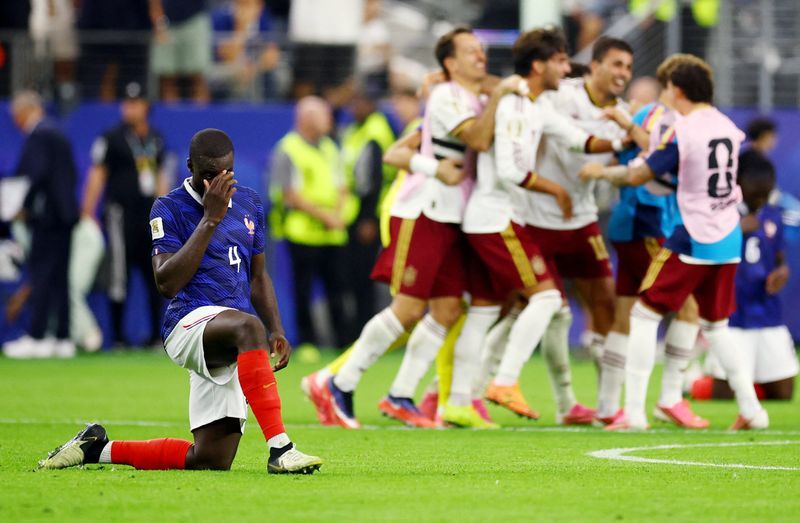
France's World Cup campaign ended in humiliating fashion on Tuesday with a 2-0 semi-final defeat to Spain in Arlington, Texas, a result that exposed the fundamental weaknesses underlying their status as tournament favourites. The match was less a competitive encounter than a one-sided demonstration of Spanish superiority, with the French reduced to passive spectators as their opponents seized control from the opening minutes and never relinquished it. For a team installed as the competition's strongest contenders, the collapse was both swift and comprehensive, vindicating those who had questioned the validity of the pre-tournament hype.
The parallels to France's opening hour during the 2022 World Cup final against Argentina were immediately apparent, yet with one critical difference. Two years earlier, despite a shaky start, Didier Deschamps' squad fought back, lost only on penalties and departed with pride intact from one of football's greatest matches. This encounter offered no such redemption narrative. There was no second-half resurrection, no dramatic comeback, and no consoling storyline. What unfolded instead was a methodical, surgical dismantling by a Spanish team that understood the tactical battle and executed their game plan with near-perfect precision. "The players are devastated, but we have to be clear-headed: technically, we were second best. That is on us," Deschamps conceded in the aftermath, his words reflecting the magnitude of the underperformance.
The root cause of France's defeat lay in their inability to control the midfield, where Spain's Rodri imposed his will with extraordinary authority. The midfielder glided through the centre of the pitch seemingly at will, dictating tempo and tempo precisely as his team required. France's double pivot of Adrien Rabiot and Aurelien Tchouameni proved wholly inadequate to the task. Rabiot's early yellow card blunted his natural aggression and forced him to play with caution when France needed decisive action. Tchouameni, meanwhile, was visibly underpowered and lacking rhythm after missing the previous two matches through a hamstring injury, leaving the defensive shield critically compromised. The consequence was that France's defensive line stood exposed, vulnerable to penetrating passes that Spain executed with clinical efficiency.
The penalty that opened the scoring in the 22nd minute epitomised France's defensive fragility. Mikel Oyarzabal converted from the spot, and the goal seemed to crystallise what observers had gradually come to understand: that Spain, under the leadership of the teenage Lamine Yamal, had correctly assessed the tactical battle. Yamal's pre-match swagger, his declaration that France should be afraid, appeared vindicated even before the half-time whistle. Pedro Porro's goal shortly before the hour mark merely confirmed what had become evident: Spain were the superior team, and France lacked the resources or ingenuity to respond. The final whistle saw Kylian Mbappe standing alone on the pitch, a solitary figure amid the desolation, while some teammates dropped to their knees in defeat.
The failure of France's attacking talents proved equally damning as their midfield collapse. Michael Olise, the player who had been thrust into Ballon d'Or conversations and hailed as an old-school playmaker capable of unlocking rigid defences, was utterly anonymous on the Dallas Stadium pitch. Starved of space and coherent ideas, he repeatedly surrendered possession and was entirely outclassed by Rodri's commanding display. The statistics told a bleak story: the 24-year-old gave the ball away 20 times and failed to complete a single dribble, a devastatingly poor return for a player upon whom the team's attacking hopes had substantially rested. His performance symbolised France's broader attacking dysfunction.
Olise was far from alone in his underperformance. Ousmane Dembele, expected to provide width and penetration, posed almost no threat throughout the encounter. Bradley Barcola, selected in attack, was equally ineffectual, while his replacement Desire Doue failed to inject any attacking momentum when introduced. France's much-celebrated forward line, built around this constellation of attacking talent, looked strangely powerless and toothless against Spanish defending that was fundamentally sound rather than exceptionally brilliant. Mbappe's anticipated moment of magic never materialised, and the afternoon's loudest roar came instead when David and Victoria Beckham appeared on the giant screen, an ironic commentary on the match's lack of drama.
The tactical miscalculations appeared systematic rather than accidental. France seemed entirely to have misread the balance of power before the match, and the players themselves appeared to labour under the same delusion. Rayan Cherki, introduced as a second-half substitute, later acknowledged the team's strategic error: "We knew their main strength was their ability to play at a false tempo, to slow the game down. At times, we should have done the same. It was more difficult than we expected." This admission revealed that France had neither anticipated Spain's capacity to control the match nor prepared adequate responses. It suggested a confidence bordering on complacency, born from their pre-tournament favouritism and preceding successes.
Spain's performance demonstrated the danger of tournament momentum building false certainties. The team that had been installed as favourites had failed when subjected to genuine adversity and tactical sophistication. Their vaunted cohesion and unity, themes endlessly repeated in pre-match analysis, proved inadequate when genuine pressure materialised. The contrast between the rhetoric surrounding France throughout the tournament and the reality of their performance could hardly have been starker. All the discussion of defensive stability and attacking prowess had evaporated within ninety minutes against opponents who simply played better football.
For Southeast Asian observers and Malaysian readers following the tournament, France's exit underscored an important principle: tournament favouritism carries inherent risk, and the team wearing the laurels of pre-competition hype faces extraordinary pressure and heightened expectations. France's collapse demonstrated that even elite squads, brimming with individual talent and recent success, can be thoroughly dismantled when they encounter opponents with superior tactical discipline and midfield control. The manner of their defeat—not through bad luck or narrow margins, but through clear inferiority across multiple dimensions—suggested that Spain represented a genuinely superior force, one that had correctly understood the nature of the competition and prepared accordingly. For France, the only consolation lay in the knowledge that their journey would end with substantial analysis of what went wrong, rather than basking in undeserved plaudits.

