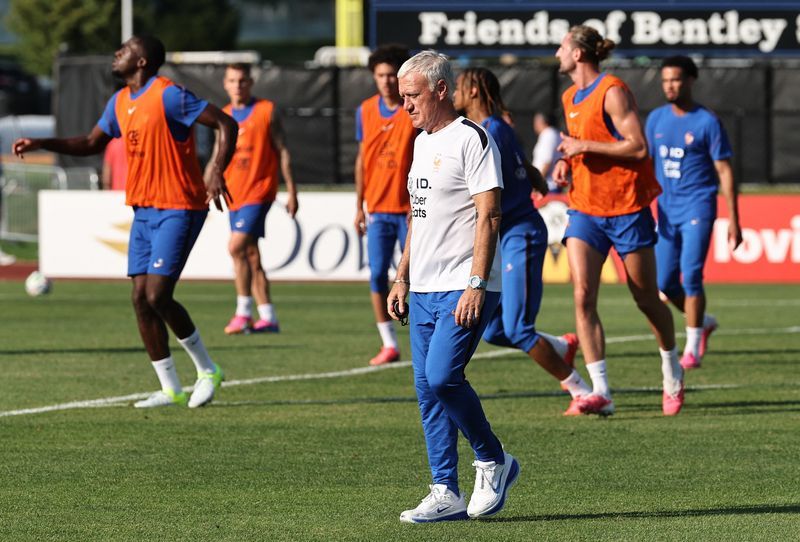
France enters the knockout stage of the World Cup with one of the tournament's most formidable attacking arsenals, having swept through Group I with ten goals across wins against Senegal, Iraq and Norway. Coach Didier Deschamps faces Sweden on Tuesday in the Round of 32 with the luxury of multiple attacking options, yet tactical refinements on the left side of his formation remain a consideration before the intensity of knockout football begins.
The French attacking trident of Kylian Mbappe, Ousmane Dembele and Michael Olise has emerged as arguably the most potent offensive force at the tournament. Mbappe has been the focal point of Les Bleus' campaign, while Dembele's hat-trick against Norway and Olise's creative contributions from the right flank have demonstrated the breadth of attacking talent at Deschamps' disposal. The depth available on the bench—featuring Bradley Barcola, Desire Doue, Rayan Cherki, Jean-Philippe Mateta and Marcus Thuram—underscores a level of forward strength that few international squads can match. No other team appears capable of matching France's capacity to replace world-class attackers with equally dangerous alternatives.
However, the left flank has not performed with the same cohesion as the right side throughout the group stage. Theo Hernandez, the AC Milan left-back, has struggled to establish the consistency Deschamps demands at full-back, leading the coach to consider tactical adjustments. Lucas Digne is expected to replace Hernandez, offering greater defensive solidity and more reliable service from wide areas—a trade-off that sacrifices some attacking flair for structural security. Further up the left wing, Bradley Barcola appears poised to displace Desire Doue, bringing more directness, explosive pace in transition and natural width to balance the right-sided dominance of the Olise-Mbappe-Dembele axis.
These changes reflect a pragmatic recognition that Sweden, while not a spectacular opponent, possesses enough physical presence and tactical organisation to punish complacency. The Swedish team finished second in Group F behind the Netherlands, having blitzed Tunisia 5-1 before suffering a similar fate against the Dutch, then drawing with Japan. Their counter-attacking threat and set-piece prowess could expose space behind France's defensive line if Les Bleus become too attack-minded. The repositioning of personnel on the left would not fundamentally alter France's attacking philosophy but rather create a more balanced, coherent shape less vulnerable to transitions and aerial bombardment.
The stability of France's central defence also improves with the return of William Saliba, whose presence in the back line provides the assurance needed heading into knockout competition. Throughout the group stage, occasional defensive oversights suggested vulnerability when opponents pressed with genuine intensity, a concern the defensive reinforcements should address. Sweden's capacity to absorb pressure and spring forward quickly means France cannot afford the lapses that remained manageable against less potent attacking sides during the opening phase of the tournament.
Yet even with structural tightening, the fundamental imbalance in attacking capacity remains decisive. France's offensive options are simply superior in number, speed and technical execution. Whatever adjustments Deschamps implements defensively, Les Bleus retain the ability to score multiple goals within ninety minutes, a margin of safety other teams cannot claim. The bench strength means tactical substitutions will introduce fresh attacking threats rather than necessitating defensive compromise.
France's knockout record at the World Cup offers further reassurance, despite the sobering final against Argentina in 2022. Since 2014, Les Bleus have not surrendered a knockout-stage match, suggesting the transition from group play—where overwhelming opponents proved feasible despite occasional carelessness—to the intensity of sudden-death football aligns with their demonstrated strengths. The knockout stage punishes complacency and defensive negligence more severely, conditions that historically have suited France's blend of technical excellence and attacking firepower.
Sweden represents the type of awkward but beatable opponent that frequently emerges in knockout rounds. Alexander Isak, Viktor Gyokeres and Anthony Elanga provide a functional attack, yet their firepower pales against France's constellation of talent. Former England striker Gary Lineker, assessing the matchup for French sports daily L'Equipe, acknowledged Sweden's credentials while emphasising the gap in attacking resources. France's plurality of front-line options creates a scenario where defensive solidity matters less than the likelihood of outscoring opponents multiple times over—a luxury few World Cup competitors possess.
The counter-attacking vulnerability that briefly emerged during France's encounter with Norway's reserve side illustrates the potential downside of fielding four genuine forwards simultaneously. Sweden, adopting a deep defensive posture and exploiting set pieces, will test whether France's adjustments sufficiently address this weakness. The Danish side in previous tournaments demonstrated that organisation and discipline, rather than individual brilliance, can constrain even the most formidable attacking units for periods.
Victory would propel France into the Round of 16 against either Germany or Paraguay, establishing a pathway towards the later stages. Germany represents a tantalising prospect should the German side progress, offering the type of heavyweight contest that could define the tournament narrative. Paraguay provides a more straightforward challenge, though any team capable of eliminating Germany warrants respect.
Ultimately, France enters the Sweden matchup as overwhelming favourites due to attacking superiority, greater depth and superior recent knockout-stage experience. Deschamps' tactical adjustments on the left represent prudent refinement rather than desperate remediation, fine-tuning an already formidable system. The question confronting Sweden is not whether they possess the talent to compete—they do—but whether their defensive organisation and transitional capacity can withstand France's relentless attacking waves. History and current form suggest they cannot.

