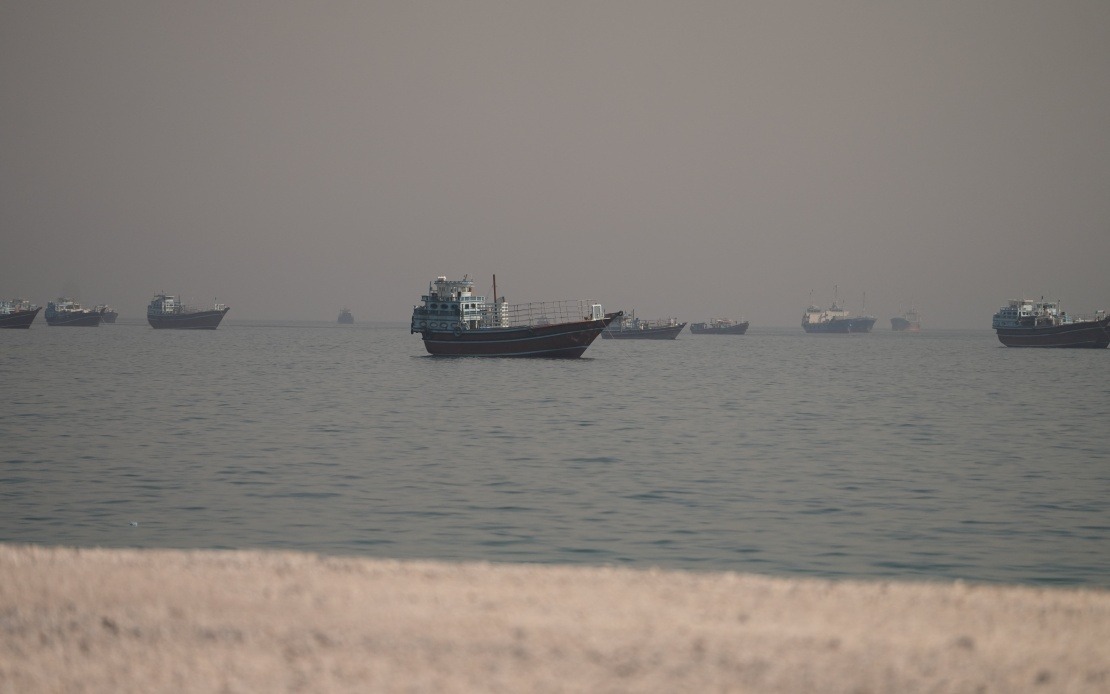
France's Foreign Minister Jean-Noel Barrot has identified Syria as a critical alternative pathway for oil transportation, signalling Paris's strategic pivot toward reducing vulnerability to disruptions in the Strait of Hormuz. Speaking in an interview with TF1 on Thursday, Barrot articulated the rationale behind this shift, linking it directly to the volatile situation between the United States and Iran that continues to threaten one of the world's most crucial energy corridors. The comments reflect a broader European preoccupation with insulating themselves from geopolitical shocks that could interrupt fuel supplies to the continent.
The Strait of Hormuz has long been identified as a critical chokepoint in global energy markets, with roughly one-quarter of the world's seaborne oil trade passing through its narrow waters between Iran and Oman. Any disruption—whether from military confrontation, sanctions enforcement, or deliberate blockade—poses an immediate threat to energy security across Europe, Asia, and beyond. Recent escalations in US-Iran relations have amplified these concerns, prompting governments and energy companies worldwide to urgently explore diversification strategies. For France, which relies substantially on imported oil and natural gas, the urgency of this quest has become a matter of national economic security and foreign policy priority.
Barrot's invocation of Syria as a solution reflects a dramatic reassessment of the country's role in regional geopolitics. Following the overthrow of Bashar al-Assad approximately eighteen months prior to his July statement, Syria has entered a period of political transition and reconstruction. The French minister suggested that this transitional moment presents an opportunity for Syria to evolve into a legitimate regional energy hub and trading centre, providing alternative infrastructure for routing petroleum shipments away from the contested waters of the Persian Gulf. This characterisation marks a significant shift in international attitudes toward Syria, moving beyond the isolation and sanctions that defined much of the past decade of Syrian politics.
The strategic logic underlying France's overture is straightforward yet ambitious. By establishing or supporting energy corridors that bypass the Strait of Hormuz, European nations can reduce their exposure to supply shocks rooted in Middle Eastern geopolitical rivalries. Syria's geographic position, stretching from the Mediterranean coast toward Iraq and the broader Levantine region, could theoretically facilitate new transportation networks for hydrocarbons. However, the practical realisation of such infrastructure would require enormous capital investment, political stability in Syria, and cooperation from neighbouring states—conditions that remain uncertain despite the change in political regime.
Barrot's comments must be understood within the context of his recent visit to Damascus alongside President Emmanuel Macron on Tuesday. This diplomatic mission represented France's formal endorsement of Syria's new political direction and a commitment to reintegration into the international community. The visit signalled that Paris views the post-Assad period as an opportunity to reset relations and position French interests advantageously in a country that has been peripheral to Western engagement for years. By coupling energy security discussions with broader economic and diplomatic cooperation, France is attempting to establish itself as a key partner in Syria's reconstruction process.
The French position also reflects Europe's wider concern about strategic autonomy in energy matters. The continent's heavy reliance on Russian gas was dramatically exposed by Moscow's invasion of Ukraine in 2022, prompting a wholesale reassessment of energy dependencies. While the Middle East has traditionally served as a crucial alternative source, the instability surrounding the Strait of Hormuz and US-Iran tensions introduce new vulnerabilities. France, which already maintains a relatively independent stance within Europe on Middle Eastern affairs, appears to be seeking to leverage Syria's transition as a means of advancing this broader objective of reducing dependence on any single source or corridor.
From a Southeast Asian perspective, France's strategic calculation holds important lessons. Regional nations including Malaysia face similar pressures regarding energy security and supply chain vulnerability. Many depend heavily on imports from the Middle East and are exposed to disruptions in the Strait of Hormuz—a risk that has become increasingly salient as geopolitical tensions rise. The French approach suggests that diversification of supply routes and strategic engagement with transitional or rising powers can offer a hedge against concentration risk. For ASEAN members, this underscores the value of maintaining flexibility in energy partnerships and exploring alternative corridors that do not depend exclusively on politically volatile regions.
The practical challenges of implementing Syria as an alternative energy hub remain formidable. The country's infrastructure has been severely damaged by a decade of civil conflict, and its governance structures remain fragile despite the change of regime. Establishing or rehabilitating pipelines, port facilities, and logistics networks would require sustained investment and technical expertise. Furthermore, any such project would need to navigate the interests of other regional players, including Iraq, Turkey, and Gulf States, all of whom have stakes in how Syria develops and which external powers gain influence there. The transition from rhetoric to actual infrastructure development could prove slow and uncertain.
Barrot's emphasis on France wanting to expand cooperation with Damascus across all fields and strengthen economic ties indicates that the energy security angle is embedded within a broader strategy of French reengagement. This multifaceted approach—combining security, trade, and political recognition—is designed to position France as a reliable partner for Syria's new leadership while simultaneously advancing French interests. The stakes extend beyond oil shipments to encompass influence in a strategically important corner of the Middle East, particularly as other powers including the United States, Russia, and regional heavyweights like Saudi Arabia and the UAE also recalibrate their approaches to post-Assad Syria.
The timing of these statements also merits examination. Uncertainty about US policy direction, combined with ongoing tensions in the Middle East and broader questions about global energy markets in an era of energy transition, creates a window in which alternative energy corridors are being contemplated more seriously than might have been the case during periods of relative geopolitical calm. Whether Syria can realistically develop into a meaningful alternative to the Strait of Hormuz for oil shipments depends not only on infrastructure investment but also on sustained political stability, regional cooperation, and international commitment to supporting such initiatives. For now, Barrot's comments represent an important signal of French intent and a recognition that diversifying energy routes is becoming an unavoidable strategic imperative for European nations seeking greater resilience against geopolitical shocks.

