The quarter-final matchup between France and Morocco carries significance that extends far beyond the pitch, rooted in a century of interconnected history and the modern reality of shared families, migration patterns, and professional networks. Thursday's encounter in Boston represents more than a contest between two footballing nations—it embodies the complex legacy of French colonial rule from 1912 to 1956 and the enduring bonds that have persisted through education, commerce, and the movement of people across the Mediterranean. The fixture becomes a lens through which to examine how sport reflects and reinforces the ties that bind contemporary Europe and North Africa, particularly within the game that has become the primary cultural expression of those relationships.
The composition of Morocco's squad underscores these intricate connections. Six players were born in France, while numerous others have developed through French academies or competed in Ligue 1 before electing to represent Morocco internationally. This reality reflects a deliberate strategy by the Moroccan federation to harness its diaspora as a competitive advantage, transforming the geographic dispersion of its population into a source of footballing strength. The approach has proven remarkably effective, allowing Morocco to access high-quality coaching, infrastructure, and development pathways while maintaining the cultural and national identity that drives these players to don the national colours.
Ayyoub Bouaddi exemplifies the layered identities that characterise this generation of players. The teenager was born in France, refined his skills at Lille, and represented France at youth level before committing to Morocco. His trajectory is not unusual but rather representative of broader patterns in European football, where the distinction between national development systems has become increasingly porous. Such cases highlight how the traditional boundaries of sporting nationalism have blurred, particularly in nations with significant diaspora populations and complex migratory histories. These players navigate questions of belonging and identity that few footballers elsewhere experience with such immediacy.
The personal relationships forged across both nations add another dimension to proceedings. Kylian Mbappé and Achraf Hakimi developed a close friendship during their time together at Paris Saint-Germain, a connection that transcends national rivalry and speaks to the cosmopolitan environment that elite football has created. Such friendships remind observers that these athletes are not merely representatives of abstract national interests but individuals whose lives and careers have been shaped by experiences in both countries. The affection between players from rival nations introduces complexity into what might otherwise be a straightforward competitive narrative.
France arrives as the defending World Cup champion from 2018, armed with tournament experience and an attacking arsenal that has generated consistent threat throughout the competition. Their victory over Paraguay secured a quarter-final berth, but Morocco's credentials should not be underestimated. The African nation demonstrated its capacity to shock established powers by becoming the first African team to reach a World Cup semi-final four years earlier, establishing a template for sustained competitive performance. That previous meeting in Qatar in 2022, won 2-0 by France, carried profound emotional weight whilst simultaneously reflecting mutual respect between opposing sides. The rematch now carries the prospect of Morocco as a more accomplished outfit, no longer operating merely from an underdog position but as a genuine challenger to football's traditional hierarchy.
Boston provides an unexpected but apt venue for this encounter, distant from the intense security apparatus that would characterise such a fixture in France or Morocco. The geographic remove offers the possibility of a gathering that retains competitive passion whilst avoiding the sectarian tensions that occasionally accompany such matches in Europe. The Moroccan community in the Boston metropolitan area, whilst smaller than in major French cities, has established itself as an organised presence through family networks, professional communities, and business connections. For these residents, the fixture does not necessarily impose a binary choice between supporting one nation or the other.
Mohammed Saadi, a 57-year-old taxi driver, articulated the prevailing sentiment: neighbours will watch together across linguistic and national divides, shake hands at the conclusion, and regard the contest as fundamentally a family affair rather than a source of division. This perspective reflects the lived reality of communities shaped by migration and cohabitation, where multiple allegiances coexist within the same households and streetscapes. The absence of manufactured tension stands in contrast to the heavy security presence that France itself deployed, demonstrating how context and geography influence the social meaning attached to sporting events.
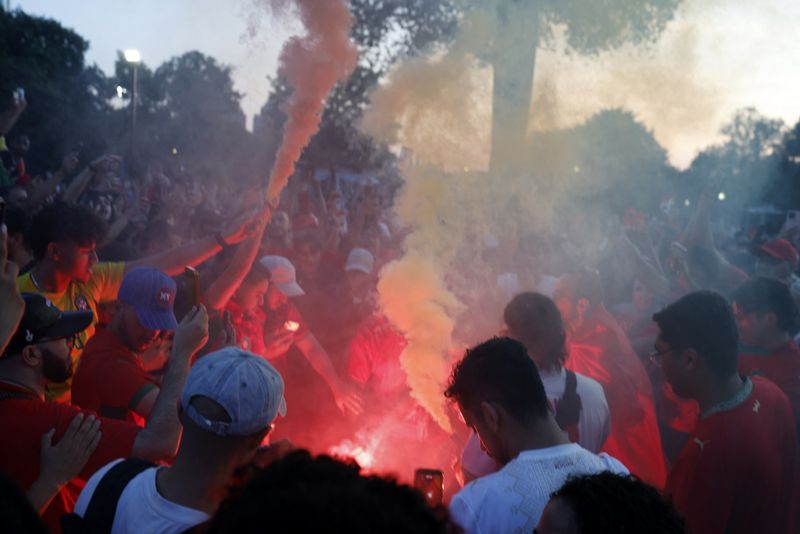
More than a thousand supporters gathered in Boston Common to celebrate Morocco's campaign, singing Dima l-Maghrib (Always Morocco) and displaying flags in scenes of peaceful collective expression. Youssef Bennani, a 36-year-old software engineer who travelled from Finland to attend Morocco's matches, described the assembly as the optimal destination for witnessing the quarter-final, a place where supporters from both nations mingled and anticipated a festive occasion rather than a hostile confrontation. His presence, having followed Morocco across multiple fixtures, reflects the global character of contemporary football fandom and the diaspora networks that sustain support across continents.
Morocco's trajectory has fundamentally altered the character of this fixture. They are no longer the romantic underdogs who captured international imagination but a well-organised side demonstrating the discipline, pace, and tactical intelligence necessary to compete against established powers. Their demolition of Canada by three goals to nil revealed defensive solidity married to attacking ambition. The federation's investment in player development has produced tangible results, creating a squad where European experience and African hunger combine effectively. Their confederation has consciously built connections between domestic advancement and talent cultivated abroad, constructing a sustainable model of international competitiveness.
France must reckon with opponents who understand their style intimately, having studied their methods across multiple continental competitions. The attacking prowess that has characterised the French tournament performance will encounter a Moroccan side versed in defensive organisation and transition play. The quarter-final thus represents not merely a clash between two nations but a meeting between different footballing philosophies and competing visions of how modern international football should be conducted. Morocco's presence in this stage, improbable yet entirely justified by their performances, challenges narratives about which nations possess the right to aspire toward tournament glory.

