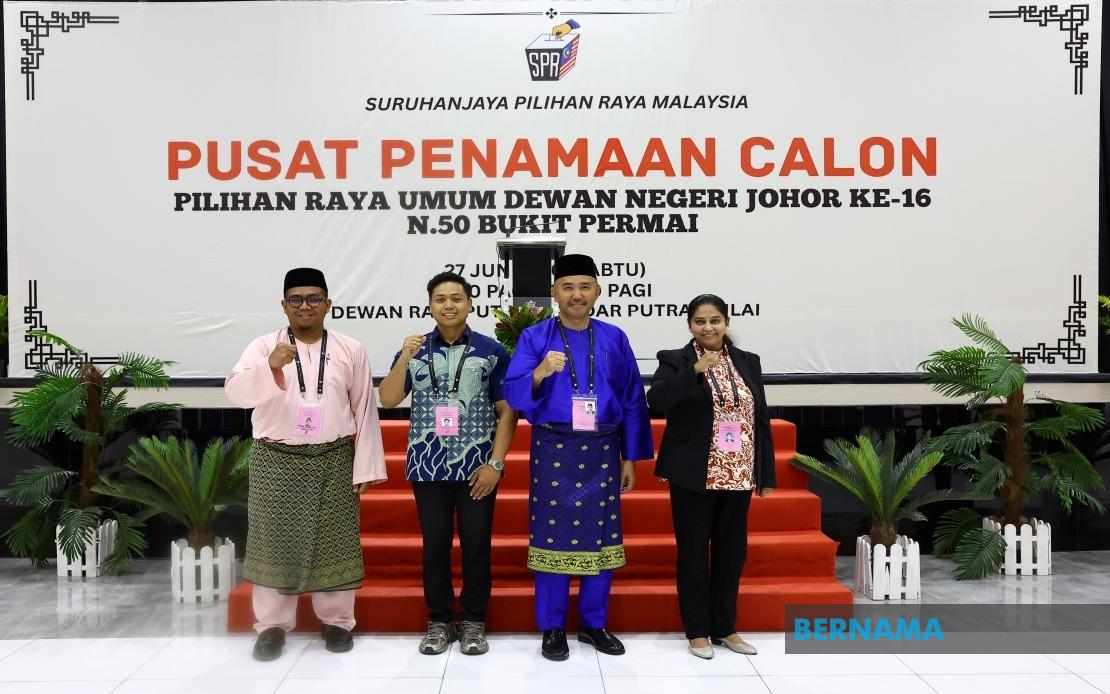
Bukit Permai's political landscape has taken shape for the upcoming state election, with the incumbent Datuk Mohd Jafni Md Shukor of Barisan Nasional now confronting a crowded field of challengers. The nomination process closed this morning in Batu Pahat, confirming that the BN representative will defend his seat against candidates from three other political camps, fundamentally altering the dynamics of what was already a closely watched constituency.
Official confirmation came through returning officer Afzan Azhari, who announced all four contenders at the nomination centre located at Dewan Raya Putra in Bandar Putra. Standing against Mohd Jafni are Mohamad Shafwan Ani representing Pakatan Harapan, M. Lina Manoh flying the Perikatan Nasional banner, and Muhammad Aidil Riduan Mohd Yusof contesting for the newer political entity Parti Bersama Malaysia. The announcement marks the formal entry of these candidates into the race, each bringing distinct political platforms and grassroots networks to their campaigns.
The presence of prominent opposition figures lends additional weight to this contest. Johor DAP chairman Teo Nie Ching made a visible show of support by arriving at the nomination centre early to accompany the Pakatan Harapan candidate, signalling the coalition's determination to reclaim what it views as a winnable seat. Such high-profile backing often translates into enhanced campaigning resources and organizational infrastructure, particularly important in tight electoral contests where ground operations frequently decide outcomes.
Mohd Jafni's previous victory provides both a baseline and a challenge for analysts assessing his re-election prospects. In the 2022 Johor state election, he secured the Bukit Permai seat with a majority of 4,755 votes, already achieved in a four-cornered contest that year. The repeat appearance of four candidates suggests the seat remains competitive and fragmented across the political spectrum, with no single opposition force commanding overwhelming support among voters dissatisfied with the incumbent.
This multipolar contest reflects broader shifts in Malaysian electoral politics, where traditional two-coalition competition increasingly fragments into multiple contending forces. The emergence of Parti Bersama Malaysia as a contestant demonstrates how newer political movements seek traction at the state level, attempting to carve out distinctive positions separate from established opposition coalitions and the ruling coalition. For voters, this proliferation of choices offers opportunities for nuanced political expression but also complicates the strategic calculus around vote concentration and effective representation.
The electoral timeline has now been finalized, with the Election Commission establishing early voting for July 7, giving registered voters a preliminary polling window before the main election day. The official polling date of July 11 represents the decisive moment when all candidates' campaigns will be tested against actual voter preferences. This compressed campaign period requires all contestants to mobilize their organizations efficiently and maximize their messaging impact across digital and traditional platforms.
For Bukit Permai specifically, the four-way configuration could prove advantageous to any candidate who consolidates support within particular demographic or geographic segments of the constituency. Incumbent advantages in name recognition and governmental resource access typically matter more in fragmented contests where opposition votes split across multiple candidates, each potentially drawing supporters from different backgrounds and motivations. Conversely, unified opposition mobilization against an incumbent remains possible if voters coalesce around a single anti-incumbent candidate perceived as most viable.
The Johor state election itself carries significance beyond individual constituency outcomes, as it will determine the composition of the state assembly and influence the trajectory of state-level governance. Bukit Permai's result will form one data point in understanding whether Barisan Nasional can consolidate its recent electoral recovery or whether opposition and new political movements can leverage fragmentation to make inroads in the state that has been a traditional BN stronghold with important strategic value for national politics.
Campaigning dynamics in such multifactorial contests often emphasize localized issues alongside state and national political narratives. Candidates typically focus on constituent concerns—economic opportunities, infrastructure development, communal harmony, and service delivery—while also positioning themselves within larger political frameworks. The incumbent's track record in addressing local grievances will be weighed against opposition candidates' promises of fresh approaches and Bersama's positioning as an alternative to established parties.
With nomination procedures completed and the electoral machinery now in motion, all four candidates enter the substantive phase of their campaigns. The weeks ahead will determine which candidate successfully resonates with Bukit Permai voters and secures their mandate. In a four-way contest where previous winning margins exceeded four thousand votes, the final outcome remains genuinely competitive, offering uncertainty that keeps Malaysian political observers closely monitoring developments in this crucial Johor constituency.

