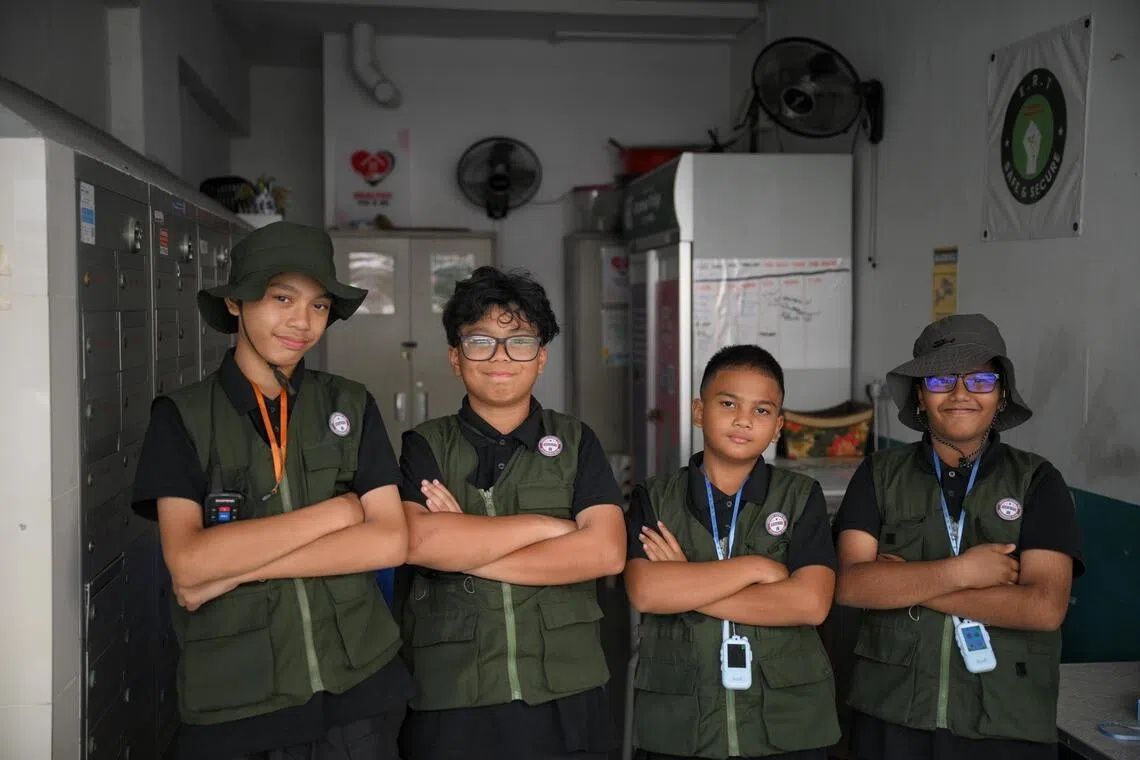
When 12-year-old Rafieq Sahin Rafizal witnessed repeated thefts from a community fridge stocked with free milk for underprivileged children in his Lengkok Bahru housing estate, he recognised a problem demanding action. Rather than merely complaining, the youngster proposed a practical solution that would evolve into something far more ambitious than anyone anticipated. Today, Rafieq and three schoolmates have formalised their response into the Emergency Response Team LB, a youth-led initiative that conducts daily patrols across multiple blocks of their estate, demonstrating the capacity of children to contribute meaningfully to community welfare.
The patrol unit consists of four members ranging from 11 to 14 years old, all students at Gan Eng Seng Primary School. Operating under the mentorship of Rafieq's mother, Marlina Yased, a 48-year-old homemaker, these young volunteers have assumed responsibility for monitoring their immediate surroundings with striking maturity. Their daily routine involves identifying and documenting problems such as illegal dumping of bulky furniture and appliances, acts of vandalism targeting common areas, and the unauthorised charging of personal mobility devices in shared spaces—a practice that poses genuine fire risks to residents. Once they identify issues, the boys photograph the evidence and report findings to Marlina, who then coordinates with estate management to ensure swift resolution.
Since formally launching their patrols in August 2025, the team has expanded their reach well beyond property maintenance concerns. They have assisted an elderly resident with mobility challenges in transporting groceries to her residence and have successfully intervened in disputes among neighbourhood children, demonstrating emotional intelligence and conflict resolution capabilities rarely seen in youth their age. These interventions reflect a growing awareness that community safety encompasses not merely physical infrastructure but also the social fabric connecting residents across different demographics and life circumstances.
The team's most significant discovery came earlier in 2026, when their vigilance uncovered a tragedy that authorities alone might have delayed in addressing. After noticing a persistent, foul odour emanating from a residential unit, the boys immediately escalated the matter to Marlina, who contacted estate cleaners and residents who subsequently alerted police. The subsequent investigation revealed the decomposed body of an elderly resident within the flat, highlighting how regular patrols and community presence can facilitate timely discovery of serious incidents affecting vulnerable populations living in isolation.
The initiative's origins trace to Marlina's earlier community fridge project launched in 2023, supported by local sponsors. This dual-door system maintains fresh groceries and prepared foods under secure storage while maintaining an unlocked refrigerator stocked exclusively with milk and beverages accessible to neighbourhood children before school. The arrangement addressed genuine nutritional gaps among low-income families in the estate. However, persistent unauthorised removal of supplies prompted the development of the patrol concept as a more sustainable community engagement mechanism. Marlina emphasised that she welcomed residents consuming beverages themselves, but systematic depletion of resources meant to sustain children's nutrition required intervention through awareness and presence rather than confrontation.
The patrols operate with remarkable organisation considering participants' ages. Following school, the four boys don matching vests identifying them by name and displaying the team's insignia before departing in pairs to survey up to six blocks within their estate. They maintain continuous contact with Marlina and fellow volunteer Fahmidah Farihullah, a 21-year-old who assists in coordination and guidance, using walkie-talkies to report observations and ensure safety. Originally, the team included seven members, though the roster has contracted to the current four, suggesting either natural attrition or selective retention of committed participants. The structural discipline mirrors professional emergency response operations, creating what Rafieq described as a model inspired by police Emergency Response Teams managing high-risk incidents.
Motivation among team members varies, reflecting diverse pathways to civic engagement. Rafieq articulated his commitment as a conscious choice to dedicate one hour daily to community service, balancing academic and recreational priorities. In contrast, Didie Andiqa Muhaimin, the team's eldest member at 14, initially joined because he lacked structured activity, but the programme provided purposeful engagement that might otherwise have defaulted to less constructive pastimes. Aaron Sarandev, 11, emphasised how the experience cultivated responsibility and perseverance, particularly on occasions when motivation flagged but obligations persisted. These varied motivations underscore how civic programmes can address multiple community needs simultaneously—providing structured activity for youth while addressing genuine neighbourhood safety concerns.
Community reception of the initiative has evolved from initial scepticism to growing appreciation. Some residents questioned whether young teenagers conducting patrols represented an appropriate or effective response to neighbourhood issues. However, neighbouring residents, including 27-year-old mother of five Nasha Asrin, expressed relief at observing the boys engaged in purposeful community service rather than loitering. The contrast between idle youth and purposefully employed youth resonates strongly within Singapore's cultural context, where visible contribution to collective welfare commands respect across demographic lines. Marlina has documented measurable impacts beyond community safety metrics, reporting that several boys' mothers have indicated improved school attendance and enhanced concentration among their children, suggesting the programme influences participants' broader development and engagement.
The team's forthcoming participation in August's National Day Parade represents institutional recognition of their contribution. Positioned within a segment celebrating ordinary Singaporeans who enhance their communities, the boys will experience their first national parade participation, an honour reflecting official acknowledgment that effective citizenship transcends age boundaries. For Rafieq, Aaron, Al-Mirza Danish, and Didie, this recognition validates months of daily commitment and reinforces the notion that young people possess agency in shaping their immediate environments. The momentum generated by this initiative—combining youth energy, community mentorship, and practical problem-solving—offers a replicable model for other Singapore housing estates and potentially for urban neighbourhoods across Southeast Asia confronting similar challenges of community cohesion and preventive safety.
The Emergency Response Team LB ultimately demonstrates that neighbourhood challenges need not await professional responses when residents, regardless of age, possess information, motivation, and organisational frameworks facilitating action. Marlina's role mentoring the boys illustrates how adult guidance can amplify rather than replace youth initiative, creating synergy between generations. As Singapore's population ages and mobility-related challenges increase, programmes mobilising younger residents to serve older neighbours address both immediate practical needs and deeper questions about intergenerational responsibility and social solidarity. The four boys of Lengkok Bahru have begun a conversation about what community actually means when children take the initiative to patrol their neighbourhoods not from obligation but from conviction that their presence matters.

