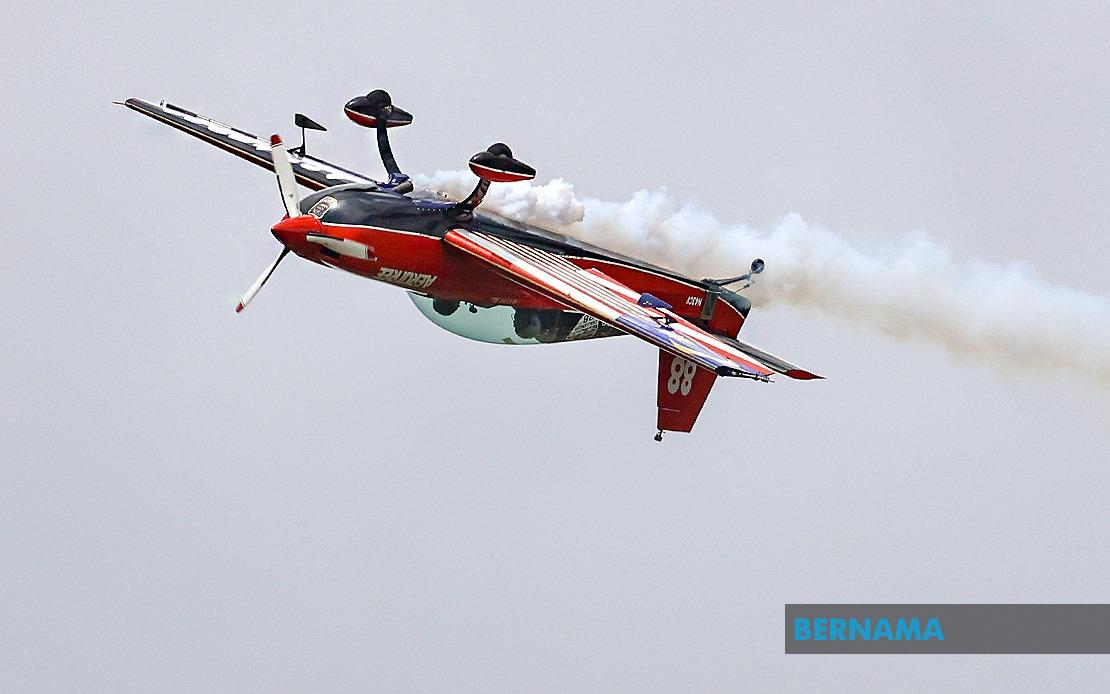
Putrajaya hosted a milestone moment in Malaysia's aviation calendar when retired Royal Malaysian Air Force fighter pilot Major (Rtd) Datuk Halim Othman, 60, took to the skies to headline the first-ever Merdeka Sunset Show: Melukis Senja, a bespoke air display crafted to commemorate the nation's 69th National Day. Drawing from four decades spent mastering military and civilian aviation, Othman delivered a solo twilight aerobatic performance beginning at 7 pm that seamlessly married technical flying precision with theatrical pyrotechnics and coloured smoke against the naturally dramatic canvas of the setting sun.
Othman's credentials in aviation extend well beyond the cockpit of Malaysia's military fleets. His distinction as the first Malaysian pilot to qualify for the prestigious Red Bull Air Race World Championship underscores the calibre of skill required to execute high-performance aerobatic manoeuvres. The discipline demanded by international competition flying—where microsecond timing errors and imperceptible control inputs determine success or failure—has shaped an operator whose understanding of aircraft behaviour borders on intuitive. These capabilities translate directly into the kind of split-second decisions necessary when choreographing complex aerial sequences over a populated area during twilight conditions, when visual references become increasingly ambiguous.
The conceptual framework for the Merdeka Sunset Show draws inspiration from its predecessor, the Melukis Senja display introduced during the Langkawi International Maritime and Aerospace Exhibition last year. That earlier iteration demonstrated strong audience reception and technical feasibility, prompting aviation authorities and cultural planners to expand the format for national celebrations. The transition from a regional aerospace showcase to a flagship National Day attraction reflects confidence in both the artistic merit and the safety protocols governing aerobatic performances over civilian populations. Incorporating smoke and pyrotechnic elements adds visual complexity while demanding stricter coordination between the pilot and ground-based safety personnel.
During an exclusive interview, Othman articulated a philosophy that distinguishes competitive aerobatic flying from mere stunt performance. He emphasised that executing extreme manoeuvres demands far more than daring; it requires systematic discipline, relentless practice cycles, and an almost clinical understanding of where aircraft perform and where they fail. When competing internationally in the Red Bull series, Othman encountered field dominated overwhelmingly by non-Malaysian and non-Asian pilots, presenting both a professional and patriotic challenge. His ambition extended beyond personal achievement; he sought to demonstrate that Malaysian aviators could operate at the elite international level, matching and exceeding the capabilities of established competitors from well-resourced nations.
Othman's professional journey began in 1985 when he joined the Royal Malaysian Air Force as a fighter pilot, eventually earning the 'Top Gun' distinction that recognises exceptional aerial combat proficiency. His subsequent diversification into military operations, aerobatic specialisation, and international racing reflects a career trajectory that few pilots achieve. His aircraft portfolio encompasses both frontline military jets and civilian competition machines: he has commanded the MiG-29N, F/A-18D Hornet, A-4 Skyhawk, and F-5E Tiger in military service, while also operating the Extra 300L aerobatic aircraft and corporate turboprops including the Learjet 35A and King Air 350i. This breadth of experience translates to adaptive problem-solving skills essential when transitioning between fundamentally different aircraft designs and flight regimes.
International competition success validates technical mastery across diverse formats. In 2014, Othman demonstrated competitive excellence by capturing the Challenger Cup at prestigious venues in Ascot, United Kingdom, and Las Vegas, United States, followed by a runner-up finish in the Challenger Cup Final contested at the Red Bull Ring in Austria. These results positioned him among the world's most accomplished aerobatic competitors and attracted international aviation media attention. For Malaysian aviation enthusiasts and defence policy observers, Othman's achievements provide tangible evidence that world-class aerial performance need not originate exclusively from established aviation powers.
Beyond individual accomplishment, Othman has shaped Malaysia's institutional aerobatic capability through his role establishing Krisakti, the nation's first official aerobatic display team. The formation debuted publicly at the Langkawi International Maritime and Aerospace Exhibition in 2011, introducing Malaysian audiences to coordinated multi-aircraft precision flying. His founding and presidency of Aerotree Defence and Services Sdn Bhd extends this institutional contribution, positioning the company as a nexus for advanced aviation services and talent development. The timing of aerobatic team establishment coincided with Malaysia's broader expansion of aerospace capabilities, reflecting broader national strategic interest in aviation excellence.
Looking forward, Othman articulated an ambitious vision for scaling aerobatic capacity and spectacle. Plans include unveiling a newly constituted aerobatic team comprising six aircraft equipped with coordinated coloured smoke systems, intended for deployment during future National Day celebrations and upcoming editions of the Langkawi International Maritime and Aerospace Exhibition. The transition from solo performances to multi-aircraft formations introduces exponential complexity: pilots must maintain precise spacing while executing identical manoeuvres in real time, with safety margins measured in metres and timing tolerances measured in tenths of seconds. Such formations demand standardised aircraft, integrated communication protocols, and dozens of coordinated training sorties before public presentation.
Othman characterised the aerobatic initiative as extending beyond entertainment into the corporate social responsibility domain. He expressed conviction that spectacular aerial displays cultivate interest in aerospace careers among younger Malaysians, potentially directing talent toward emerging sectors including defence aerospace, commercial aviation, and space technology. Given Malaysia's regional aerospace ambitions and defence modernisation imperatives, cultivating domestic expertise in advanced flying operations carries strategic significance. Public inspiration generates talent pipeline effects measurable over decades: exposure to aviation excellence in formative years correlates with subsequent career trajectory choices.
The Merdeka Sunset Show represents convergence of multiple objectives: national celebration, aviation advancement, international-standard performance, and youth inspiration. Othman's four-decade career arc—from military fighter pilot through international competition to institutional leadership—embodies the journey Malaysia's aviation sector requires. His determination to prove Malaysian capability on the world stage resonates particularly in an era when regional countries increasingly assert technological and operational independence. The twilight display served as both spectacular entertainment and subtle assertion that Malaysian aviation personnel operate at genuinely elite international standards, not merely as aspiring practitioners seeking external validation.

