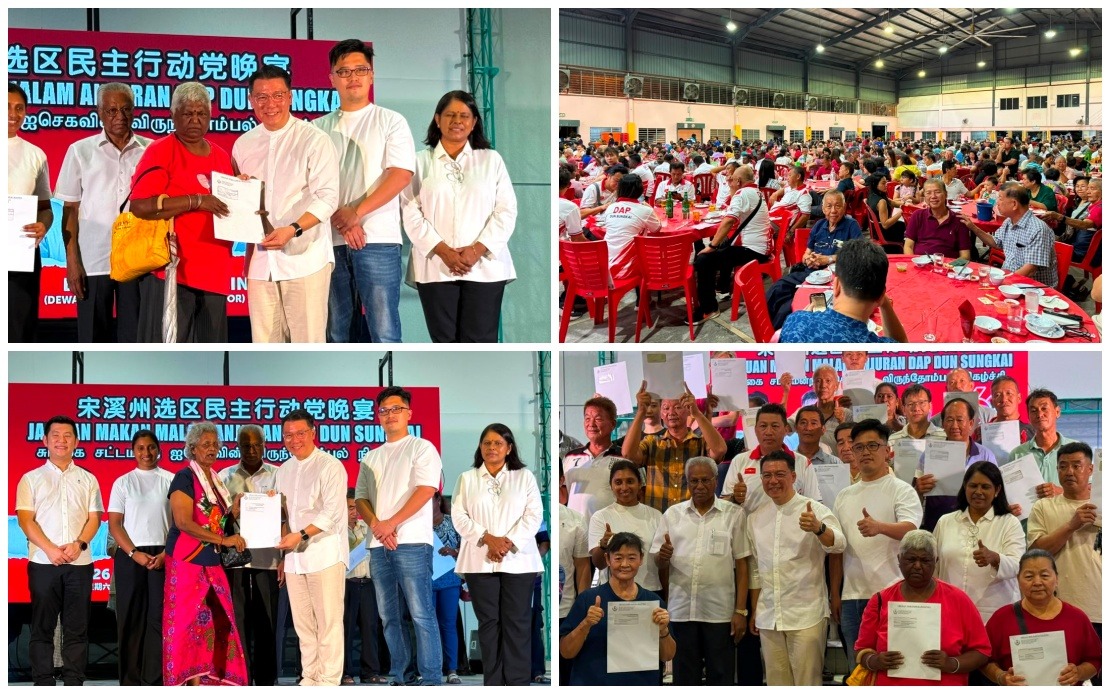
The Malaysian government has moved to resolve one of Perak's most stubborn land disputes by granting titles to 120 families whose informal settlements in Sungkai and Kuala Bikam have persisted for over four decades. Housing and Local Government Minister Nga Kor Ming presented the land grants during a DAP constituency dinner, describing the resolution as evidence of the MADANI administration's pledge to ensure equitable development across all communities regardless of ethnicity or socioeconomic standing.
The drawn-out nature of this settlement problem underscores the complexity of land administration across Malaysia's states and the accumulated backlog of disputes affecting low-income populations. Squatter communities frequently occupy land through decades of continuous habitation, creating de facto claims that complicate formal legal resolution. The Sungkai and Kuala Bikam case exemplifies how such issues can persist across generations, with successive administrations inheriting unresolved disputes. The resolution represents not merely a bureaucratic clearance but a tangible acknowledgement that occupants who have invested decades establishing homes and community structures warrant formal recognition.
Nga framed the development within the MADANI Government's broader equity narrative, emphasising that resolving the dispute reflected commitment to preventing any Malaysian from remaining marginalised in the nation's development agenda. This positioning connects land security to human dignity and opportunity, arguing that without secure tenure, families cannot access credit, invest in property improvements, or plan long-term futures. The minister's language deliberately elevated the land grant from administrative action to symbolic gesture representing generational security.
The resolution involved sustained coordination across multiple government agencies and levels. Sungkai state assemblyman Datuk A. Sivanesan, who chairs the state Human Resources, Health, Indian Community Affairs and National Integration Committee, worked alongside civil servants to navigate the overlapping jurisdictional and technical challenges inherent in formalising informal settlements. Such outcomes typically require negotiations between state land authorities, local councils, and various federal bodies, making bureaucratic persistence crucial. The acknowledgement of these officials' efforts signals that resolving historical grievances demands dedicated personnel willing to navigate administrative complexity.
The timing and scale of the presentation—at a DAP constituency anniversary dinner attended by over 1,200 people from diverse communities—demonstrates the political significance attached to the resolution. Land security resonates deeply across Malaysian society, particularly within communities that have historically experienced tenure insecurity. By presenting the grants publicly and prominently, the government ensured maximum visibility and reinforced messaging about its responsiveness to long-neglected populations.
Nga's statements about the Indian community context reveal the government's strategic allocation toward specific demographic groups. The RM20 million earmarked for Indian settlements, RM50 million directed to Tamil vernacular schools, and the RM150 million allocation for the Malaysian Indian Transformation Unit represent coordinated efforts to address historical underinvestment. These figures suggest recognition that particular communities have accumulated disadvantages requiring targeted intervention. The Sungkai resolution sits within this broader framework of correcting historical imbalances through visible, quantifiable commitments.
The minister's exhortation to judge government performance rather than be swayed by racial sentiment introduces a political dimension, implying criticism of opposition narratives. By contrasting performance-driven governance with what he termed outdated, destructive politics, Nga positioned the land grants as evidence favouring the current coalition. This rhetorical move attempts to reframe political competition around measurable outcomes—titles distributed, schools built, budgets allocated—rather than ideological or identity-based appeals. However, such framing inevitably remains contested, as opposing parties may argue about whether proposed solutions adequately address root causes or represent tokenistic gestures.
For Perak specifically, the resolution carries implications for state governance and land administration capacity. Perak has experienced complex political transitions and administrative restructuring in recent years, and demonstrating ability to resolve longstanding disputes strengthens institutional credibility. The success signals that despite political turbulence, the state apparatus can deliver on commitments to vulnerable populations. This capacity becomes crucial as Perak continues development initiatives that may generate additional land tenure questions.
The resolution also reflects evolving approaches to informal settlement management across Southeast Asia. Rather than pursuing displacement or slum clearance policies common in earlier decades, Malaysian authorities increasingly recognise that formalisation—converting squatter status to legitimate tenure through land grants—generates better outcomes for residents while reducing social friction. This approach acknowledges that informal settlers typically occupy land that remains economically productive and socially stable; formalising tenure protects these communities while potentially improving government revenue through regularised property assessment.
The 40-year duration of the dispute suggests previous administrations, despite good intentions, lacked political will or administrative capacity to resolve it. Each year of delay compounded the problem by creating deeper community entrenchment and expanding the affected population as residents had children within the informal settlement. The current resolution therefore represents not merely solving a single problem but potentially establishing precedent for addressing other longstanding tenure disputes affecting multiple communities nationwide. Success in Sungkai could justify and facilitate similar programmes elsewhere.
For residents receiving the grants, the practical implications extend beyond symbolic security. Land titles enable access to formal credit markets, allowing residents to finance home improvements, education, or business expansion. Secure tenure reduces vulnerability to arbitrary eviction and creates assets that can be inherited, transferred, or mortgaged. These economic dimensions transform the grants from primarily political gestures into instruments that can enhance recipients' productive capacity and intergenerational wealth accumulation.
The prominent participation of DAP representatives, including national deputy chairman Nga and local MPs and assemblymembers, reflects the party's political interest in demonstrating delivery to Indian community constituents. The event served simultaneously as policy implementation, political celebration, and coalition messaging. However, the substantive outcomes—120 families with secure land tenure—remain significant regardless of the political theatre surrounding their announcement, addressing a four-decade gap in administrative justice that previous governments had permitted to persist.

