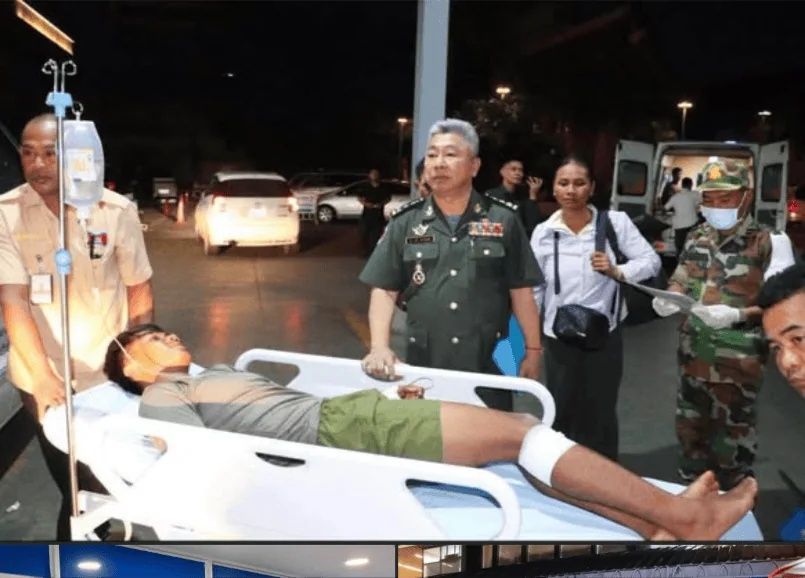
Cambodia's military confirmed on Monday that an explosive device detonated along its border with Thailand the previous day, leaving four soldiers injured during a routine patrol operation. The incident, which occurred at 12:35 p.m. local time on Sunday, took place in a cashew plantation area spanning the villages of Chouk Kruos and Thma Don in Oddar Meanchey province, a region situated in northern Cambodia that has long been a point of tension between the two neighbouring countries. Lieutenant General Maly Socheata, undersecretary of state and official defence ministry spokeswoman, made the announcement, confirming that all four wounded personnel were receiving medical treatment from military medical teams and supporting personnel stationed nearby.
The Cambodian-Thai border has historically been a volatile frontier, marked by periodic skirmishes and disputes over demarcation that have occasionally erupted into armed confrontation. Oddar Meanchey province, which lies directly adjacent to Thailand's border regions, remains one of the most sensitive areas along this contested boundary. The exact nature of the explosive device was not specified in official statements, though such incidents along this frontier have in the past involved landmines from earlier conflicts or improvised explosive devices. The timing and location of the blast raised immediate questions about responsibility and the circumstances surrounding the detonation.
Thailand's military establishment moved swiftly to clarify its position regarding the incident. Winthai Suvaree, the Thai Army's official spokesperson, issued a statement on the same day confirming that Thai troops had been conducting standard patrol operations on Thai territory when they detected the explosion originating from the Cambodian side of the border. The Thai military explicitly denied any involvement, stating categorically that its forces had not discharged weapons or deployed grenades during the period in question. This denial reflected Thailand's concern about potential accusations that could inflame already delicate bilateral relations.
The Royal Thai Army conducted what it described as a rapid investigation involving responsible military units in the area. Following this preliminary inquiry, Thai officials concluded that the explosion had definitively occurred on Cambodian soil and had not resulted from any actions by Thai forces. This determination was publicly emphasized, seemingly intended to preempt any diplomatic complications that might arise from the incident. The statement represented a standard protocol response when such incidents occur near the shared frontier, with both nations typically seeking to establish clear positions early to avoid misunderstandings.
For Malaysian and Southeast Asian observers, this incident underscores the persistent instability that characterizes certain border regions within ASEAN, despite the organization's founding principles emphasizing peaceful resolution of disputes and non-interference. The Cambodia-Thailand frontier has been particularly problematic, with historical land disputes and military tensions occasionally threatening regional stability. While the July incident appears to have been relatively contained, it demonstrates how fragile the peace remains in such areas, where historical grievances, demarcation ambiguities, and military presence combine to create volatile circumstances.
The involvement of military personnel on routine patrol duties highlights how border security operations, intended to maintain order and sovereignty, can inadvertently become flash points for international incidents. The four wounded soldiers represented the human cost of patrolling an environment where explosive remnants of past conflicts may still pose hazards. Cambodia, like several Southeast Asian nations, continues to contend with landmine contamination from its extensive civil conflicts during the 1970s and 1980s, a legacy that periodically surfaces in incidents such as this one.
Both countries' swift public communications regarding the incident reflected efforts to manage potential diplomatic fallout. Thailand's detailed denial of involvement and its assertion that the explosion occurred on Cambodian territory represented an attempt to establish a clear factual record that would prevent escalation. Cambodia's focus on medical care for the wounded soldiers and the straightforward reporting of the incident suggested an effort to treat it as a localized incident rather than a major diplomatic crisis. This measured approach contrasted sharply with how such incidents might have been handled during periods of heightened regional tension.
The incident also reflected broader security challenges facing Cambodia as it manages its northern border with Thailand while simultaneously dealing with internal security priorities. The cashew plantation setting where the explosion occurred illustrates how civilian economic zones and military operational areas often overlap near borders, creating complex situations where security imperatives must be balanced against economic activity and civilian safety. The presence of Cambodian military patrols in such areas represented routine efforts to assert territorial control and security presence.
For regional analysts, the incident served as a reminder that despite decades of regional cooperation frameworks and bilateral engagement, Southeast Asia's borders remain inherently challenging to manage. The ASEAN mechanism has succeeded in preventing major armed conflicts between member states in recent decades, yet incidents such as explosions along the Cambodia-Thailand border demonstrate that underlying vulnerabilities persist. The quick clarification from both sides, while helpful in preventing immediate escalation, does not address the deeper questions about border demarcation, security protocols, and mechanisms for preventing future incidents.
Moving forward, the incident may prompt both governments to review security procedures along shared border areas, particularly in regions where historical conflict has left dangerous remnants. Enhanced coordination between Cambodian and Thai military units, improved communication protocols, and potentially expanded joint border patrols could reduce the risk of future misunderstandings. However, implementing such measures requires sustained political commitment and diplomatic engagement that extends beyond immediate crisis response. The recovery of the four wounded soldiers will likely be monitored closely by military medical services, with their condition serving as an indicator of the severity of the blast.

