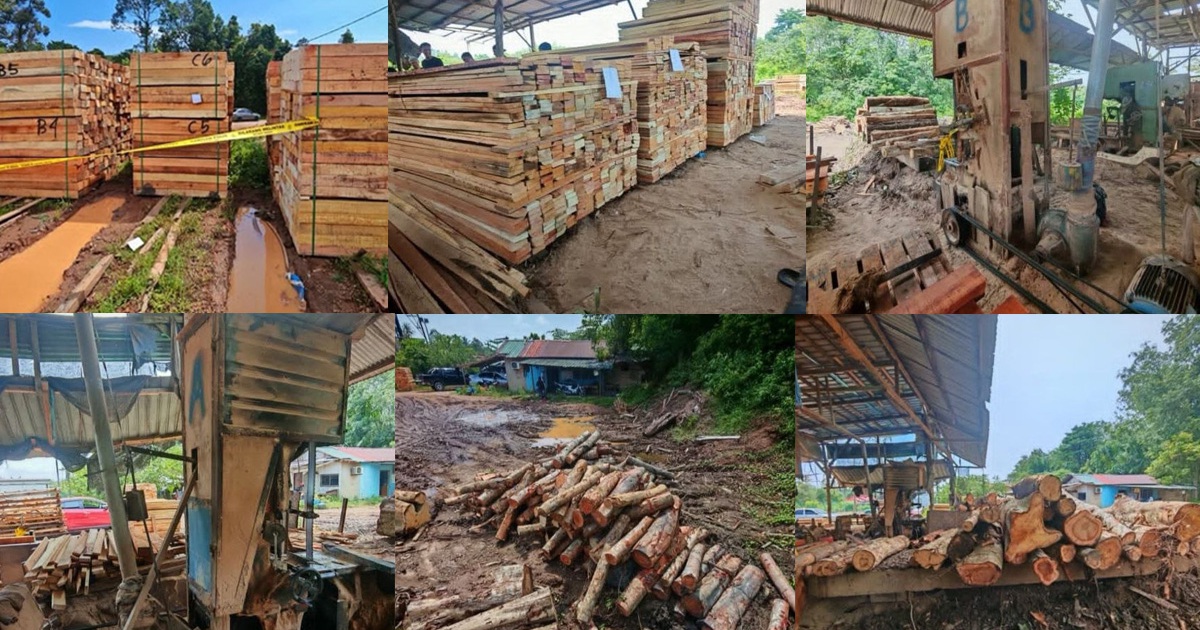
Enforcement authorities in Kelantan intensified their crackdown on illegal timber operations, apprehending four individuals—a sawmill operator and three labourers—during a coordinated operation in Kampung Bukit Kechik in Tanah Merah today. The raid targeted an unlicensed timber processing facility that had been flagged as operating without proper regulatory authorisation, marking another significant intervention in a region long grappling with unauthorised forestry activity.
The operation resulted in the seizure of timber stocks and processing machinery collectively valued at approximately RM600,000, representing a substantial blow to the illegal operation. The confiscation underscores the scale of investment in underground timber enterprises that circumvent Malaysia's forestry licensing framework and environmental safeguards. Such clandestine operations typically generate substantial profit margins by avoiding compliance costs, licensing fees, and environmental assessments that legitimate mills must bear.
The four detainees—comprising the facility's operator and three workers—are expected to face prosecution under forestry and licensing legislation applicable in Kelantan. The enforcement action reflects a broader shift toward more aggressive action against unlicensed timber processors, who have long represented a significant compliance challenge for Malaysian authorities. These underground operations not only deprive the government of legitimate tax revenue and licensing income but also bypass environmental monitoring protocols designed to prevent unsustainable harvesting practices.
Kelantan has historically served as a nexus for timber-related infractions, partly owing to the state's extensive forest reserves and the profitability of forestry-linked operations. The prevalence of such illegal processing mills—often located in remote kampung areas—complicates enforcement efforts, as operators exploit geographic distance and local connectivity to evade detection. The strategic positioning of this facility in Kampung Bukit Kechik suggests a deliberate attempt to capitalise on rural isolation and reduced regulatory oversight.
The seizure of RM600,000 in assets demonstrates the financial viability sustaining these unlawful enterprises, a factor that perpetually motivates individuals to establish processing operations outside formal channels. Illegal sawmill operators frequently undersell legitimately licensed competitors by margins of 15-20 percent, pricing enabled by avoidance of compliance expenditure. This pricing advantage distorts the timber market and undermines the commercial viability of lawful processors operating under regulatory constraints and environmental accountability frameworks.
Enforcement actions of this magnitude typically involve multi-agency coordination, with involvement from state forestry departments, local authorities, and in some instances, federal law enforcement bodies. The operational complexity and coordination required underscores Malaysian authorities' commitment to disrupting supply chains that feed unregulated timber into domestic and potentially export markets. Southeast Asian timber trafficking remains a persistent transnational concern, with illegal logs occasionally making their way into global supply chains despite domestic enforcement efforts.
The raid's success depends critically on sustained intelligence gathering and community reporting mechanisms. Local residents frequently possess knowledge of operational patterns at illicit mills but may hesitate to report activities owing to economic interdependencies within rural communities where such facilities provide employment. Building community participation in enforcement represents a persistent challenge for regulatory agencies seeking to dismantle networks that operate with informal community tacit acceptance.
Legislative frameworks governing timber processing in Kelantan stipulate specific licensing requirements, mill specifications, and environmental impact assessments. Operating without explicit authorisation constitutes a serious breach that exposes offenders to fines and potential imprisonment. The decision to prosecute the apprehended individuals signals administrative determination to impose meaningful consequences that might discourage future infractions and deter others considering entry into the illegal timber processing sector.
The seized machinery and timber inventory will likely be inventoried and either forfeited to the state or retained as evidence during legal proceedings. The forfeiture of substantial operational assets imposes real economic consequences on offenders beyond statutory penalties, incrementally raising the cost calculus for potential entrants to the illegal market. However, the persistence of such operations suggests that profit expectations continue to outweigh perceived enforcement risks for many operators.
This enforcement action arrives amid broader Malaysia-wide initiatives addressing forestry compliance and sustainable timber management. The government has increasingly prioritised transparency in supply chain verification to align with international environmental expectations and regional sustainability commitments. Addressing unlicensed timber processing constitutes a foundational component of these broader sustainability agendas, as clandestine operations undermine the credibility of Malaysia's forestry governance frameworks internationally.
For Malaysian consumers and businesses reliant on timber products, enforcement actions targeting illegal mills theoretically support market transparency and price stability. However, the continued viability of underground operations indicates that price differentials remain substantial enough to sustain illicit activity despite regulatory risks. Strengthening market-based incentives for compliance—potentially through consumer awareness campaigns highlighting sustainable timber sourcing—could supplement enforcement efforts in shifting market behaviour toward legitimacy.

