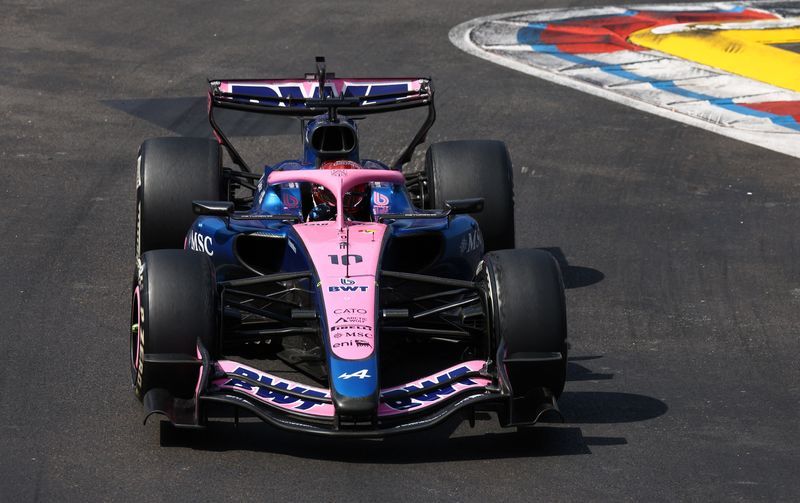
The motorsport world waits in limbo as the FIA's international court of appeal determines the final standings of June's Monaco Grand Prix, a decision that could reshape the remainder of the season's championship battle. Following a confidential hearing on Tuesday in Paris, judges indicated they need between two and three weeks to deliver their verdict on whether Alpine's Pierre Gasly retains third place or whether the trophy reverts to Red Bull's Isack Hadjar, a technical dispute with implications cascading through the top ten finishers.
The controversy centres on a seemingly straightforward infraction: pit-lane speeding during the race itself. Gasly crossed the line initially, serving no penalty at the time, only to receive two five-second post-race sanctions that demoted him from third to seventh position. Hadjar was subsequently elevated to third and celebrated with champagne spray on the podium, the customary Formula One victory ritual for third-place finishers. Yet within days, Alpine provided evidence of a timekeeping error that undermined the stewards' decision, leading to a remarkable reversal on June 12 when officials accepted that the penalty application had been fundamentally flawed.
The drama intensified when Hadjar unselfishly returned his trophy to Gasly following the reversal, a gesture reflecting the muddled nature of the ruling. However, on June 16, both Red Bull and McLaren lodged appeals challenging the decision to overturn the penalties, arguing that once a penalty has been served during the race—as opposed to applied post-race—it cannot logically be erased from the record. This technical distinction forms the crux of the dispute now before the appeals court, with enormous implications for the championship standings and the principle of sporting fairness that underpins competitive racing.
The case exposes a fundamental inequality in how pit-lane violations were handled during the Monaco event. Oscar Piastri, Gasly's counterpart, received identical speeding offences but served his five-second penalties during the race itself, dropping from what would have been a higher finishing position to fifth. Unlike Gasly, Piastri's penalty cannot be undone because the sporting regulations contain no provision for reviewing or overturning penalties that have already been served and completed. George Russell of Mercedes faced the same situation, serving a drive-through penalty for pit-lane speeding that cost him points and a position in the scoring positions, while he had explicitly requested post-race application to preserve his right to appeal.
This discrepancy troubles McLaren team principal Andrea Stella and his organisation deeply. At the Dutch Grand Prix the following weekend, Stella articulated McLaren's dual motivation for pursuing the appeal: broad concern for Formula One's sporting integrity and a material interest in recovering championship points that Oscar Piastri lost through the unequal application of penalties. The situation presents a stark lesson in procedural inconsistency, where the timing of penalty application rather than the severity of the infraction determines whether a driver can later seek redress. McLaren's stance resonates with many observers who view the reversal as creating an unfair precedent, particularly since Piastri served an identical penalty without recourse.
The original stewards' statement acknowledging the reversal itself highlighted the predicament. They explicitly noted that no regulatory framework exists allowing stewards to "undo" a penalty once it has been served and completed during a race. The logic is straightforward: once a driver has already lost time sitting in the pit lane serving their penalty, there is no mechanism to restore that lost time or racing position. The stewards emphasised that envisioning how such a power could even function in practical terms strains credibility, yet the alternative—allowing systematic use of post-race penalties specifically to enable future appeals—creates a two-tier system.
For Malaysian and Southeast Asian readers following Formula One's elite competition, this controversy illustrates how the sport's regulatory framework, while sophisticated, remains vulnerable to interpretation disputes at its highest levels. The case occurs amid a particularly competitive championship season, with Mercedes' Kimi Antonelli currently leading ahead of Ferrari's Lewis Hamilton after their first and second-place finishes in Monaco. Any alteration to the points distribution from that race will ripple through the championship mathematics, potentially affecting which team brings home the constructor's title and which driver claims the driver's championship in December.
The broader context matters considerably. Formula One operates under a dense rulebook designed to ensure consistency across 24 races spanning multiple continents and time zones, yet edge cases regularly challenge its application. The Monaco Grand Prix, traditionally held on a permanent street circuit in the principality, presents unique challenges to stewards who must make split-second decisions in tight spaces where pit-lane boundaries are razor-thin and vehicles operate at high speeds. The timekeeping error identified by Alpine presumably stemmed from the complex logistics of track management, a reminder that even elite sporting organisations depend on human precision in recording and measuring events that unfold across seconds.
McLaren's championship aspirations depend partly on preserving every point earned during the season, making the appeal both legally and strategically significant. The team's decision to fight reflects Stella's conviction that principles of sporting fairness matter as much as individual decisions. The involvement of Red Bull, another team with championship ambitions, underscores that the appeal extends beyond McLaren's narrow interests to questions about how the sport should operate going forward. If the court rules in McLaren's and Red Bull's favour, affirming that served penalties cannot be retrospectively undone, it establishes clear guidance for future races. If the appeals court upholds the reversal, it implicitly permits post-race penalty adjustments under certain circumstances, potentially opening avenues for future challenges.
With the Italian Grand Prix at Monza scheduled for September 6 and Madrid's debut circuit following on September 13, Formula One races forward while this legal process unfolds. The uncertainty hanging over the Monaco standings, though limited to two to three weeks according to the court's timeline, extends the controversy through a critical phase of the season when points accumulation shapes title narratives. Teams, drivers, and fans will closely monitor the appeals court's reasoning when it arrives, knowing that the decision sets precedent for how motorsport's highest authority interprets the boundary between serving penalties and reviewing them, between fairness to individuals and consistency across the field.

