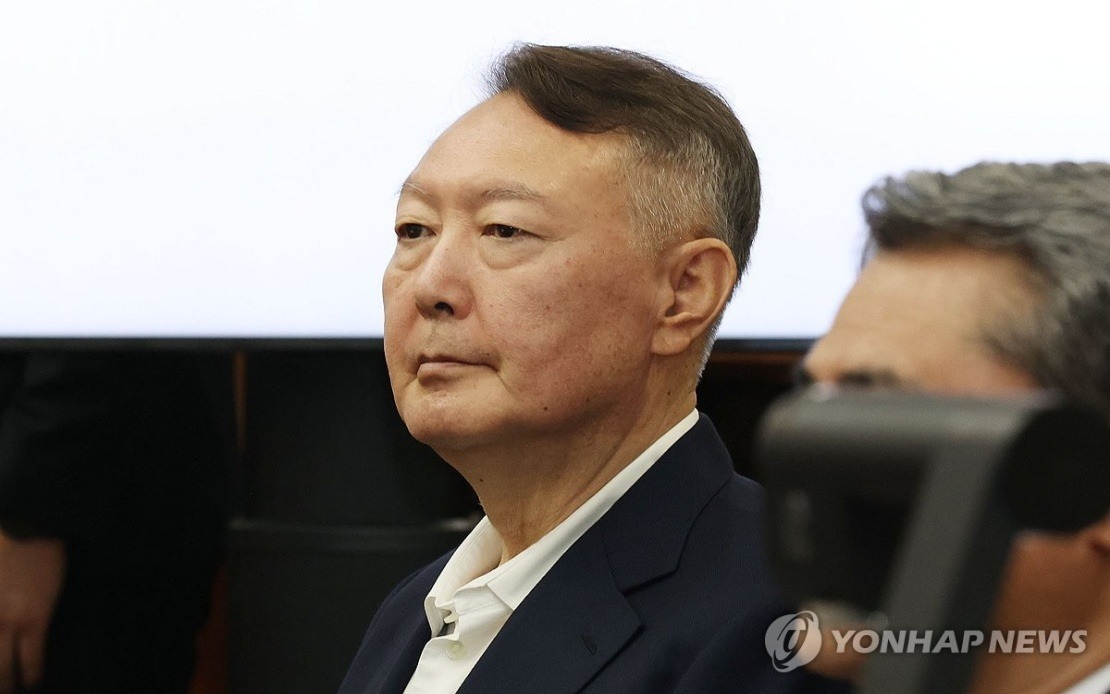
Former South Korean President Yoon Suk Yeol faced fresh legal consequences on Monday when the Seoul Central District Court handed down a two-year prison sentence for accepting illegal political funds cleverly disguised as free opinion polls. The conviction, delivered by a Seoul district court, stems from Yoon's dealings with self-proclaimed power broker Myung Tae-kyun and represents another significant judicial setback for the embattled former leader already navigating multiple concurrent trials that threaten his political future and personal freedom.
The court's findings determined that between April 2021 and March 2022, Yoon received fourteen complimentary opinion polls from Myung with an estimated combined value reaching approximately 270 million won, equivalent to roughly US$180,100 in total value. Rather than accepting campaign contributions through conventional channels, which would trigger transparency requirements and regulatory scrutiny, the arrangement operated in a grey zone where polling services functioned as a proxy for direct financial support. This methodology enabled the former president to circumvent provisions of the Political Funds Act, legislation designed specifically to prevent hidden financial influence over politicians and maintain electoral integrity.
Special counsel Min Joong-ki's investigation team alleged that Yoon orchestrated a coordinated scheme with his wife, former first lady Kim Keon Hee, both benefiting from Myung's generosity. The prosecutors contended that Yoon entered into an explicit quid pro quo arrangement, pledging to champion former Representative Kim Young-sun's nomination as a People Power Party parliamentary candidate during the June 2022 by-elections in direct exchange for receiving the opinion polls at no charge. This political horse-trading illustrates how opinion polling—ostensibly a neutral research tool—can become weaponised within political networks to reward loyalty and secure electoral outcomes.
The court recognised the prosecution's core argument, ultimately concluding that sufficient evidence demonstrated Yoon had indeed received these benefits with the understanding that political favours would follow. Beyond imprisonment, the tribunal also imposed a financial penalty ordering forfeiture of 13.96 million won, ensuring that Yoon faced both custodial and monetary consequences for his violation. Notably, Myung Tae-kyun, the power broker facilitating this arrangement, received an eighteen-month prison sentence, underscouring judicial determination to hold all parties accountable within the scheme.
The prosecution had originally sought harsher punishment, requesting four years imprisonment for Yoon and a three-year term for Myung, suggesting they viewed the violations as particularly egregious. The court's decision to impose lighter sentences, while still resulting in incarceration, potentially reflects judicial assessment that aggravating factors, while present, did not justify maximum penalties. Nonetheless, the conviction itself carries profound implications, cementing legal findings that Yoon abused his presidential position to cultivate hidden political advantages through carefully obscured financial arrangements.
This verdict creates notable tension with a separate concurrent proceeding involving Yoon's wife. In April, the Seoul High Court acquitted Kim Keon Hee of nearly identical charges, reasoning that she could not be deemed to have profited from the opinion polls since Myung had distributed similar services to other individuals as well. The appellate court's logic suggested that receiving something valuable did not constitute illegal enrichment if the item held broader distribution. However, this reasoning appears to conflict with the principle that accepting any benefit in exchange for political action violates campaign finance regulations, regardless of how widely the benefit was distributed.
Ministry prosecutors have appealed the acquittal of Kim Keon Hee, indicating their disagreement with the appellate court's interpretation and their intention to pursue conviction through higher judicial levels. This divergence between the acquittal of the former first lady and the conviction of the former president, despite their alleged joint participation in the same scheme, introduces considerable legal inconsistency that may influence future jurisprudence on campaign finance violations. The contrasting outcomes underscore how judicial interpretation of identical factual circumstances can vary significantly depending on procedural context and appellate perspective.
The conviction adds to an accumulating catalogue of legal troubles engulfing Yoon since his dramatic departure from office. In February of this year, a separate court imposed a life sentence on the former president for masterminding an insurrection through his ill-fated imposition of martial law in December 2024, an extraordinary emergency declaration that lasted only hours before parliamentary intervention and constitutional challenges forced its rescission. That conviction related directly to his attempted consolidation of executive power against what he characterised as obstructionist opposition-controlled parliament, though critics viewed it as an authoritarian power grab.
These concurrent legal proceedings reflect deep institutional fractures within South Korean politics, where executive-judicial conflicts have historically produced inconsistent outcomes depending on which political faction controls investigative and prosecutorial resources. Yoon's prosecutions follow a pattern familiar to Korean political history, where former leaders frequently face legal jeopardy after leaving office as successor administrations pursue their predecessors through the judicial system. The Opinion Poll case specifically illustrates how even seemingly technical violations of campaign finance law, when aggregated across multiple incidents, can substantially damage a political figure's credibility and legal standing.
For regional observers, particularly those in Southeast Asia monitoring democratic governance challenges, the Yoon case demonstrates how established democracies like South Korea struggle with institutional checks on executive power and how the judiciary becomes weaponised during periods of deep political polarisation. Malaysia and other ASEAN nations grappling with questions of executive accountability and institutional independence may find instructive lessons, both positive and cautionary, in how Korean courts navigate complex cases involving sitting and former presidents. The tension between judicial independence and perceived political motivation in high-profile prosecutions remains a persistent challenge across democracies.
Yoon's legal predicament extends beyond these specific convictions to encompass broader questions about South Korean governance, the appropriate limits of executive authority during national crises, and whether the judicial system can function impartially when prosecuting political leaders. His case will likely influence how future administrations approach similar situations, potentially establishing precedents that constrain future presidents from attempting comparable emergency measures. The accumulating sentences and convictions effectively end any realistic prospect of Yoon returning to elected office, permanently altering South Korean political dynamics for the foreseeable future.

