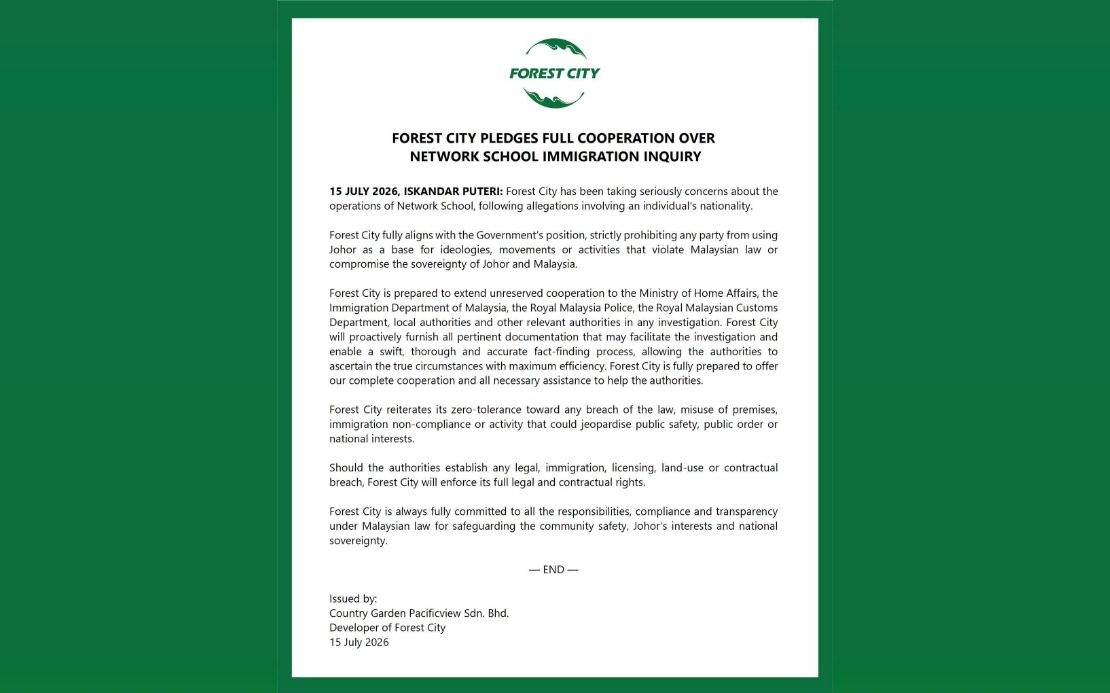
Country Garden Pacificview Sdn Bhd, the developer behind Forest City in Johor Bahru, has committed to working collaboratively with law enforcement agencies investigating the contentious Network School operation that has drawn scrutiny over the presence of individuals holding Israeli citizenship. The developer issued a formal statement expressing readiness to extend its full support to authorities, signalling a proactive stance in what has become a sensitive matter touching on national sovereignty and immigration compliance.
The investigation stems from concerns raised by Johor Menteri Besar Datuk Onn Hafiz Ghazi regarding the educational institution's operations within the massive integrated development. According to public statements, foreign nationals allegedly used alternative travel documents from other countries to gain entry to Malaysia, subsequently participating in the Network School programme. This method of entry has triggered alarm among officials who view it as circumventing standard immigration protocols and potentially masking the true citizenship and intentions of participants.
Country Garden Pacificview's statement underscores the developer's commitment to maintaining Forest City as a jurisdiction that respects Malaysian law and constitutional principles. The company explicitly affirmed its opposition to any activities that might undermine national sovereignty or create conditions that allow Malaysia to serve as a base for operations contrary to established legal frameworks. This positioning is particularly significant given Forest City's status as a prominent foreign investment project that has occasionally drawn public scrutiny regarding its management and regulatory oversight.
The developer has signalled willingness to coordinate with multiple government agencies in the investigative process, including the Home Ministry, Immigration Department, Royal Malaysia Police, Royal Malaysian Customs Department, and relevant local authorities. This multi-agency involvement reflects the complexity of the situation, which spans immigration violations, potential document fraud, and questions about the nature and legitimacy of educational activities conducted within the development. By endorsing cooperation across these bodies, Country Garden Pacificview aims to facilitate a comprehensive examination of circumstances surrounding the Network School.
In terms of documentary support, the developer committed to furnishing all required records that might assist investigators in establishing facts and determining whether any breaches occurred. This includes operational records, attendance documentation, participant registration materials, and administrative files that could illuminate the nature of the school's programmes and the identities of individuals involved. Such transparency measures are intended to accelerate the investigative timeline while ensuring that fact-finding efforts remain thorough and reliable.
Country Garden Pacificview also articulated a zero-tolerance policy regarding legal violations, misuse of premises, breaches of immigration regulations, and activities that compromise public safety and community order. This declarative stance attempts to position the developer as a responsible corporate actor committed to upholding Malaysia's legal and regulatory standards. For a large-scale international property venture, such public commitments carry significance in maintaining investor confidence and community relations, particularly in contexts where questions about governance have emerged.
The Immigration Department conducted an immediate inspection of 266 foreign nationals representing 40 different countries within Forest City following the menteri besar's intervention. Initial results indicated that all individuals checked possessed valid immigration documentation, suggesting that at least a portion of the foreign community residing or working in Forest City maintains proper status. Nevertheless, authorities indicated that more detailed investigations would continue, implying that cursory documentation checks do not necessarily rule out other irregularities or provide complete assurance regarding compliance with all applicable regulations.
The Network School controversy touches on broader questions about how developments like Forest City, which attract substantial foreign investment and expatriate populations, are monitored and regulated. Malaysia has maintained a carefully calibrated position regarding engagement with Israeli entities and individuals, rooted in the country's consistent diplomatic stance on Palestinian issues and Middle Eastern affairs. Any programme or activity involving Israeli nationals, whether conducted explicitly or disguised through alternative documentation, inevitably invokes scrutiny regarding alignment with national foreign policy positions.
For investors and administrators of large integrated developments across Southeast Asia, the Forest City situation illustrates the compliance challenges inherent in managing cosmopolitan communities with diverse national origins. It also underscores the importance of rigorous vetting procedures for educational and training programmes operating within such spaces. Country Garden Pacificview's cooperative posture suggests recognition that proactive engagement with authorities, transparency, and demonstrated commitment to regulatory compliance represent the most effective approach to resolving such controversies and protecting the long-term viability of major development projects.
The investigation's outcome will likely influence how future international educational and business activities are screened and monitored within Forest City and comparable developments throughout Malaysia. Authorities will be assessing whether the Network School operated with adequate oversight, whether participants' true identities and nationalities were properly verified, and whether the programmes themselves conformed to educational standards and policy requirements. The developer's cooperation stance positions it favourably in this process while demonstrating that even high-profile foreign ventures are ultimately subject to Malaysian regulatory authority and national interest considerations.
For Malaysian stakeholders ranging from policymakers to civil society observers, the matter underscores the ongoing tension between attracting foreign investment and talent while maintaining sovereignty and regulatory control. The resolution of the Network School investigation will contribute to clearer frameworks for how such issues are handled, potentially establishing precedents that inform policy discussions around immigration, investment regulation, and the governance of special economic developments.

