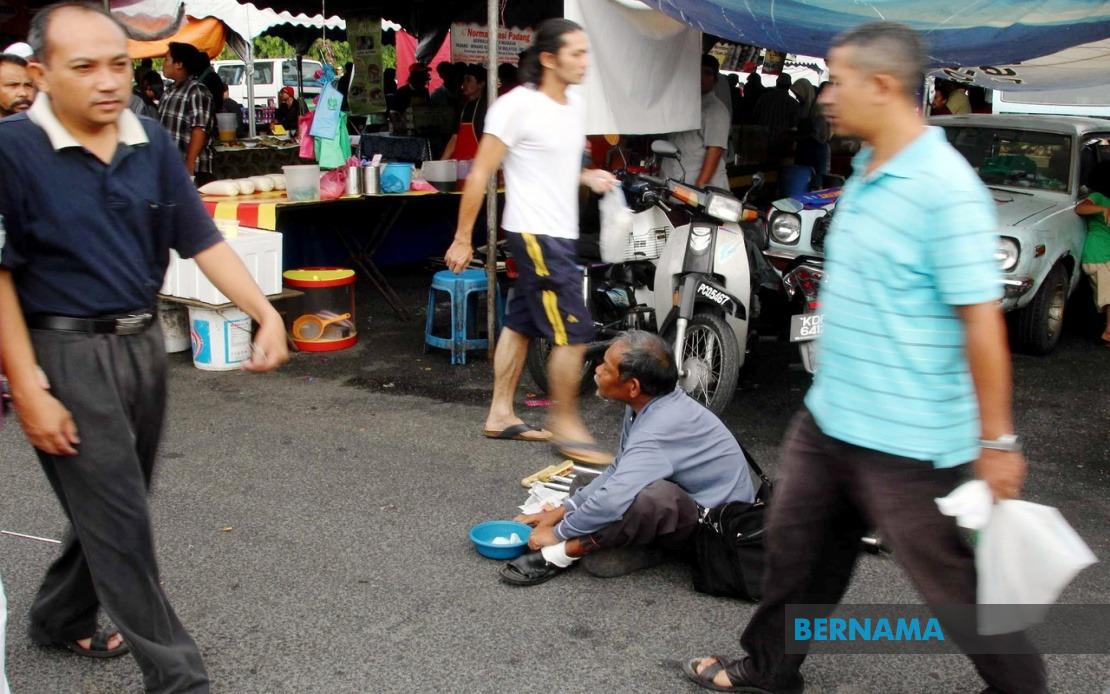
The Malaysian Home Ministry has raised alarm over structured begging operations involving foreign nationals, suggesting they may constitute organized criminal enterprises rather than isolated incidents of street-level vagrancy. In a parliamentary response, the ministry disclosed that investigative efforts are underway not only against foreign individuals engaged in begging but also against Malaysian citizens suspected of facilitating, managing, or profiting from such schemes. This multi-pronged approach reflects growing official concern that sophisticated networks are exploiting vulnerable populations, particularly children, to generate illicit income in high-traffic commercial districts.
Statistics released by the ministry paint a picture of sustained enforcement activity aimed at curbing the problem. Between January and the end of May this year, the Immigration Department executed 836 separate operations concentrated across Kuala Lumpur and its surrounding municipalities. These raids resulted in the inspection of just over 10,600 individuals, among whom nearly 5,411 foreign nationals were apprehended for various immigration violations. The detention count includes 42 individuals specifically detained for begging-related offences, suggesting that while begging constitutes a minority of immigration breaches, it remains a distinct enforcement priority warranting dedicated resource allocation.
The issue came into sharper parliamentary focus when Fong Kui Lun, representing the Pakatan Harapan coalition in Bukit Bintang, pressed the ministry for details on operational effectiveness and syndicate-busting measures. Bukit Bintang, Jalan Alor, and Changkat Bukit Bintang emerged as focal points of concern, reflecting the concentration of begging activities in Kuala Lumpur's premium retail and entertainment precincts where tourist foot traffic and commercial activity create conditions conducive to street solicitation. The question implicitly acknowledged that surface-level enforcement operations must be coupled with deeper investigation into the organizational structures sustaining such activity.
To sharpen its investigative and preventive capacities, the Immigration Department has substantially expanded inter-agency coordination. Joint operations now routinely involve the Royal Malaysia Police and Kuala Lumpur City Hall, creating operational synergies that allow multiple enforcement bodies to converge on suspected hot spots. Beyond tactical cooperation, the ministry emphasized enhanced intelligence sharing and analytical work designed to map syndicate networks, identify recurring operational patterns, and pinpoint geographic concentration zones. This intelligence-driven approach represents a shift from purely reactive enforcement toward proactive identification of criminal architecture.
A newly constituted mechanism called the KL Strike Force has emerged as a central coordination instrument. Comprising representatives from the Immigration Department, police, City Hall, the Department of Social Welfare, and other enforcement agencies, this task force convenes periodically through the Federal Territory Security Working Committee to align operational priorities. The Strike Force methodology combines scheduled and unannounced integrated raids with systematic monitoring to prevent re-emergence of dismantled networks. Public complaints are expedited through intelligence channels, creating feedback loops that theoretically allow rapid response to community-reported violations. Continuous surveillance of identified hotspots aims to disrupt the organizational continuity that allows syndicates to operate.
The ministry's response underscores that preserving Malaysia's international image and public safety reputation constitutes a non-negotiable priority in this domain. The phrasing that Malaysia "will not compromise on any breach of the law or any form of exploitation" signals determination to tackle not merely the visible symptom of street begging but the underlying criminal infrastructure. For Malaysian and Southeast Asian observers, this stance reflects broader regional anxieties regarding human trafficking, labour exploitation, and transnational organized crime networks that frequently leverage vulnerable populations across porous borders. The ministry's emphasis on investigation into local "protectors, organisers, or financial beneficiaries" suggests that the problem is not merely a foreign incursion but involves complicity within Malaysian society.
Parallel to the begging enforcement effort, the ministry disclosed information regarding foreign worker quota applications submitted during an extended special application window. Between January 19 and March 31 this year, employers filed 1,919 applications seeking foreign worker quotas, of which 314 received positive recommendations. This special extension period was instituted to accommodate employers who had missed the December 31, 2025 deadline under the 2025 quota ceiling. The recommended applicants now await deliberation by the Department of Labour Peninsular Malaysia, which must grant formal approval under Section 60(K) of the Employment Act 1955. The disclosure arose from a parliamentary question by Datuk Ngeh Koo Ham representing Beruas.
The simultaneous handling of begging enforcement and foreign worker quota management reflects the ministry's broader portfolio spanning immigration, labour mobility, and public order. While these issues appear superficially distinct, they intersect in immigration regulatory frameworks and enforcement capacity allocation. Large-scale foreign worker programs, if inadequately monitored, can create vulnerability windows through which irregular migrants, including those engaged in illicit begging, infiltrate labour markets and urban economies. Conversely, stringent legitimate labour frameworks may increase incentives for illicit economic activity among unauthorized foreign populations. The ministry's parallel attention to both domains suggests awareness that comprehensive immigration governance requires coordinated approaches across multiple dimensions.
For Malaysian business interests and international investors, the ministry's focus on cleaning up street-level exploitation in premium commercial zones carries implications. Tourist destinations and high-value retail precincts depend partly on perception of safety, cleanliness, and orderly commerce. Visible begging, particularly involving children, can deter international visitors and project an image of social disorder inconsistent with Malaysia's positioning as a developed economy and regional commercial hub. The enforcement campaign thus serves economic as well as humanitarian and public safety objectives. Regional competitors in Southeast Asian tourism similarly confront these challenges, making the Malaysian experience relevant across the ASEAN context.
The investigation into local collaborators represents a particularly significant dimension. Syndicates cannot sustain operations without indigenous facilitators who understand local geography, law enforcement patterns, and exploitation opportunities. By targeting Malaysians suspected of abetting foreign begging networks, authorities implicitly acknowledge that the problem cannot be solved through immigration enforcement alone. Corruption or connivance within local communities may actively enable the syndicate ecosystem. This domestic dimension complicates the policy response, as it requires law enforcement to operate against its own communities while maintaining legitimacy and public cooperation.
Moving forward, the ministry's stated commitment to empowered integrated approaches with multiple agencies suggests that begging suppression will remain embedded within a broader public order and security framework. The emphasis on continuous monitoring to prevent recurrence indicates recognition that syndicates possess organizational resilience and adaptability. As enforcement pressure intensifies in known hotspots, criminal networks may relocate, modify operational methods, or recruit new personnel. Sustained suppression thus requires not episodic enforcement surges but institutionalized inter-agency mechanisms with consistent resourcing and intelligence capacity. For Malaysia and the region, this case study illustrates both the sophisticated operational challenge posed by organized street-level exploitation and the evolving governmental response frameworks attempting to address it.

