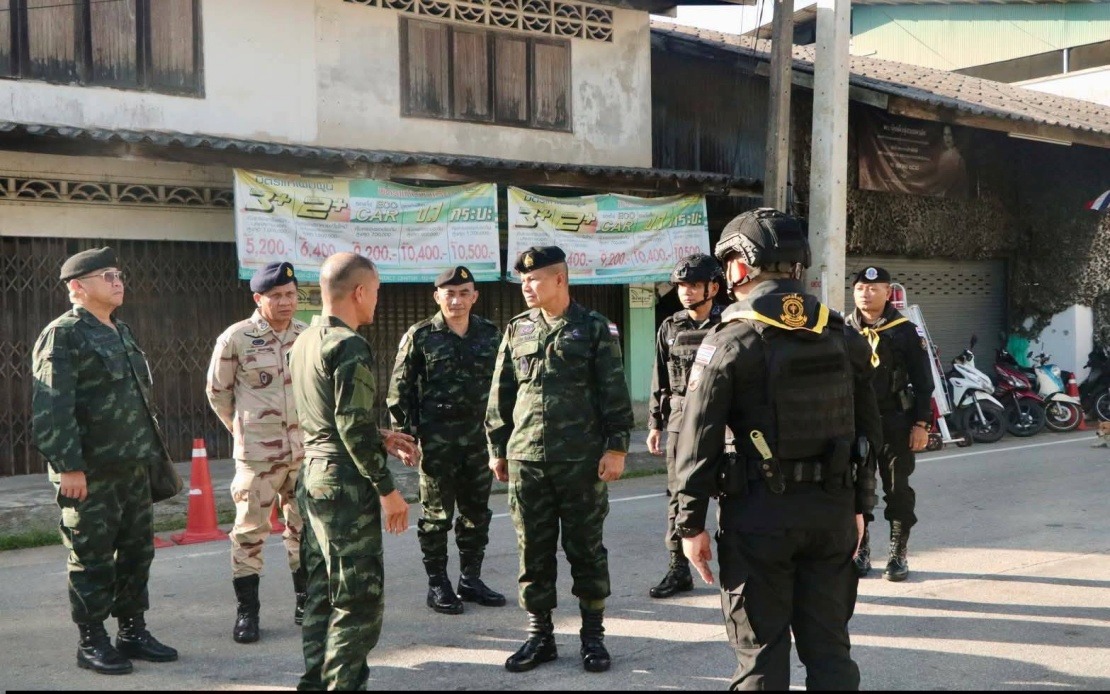
Violence erupted in southern Thailand's Narathiwat province when heavily armed assailants launched a coordinated attack against a ranger security position in the early evening of Wednesday, resulting in five military fatalities and multiple civilian injuries. The incident, which unfolded at approximately 6.45 pm local time at the 4509 Ranger Company checkpoint positioned on Sami Hill in Rangae District, represents a significant security flashpoint in a region long troubled by insurgent activity and cross-border tensions.
Lieutenant General Norathip Phoyanok, who commands the Fourth Army Region and directs operations for the Internal Security Operations Command Region 4, provided initial details after personally inspecting the attack site. According to his account, more than six assailants dressed entirely in dark clothing and wearing face coverings descended upon the checkpoint with overwhelming firepower. The attackers deployed both conventional gunfire and improvised explosive devices, specifically pipe bombs, creating a chaotic scene that overwhelmed the ranger garrison despite their defensive position.
The human toll extended well beyond the military personnel killed at the scene. Six civilians sustained injuries during the assault, a particularly troubling detail given that the victims included vulnerable populations. Among the wounded were a three-year-old girl and an elderly individual, underlining how such violence inevitably affects non-combatants in border communities where military installations often coexist with civilian settlements. The targeting of a checkpoint in a populated area raised immediate concerns about the indiscriminate nature of the assault.
Investigators have established that the attackers made their escape in a black four-wheel-drive vehicle, though Norathip cautioned that these initial findings remained subject to refinement as forensic evidence was collected and analysed. The vehicle's apparent use suggests a degree of operational coordination and planning, elements that typically characterise attacks by organised militant groups rather than spontaneous violence. The deliberate selection of tactical equipment and the coordinated timing of the assault point toward a trained force with specific objectives.
Narathiwat Governor Boonchuai Hormyamyen responded to the incident by implementing immediate security escalations across the province. He has instructed an integrated security apparatus comprising police units, military forces, and civilian administrative personnel to substantially heighten vigilance along the sensitive Malaysia-Thailand border region. The security tightening extends across twelve districts within Narathiwat, reflecting the provincial administration's assessment that the threat landscape has deteriorated sufficiently to warrant region-wide precautions.
The timing of this directive carries particular significance for cross-border stability. The Malaysia-Thailand boundary in this region represents one of Southeast Asia's most complex security environments, where legitimate commerce and movement intersect with organised trafficking networks and militant activity. Enhanced Thai military presence and checkpoint operations can strain bilateral relations if not coordinated carefully with Malaysian counterparts, creating potential friction between governments even as both seek to address genuine security concerns.
Forensic teams immediately cordoned off the checkpoint area to preserve evidence and conduct thorough examinations. Thai authorities indicated that investigations aimed at identifying individuals who orchestrated the attack remain in preliminary stages. This distinction between the tactical operators captured at the scene and potential command figures highlights how security incidents in the deep south often involve multiple organisational layers, with foot soldiers separated from decision-makers by deliberate compartmentalisation that complicates law enforcement efforts.
The attack reflects an alarming trend of escalating violence in Narathiwat and neighbouring provinces. The region has experienced periodic spikes in insurgent activity over many years, driven by complex factors including historical grievances, religious and ethnic tensions, and criminal networks that exploit the porous border environment. Each major incident raises questions about whether security force capabilities have adequately adapted to evolving militant tactics and whether counterinsurgency strategies are effectively addressing root causes or merely responding to symptoms.
From a Malaysian perspective, this violence carries direct implications. The proximity of the incident to the shared border means that operational spillover remains a realistic possibility. Malaysian security agencies maintain close relationships with their Thai counterparts, sharing intelligence and coordinating patrols, yet the fundamental challenge of securing a lengthy frontier with difficult terrain persists. Enhanced Thai security operations can improve local conditions but may also displace threats geographically rather than eliminate them entirely.
The incident underscores the persistent instability in Thailand's southernmost regions despite years of military and police interventions. The provincial security apparatus has repeatedly launched operations against suspected militant groups, yet attacks of this scale and coordination continue to occur. This dynamic suggests that military responses alone have not resolved underlying grievances that motivate recruitment into armed groups, raising difficult questions about whether comprehensive solutions require political dialogue alongside security operations.
Government officials will face mounting pressure to demonstrate tangible progress in apprehending those responsible and preventing similar attacks. The involvement of civilian casualties, particularly a young child, may generate public criticism of security force tactics and positioning. Thai authorities will need to balance public reassurance with operational security, acknowledging the severity of the threat while avoiding statements that might inflame tensions or suggest governmental instability.

