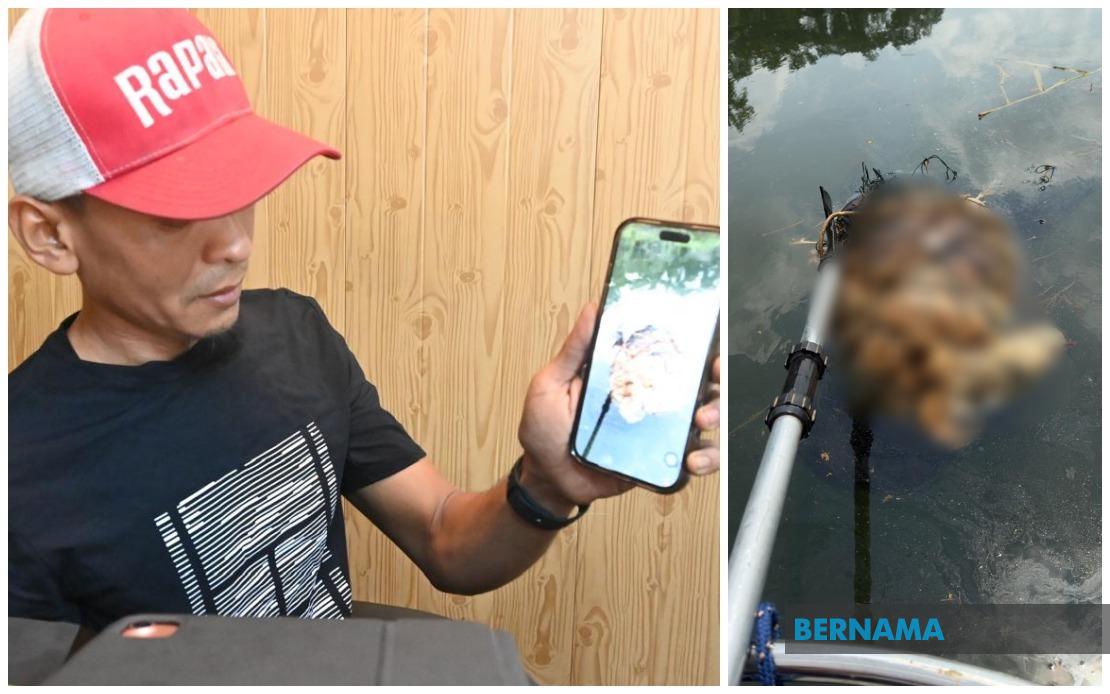
A routine fishing expedition in Johor took a macabre turn yesterday when a 33-year-old angler stumbled upon a decomposed corpse while seeking material for his social media channels at Sungai Tanjung Sembrong in Parit Raja, Batu Pahat. Muhamad Zul Fikri Borhanodin initially believed he had encountered a discarded animal carcass, a sight not uncommon in the waterway, but the overwhelming stench and the distinctive bindings of fishing netting wrapped around the object prompted him to investigate further.
The discovery took shape gradually as Muhamad Zul Fikri approached the floating bundle around 11 am. Upon detecting what appeared to be denim fabric—unmistakably human clothing—he immediately recognised the gravity of the situation and alerted a companion operating a nearby vessel. His decades of experience on the river, accumulated over more than twenty years of regular fishing, had taught him the difference between ordinary debris and something far more sinister. Yet the experience remained deeply unsettling. This marked the second instance in Muhamad Zul Fikri's tenure on the waterway where human remains had surfaced at this exact location, with the prior occurrence involving an individual who had fallen into the river years earlier.
Police response was swift following the 12.30 pm notification received on the day of discovery. The investigation immediately gained momentum when authorities cross-referenced the find with existing missing person reports filed with Johor's constabulary. The victim's wife had lodged an official report on July 29 regarding her husband's unexplained disappearance in Mutiara Rini, Iskandar Puteri, establishing a critical timeline for investigators. The apparent connection between the missing person case and the discovered remains provided immediate direction for the police inquiry.
According to Johor's deputy police chief DCP Hoo Chuan Huat, the investigation progressed rapidly with the apprehension of three male suspects aged between 26 and 40 years. These individuals were detained in the broader Batu Pahat area on the same day as the body's discovery, prompting speculation about their potential involvement in circumstances surrounding the death. The swift arrests suggest that authorities had either received credible information prior to the discovery or identified persons of interest through preliminary investigative work conducted immediately following the notification.
The case underscores the persistent challenges Malaysian law enforcement faces in addressing violent crime and missing person investigations, particularly in regions surrounding major urban centres like Iskandar Puteri. The Mutiara Rini area, a residential neighbourhood within the Iskandar Puteri development corridor, represents the demographic profile of communities increasingly affected by interpersonal violence and criminal activity. The recovery of remains in a neighbouring district indicates the geographical disconnect that sometimes emerges during crime investigations, complicating both the search process and the eventual resolution.
For Muhamad Zul Fikri, the experience represents an unwelcome intrusion into what should have been an ordinary recreational pursuit and content creation effort. Fishing communities often develop tight-knit relationships with their environments, and the psychological impact of such discoveries cannot be underestimated. The frequency of such incidents at Sungai Tanjung Sembrong may also warrant environmental and public safety reviews by relevant authorities to determine whether the location presents particular vulnerability to criminal activity or accidental drowning incidents.
The incident also raises questions about the adequacy of missing person protocols and inter-agency coordination between police stations and enforcement divisions across district boundaries. The July 29 report filed in relation to Iskandar Puteri ultimately connected to remains discovered in a different administrative jurisdiction, highlighting the importance of comprehensive database systems and swift information sharing among law enforcement personnel. Malaysian police have invested significantly in technological infrastructure to address such coordination challenges, though real-world application continues to demonstrate both successes and gaps.
The discovery serves as a sobering reminder of the dangers lurking within what many regard as serene natural environments. Johor's river systems, while important for both recreational and economic activities, occasionally become repositories for serious crimes. Ongoing investigations will likely reveal whether the victim met with foul play through deliberate action or whether circumstances point toward a tragic accident subsequently concealed through deliberate concealment.
As the investigation enters its subsequent phases, the three detained individuals face questioning regarding their knowledge, involvement, or connections to both the deceased and the circumstances of the body's placement in the river. The manner in which the remains were wrapped and secured with netting suggests either deliberate concealment or possible association with fishing-related activity, though investigators will pursue both criminal and accidental theories during their interrogations. The conclusion drawn from forensic examination and witness statements will ultimately determine the trajectory of the case through Malaysia's criminal justice system.

