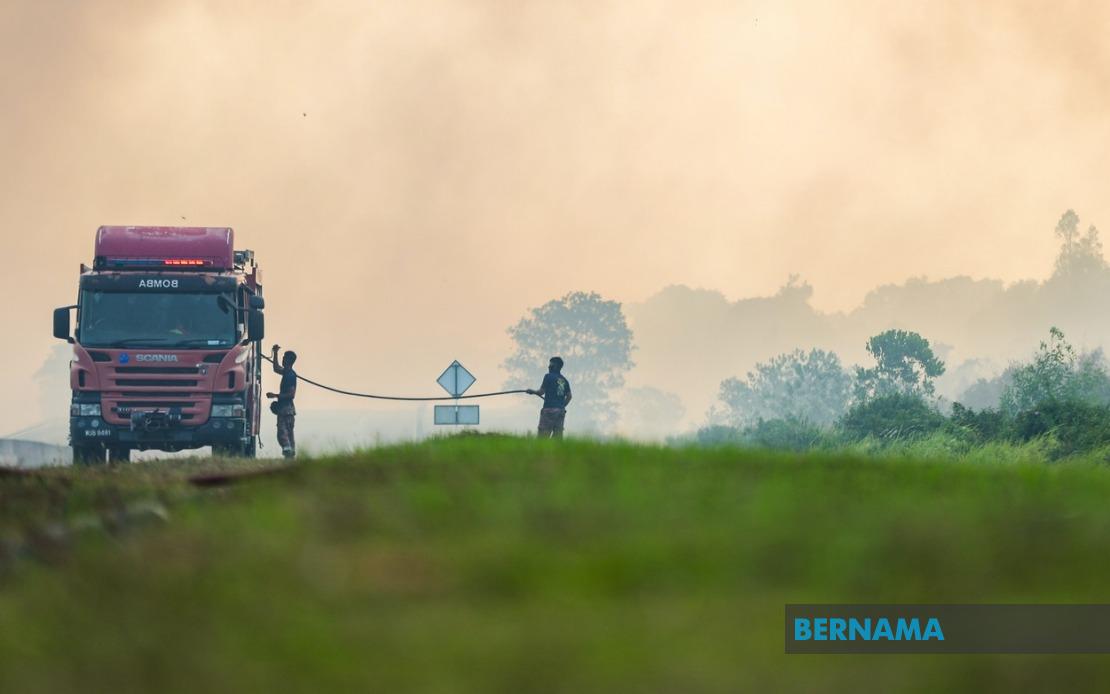
Firefighting teams in Pengerang, Johor have made significant progress against a stubborn peatland blaze that erupted on the Jalan Bypass Punggai-Sebana Cove near Kota Tinggi, with more than 29 of the affected 51.4 hectares brought under control by Monday afternoon. The successful containment of approximately 56 percent of the fire zone marks a turning point in what has emerged as a complex and labour-intensive emergency response involving multiple government agencies and private contractors working in coordinated fashion across two operational sectors.
The Sungai Rengit Fire and Rescue Station has maintained the intensity of its response since the fire first ignited on Monday, deploying personnel across both Sector A and Sector B in a dual-pronged strategy designed to simultaneously suppress active flames, establish protective firebreaks, and prevent the blaze from advancing into unaffected areas. Fire Superintendent II Baharuddin Idris, commanding the ongoing operations, underscored the critical importance of maintaining vigilance around the clock, noting that the 24-hour operational tempo reflects the unpredictable nature of peatland fires, which can reignite or spread rapidly when conditions shift.
Peatland fires present distinctive challenges compared to conventional vegetation blazes. The subsurface organic matter burns slowly and can smoulder for extended periods, making complete extinguishment difficult and allowing flames to resurface in supposedly controlled zones. This characteristic demands constant monitoring and the maintenance of moisture levels across affected terrain, a labour-intensive process that explains the deployment of such substantial human resources to the site. The concentrated effort has proven effective in Sector B, which has reached near-complete extinguishment status, while Sector A remains the focus of intensive firefighting and firebreak construction operations.
The aerial component introduced into the response on Monday afternoon represents a significant escalation in tactical approach. Aircraft support, approved by the Air Operations Control Centre (PGOU) and deployed at 2:30 pm, extends firefighting capabilities beyond ground-level constraints and enables delivery of water or fire retardant across difficult terrain that ground crews cannot readily access. This represents standard practice in managing large-scale peatland incidents across Southeast Asia, where aerial assets have become increasingly valuable in recent years as fire seasons have intensified.
The scale of the human resource commitment demonstrates the seriousness with which authorities are treating the incident. The operation draws together 36 firefighters from the primary response agency, nine personnel from the Malaysian Civil Defence Force (APM) providing logistical and coordination support, fourteen specialists from Ranhill SAJ—a private water utility company with emergency response capabilities—two environmental specialists from the Department of Environment, and three representatives from the Pengerang Municipal Council. This inter-agency composition reflects established protocols for managing environmental disasters that extend beyond conventional fire suppression into ecological preservation and municipal coordination.
The involvement of the Department of Environment underscores legitimate concerns about the broader environmental impact of peatland combustion. Beyond the immediate fire danger, burning peat releases substantial quantities of particulate matter and greenhouse gases into the atmosphere, creating air quality implications not only for the immediate vicinity of Pengerang and Kota Tinggi but potentially affecting air quality across a wider region of Johor and neighboring areas. Such incidents have triggered transboundary air quality alerts in previous years, making rapid extinguishment a matter of regional significance.
Ranhill SAJ's participation as a private contractor with firefighting resources reflects the Malaysian approach of leveraging private sector capabilities during public emergencies. Water utility companies maintain pumping and distribution infrastructure that can be rapidly mobilized for emergency response, creating synergies between routine operational capacity and crisis management requirements. This model has proven effective in previous major fire incidents across Malaysia and demonstrates the value of pre-established mutual aid agreements between government agencies and essential service providers.
The tactical division into two sectors suggests a geographical strategy where terrain or fire intensity warranted separate command structures. Sector B's near-complete extinguishment implies that this zone either burned with lower intensity, benefited from more favorable wind and humidity conditions, or received concentrated suppression efforts earlier in the incident timeline. Sector A's remaining 21 hectares demanding firefighting and firebreak operations suggests ongoing active fire requiring sustained attention and resource concentration to prevent breakthrough and lateral spread.
Peatland fires in Malaysia typically trace to either human activity—including agricultural clearing, industrial negligence, or arson—or spontaneous combustion under conditions of extreme heat and dryness. The Pengerang area, which hosts significant petrochemical and industrial facilities, warrants investigation into the fire's origin once suppression operations conclude. Establishing causation carries implications for liability, insurance coverage, and future prevention protocols across what represents one of Johor's important economic zones.
The continuation of round-the-clock operations reflects commitment to preventing re-ignition, a persistent challenge in peatland management. Even as visible flames subside and areas register as officially extinguished, subsurface combustion can persist, particularly in deeper peat deposits. Moisture content monitoring and continued firebreak maintenance will likely extend for days or weeks beyond the initial extinguishment declaration, representing the unglamorous but essential phase of incident conclusion that often receives minimal public attention.
For Malaysian readers, this incident carries lessons regarding fire preparedness during high-risk seasons and the coordination demands that major environmental emergencies impose on multiple institutional actors. The Pengerang incident also highlights the interconnection between industrial development, land management, and environmental vulnerability that characterizes Johor's landscape. As climate patterns continue shifting toward greater temperature extremes, such incidents may become increasingly frequent, placing ongoing demands on firefighting capacity and emergency response systems across the state.

